Alphabet, Samsung among 40 Big Companies Investing in Blockchain, Study Finds
Google’s parent firm is the largest participant in blockchain investing on a list of 100 public companies, Blockdata found
Source: Shutterstock
- BlackRock and Morgan Stanley have also invested in funding rounds which raised over $1 billion in total
- Big Tech critics are wary of the power they hold in the digital worlds
US tech giant Alphabet is the largest among publicly-traded companies that invested in the space between September 2021 and June 2022.
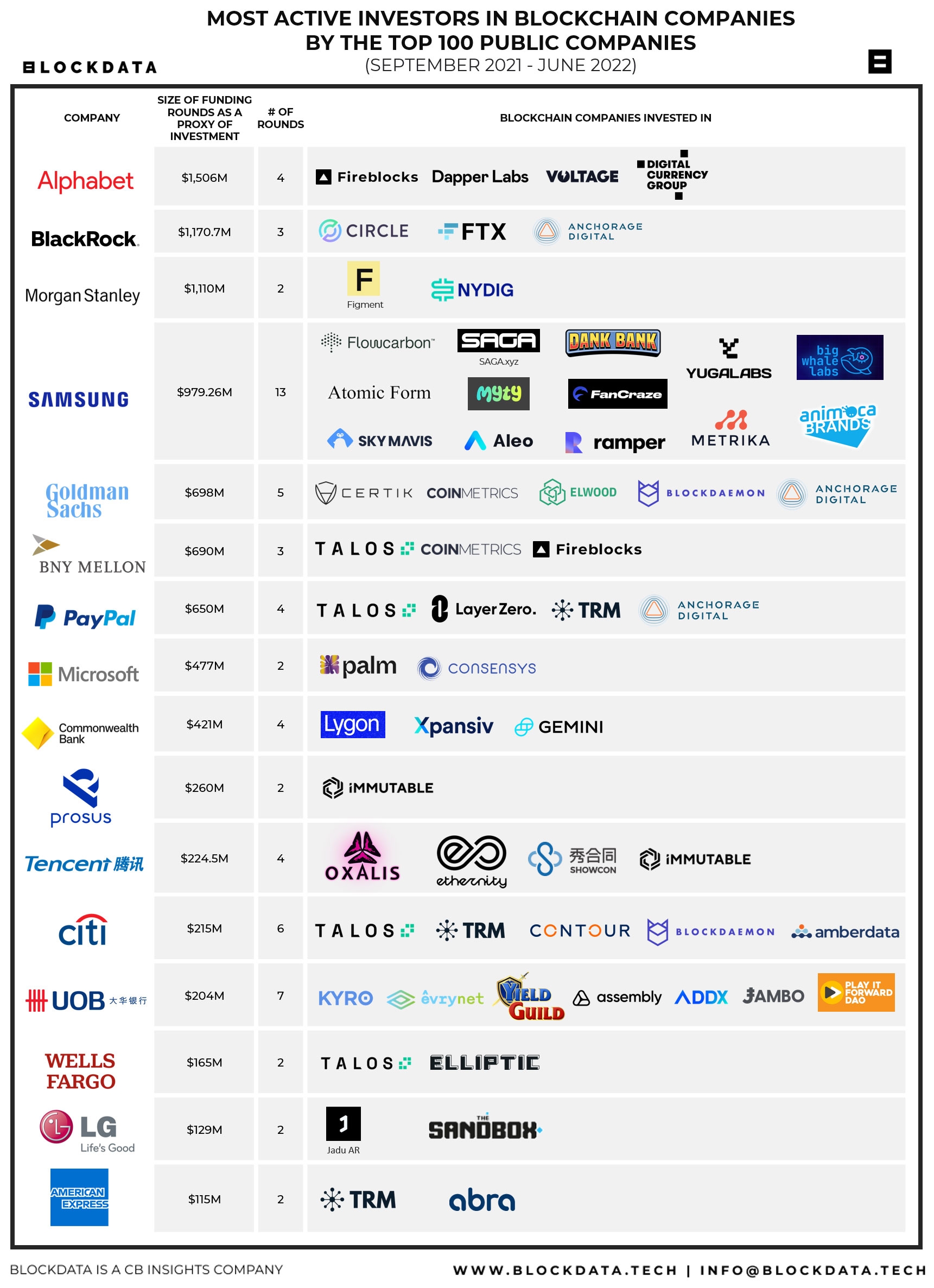
Crypto intelligence platform Blockdata used the size of funding rounds as a proxy for investor involvement. The Google parent invested in funding rounds that totaled $1.5 billion across four blockchain companies — Fireblocks, Dapper Labs, Voltage and Digital Currency Group — in the last 10 months, Blockdata’s study found.
“In most cases, we cannot determine how much money these corporations have invested, as they participate in funding rounds with multiple or many other investors,” the platform noted.
 Click to expand image; Source: Blockdata
Alphabet, which held cash reserves of nearly $125 billion by the end of June, is one of the most prolific investors in the startup ecosystem through its investing vehicles. Crunchbase data shows Google Ventures has made 990 investments, CapitalG counts 106 and Gradient Ventures has 158.
Other top companies participating in the funding of blockchain companies over the same time frame are BlackRock and Morgan Stanley, according to the study. Top Wall Street banks Goldman Sachs, BNY Mellon, Citi and Wells Fargo also feature on the list.
Overall, 40 companies invested about $6 billion in blockchain-related investments in that time period. Investments covered in the study would’ve partly been carried out during the cryptocurrency market downturn, triggered by TerraUSD’s crash in May.
Alphabet boss Sundar Pichai confirmed earlier this year that the company was exploring how to integrate blockchain technology into its services like YouTube and Google Maps.
“Anytime there’s innovation, I find it exciting, and I think it is something we want to support the best we can,” Pichai said during an earnings call.
“The web has always evolved, and it’s going to continue to evolve, and as Google, we have benefited tremendously from open-source technologies, so we do plan to contribute there,” he said.
Worries over Big Tech influence
Critics of Big Tech firms have previously lashed out over them wielding too much power. Web3 companies, built on the premise that future companies will live on the blockchain, operate with the same idea that supports cryptocurrencies. They won’t be controlled by single entities like Facebook or Google.
Yat Sui, board chairman at Animoca Brands, recently described the empires of Meta and Microsoft as “digital dictatorships” in a Bloomberg interview. Animoca, which itself is a big blockchain investor, says its goal is to give people ownership of their digital property and dissolve the influence of Big Tech.
Correction, Aug. 19, 2022, at 9:09 am ET: The size of the individual investments from Alphabet-affiliated companies and others studied is not known. Blockdata used the total amounts companies fundraised as an approximation of the relative size of investments.
Get the news in your inbox. Explore Blockworks newsletters:
- The Breakdown: Decoding crypto and the markets. Daily.
- 0xResearch: Alpha in your inbox. Think like an analyst.
