An IR team of one
The Metaplex investor relations team is one person: Mack Hom, the protocol’s president. He started his career in traditional finance, on the sell side and then the buy side, and joined Metaplex about four years ago. He jokes that the job makes him “the janitor or the zookeeper.”
Every month Metaplex publishes a summary, and Mack sends it to every liquid fund in crypto, one by one, so each has a chance to ask questions. In 2024 Metaplex brought on a wave of liquid funds looking for revenue-generating tokens with fundamentals behind them, and Blockworks helped Mack tell that story.
“I feel like I can effectively operate as maybe a three or four-man IR team, but I’m only one person.”
Keeping IR to one person is a choice. Metaplex is a lean startup and would rather put its money into engineering and shipping faster. A project with a liquid token still needs IR done well. “I don’t think I could function as a one-man IR team if it wasn’t for the Blockworks resources that are available,” Mack says.
A story with chapters
Metaplex is a modular tokenization platform on Solana. Builders use its smart contracts and developer tools to create any kind of asset onchain, from an NFT or a memecoin to an RWA or a tokenized security. It also runs launch tools for price discovery and a trading platform for the secondary market. More than a billion digital assets have been created with Metaplex.
“Metaplex 1.0 was NFTs. Metaplex 2.0 was a lot of meme coins and similar crypto-native assets. Metaplex 3.0 is expanding the range of assets we support to include RWAs and tokenized securities.”
Most people still know Metaplex for NFTs. It built the infrastructure under NFTs on Solana, and marketplaces, wallets and lending protocols all ran on its rails. Over the last couple of years, tokens have driven most of the protocol’s activity and revenue.
“That figure is usually quite surprising to people,” Mack says. The next chapter, RWAs and tokenized securities, asks the market to update its picture of Metaplex again. Mack has found the fastest way to get it there is data.
“One of the biggest unlocks for us has been partnering with Blockworks. We can use data to tell that story and put some numbers behind the narrative and give it some substance.”
The product and the token
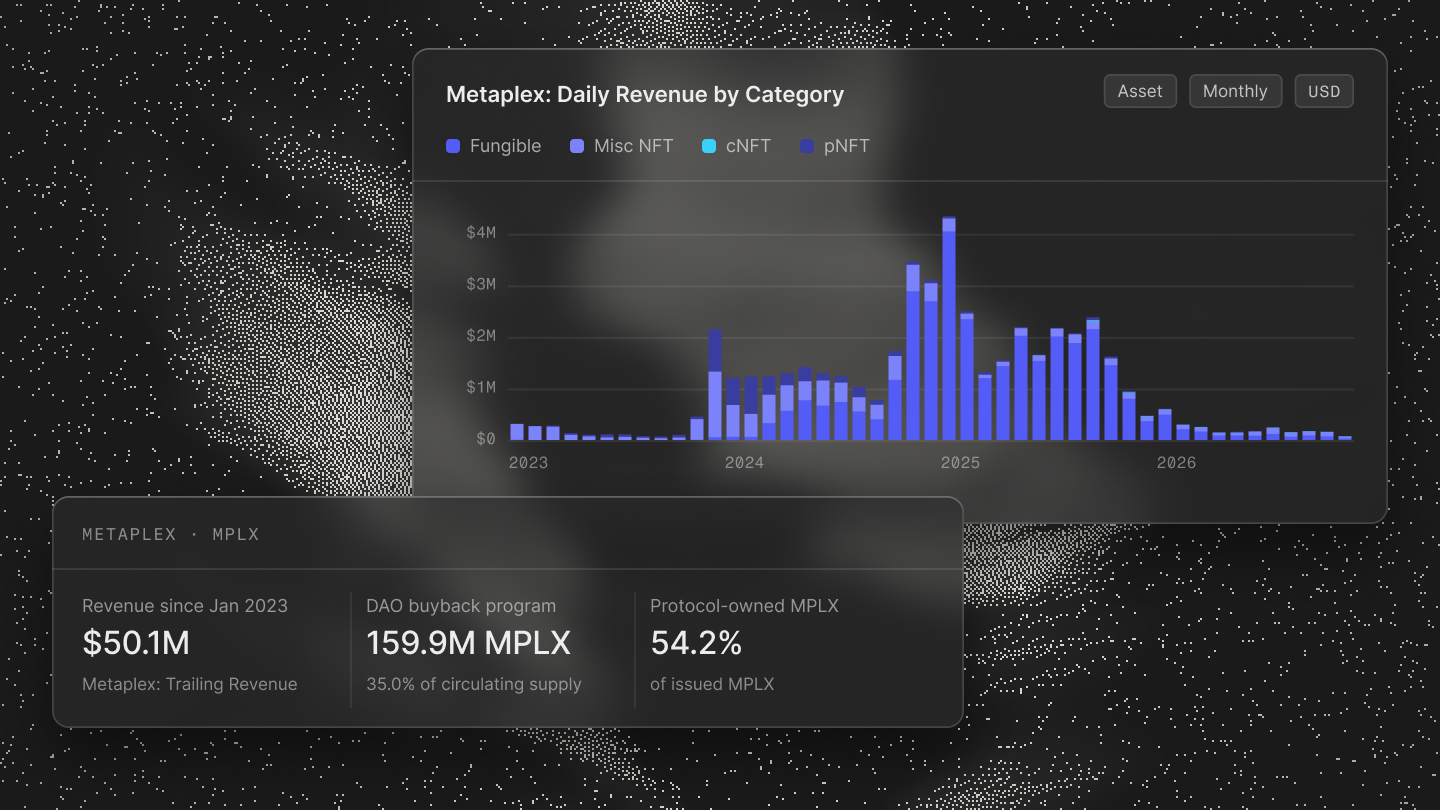
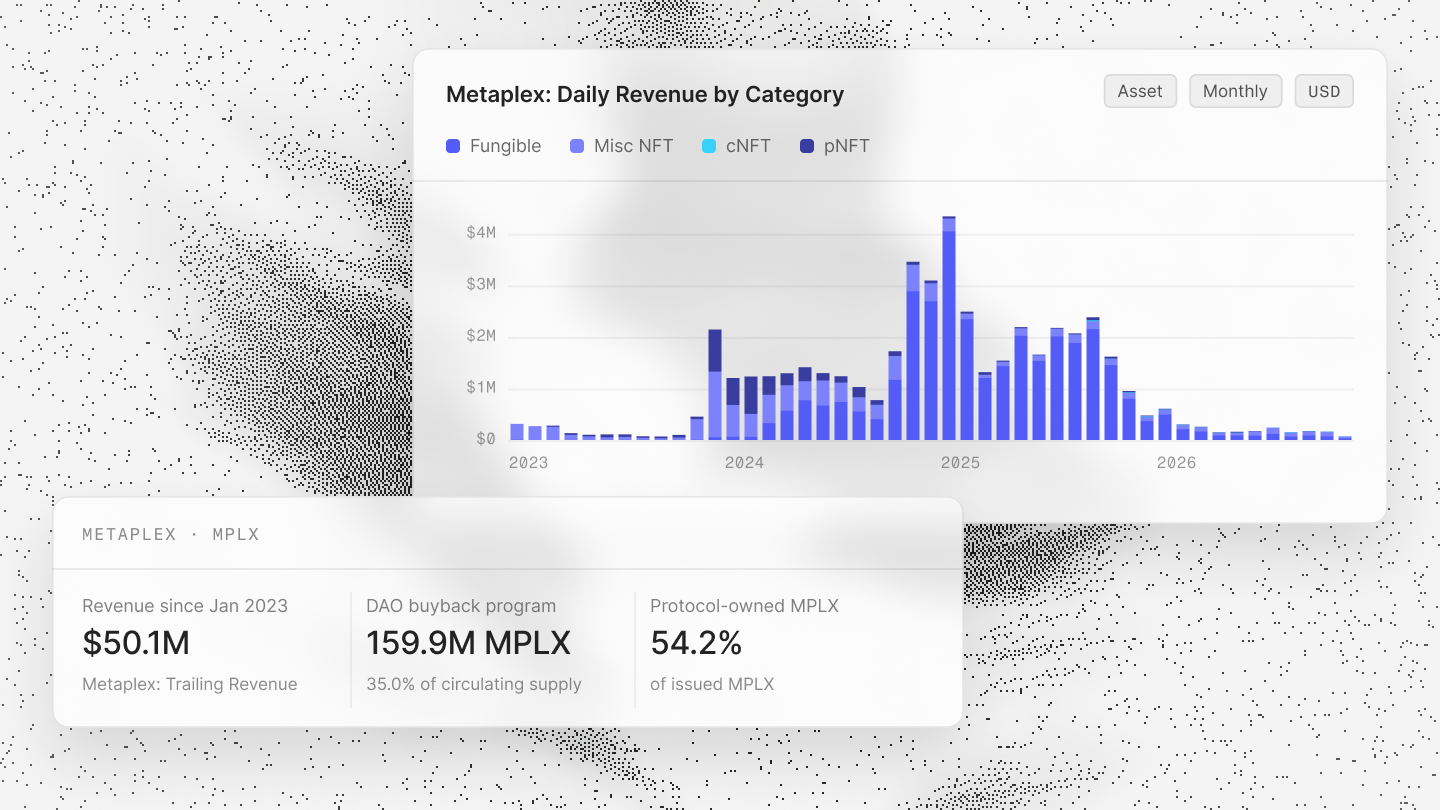
Every crypto protocol has to explain its product to the market. Metaplex uses its Blockworks dashboard to lay out the KPIs: revenue and financial metrics, the kinds of assets being created, who trades them, the onchain activity that follows and who the issuers are. Metaplex covers a lot of ground, and that level of detail is what lets outsiders see its traction.
A protocol with a token has a second story to tell. Metaplex raised from venture investors at the start of 2022, launched its token later that year and finished unlocking in September 2024. Its holders went from venture funds to liquid funds, and now include retail buyers around the world. Metaplex also spends 50% of its revenue buying back the token every month. Showing how supply has changed, and how value from the protocol flows back to the token, takes data.
“Blockworks dashboards have given us a fantastic way to do that in a way that’s visually compelling and very easy to understand for market participants who want to understand Metaplex better.”
Seeing who’s looking
Metaplex has early access to attribution in Blockworks Console. It shows which firms are looking at a project’s data on Blockworks and how often, lined up against announcements and milestones. Between the monthly updates and the follow-up messages, Mack figured he knew who was watching Metaplex. Attribution turned up more than ten institutions, some liquid funds and some more venture-oriented, that weren’t on his monthly update list.
“I noticed a handful of names that I’d never spoken to. And not only had they taken a look at Metaplex, they’d taken a look at Metaplex multiple times over a very short period of time.”
For a one-person IR team, that’s a list of people to call. It also shows what moves attention. Views spiked when Metaplex appeared in a Blockworks newsletter and when posts went out about its new analytics dashboard. “You could see it firsthand in the data,” Mack says. After the dashboard launched, Metaplex’s account manager told him its content was some of the most viewed on Blockworks.
Why not build it in-house?
Mack built a lot of charts early in his TradFi career, so he knows what goes into them. He calls the way Blockworks displays data and tells a story with it “second to none,” and points to how much users can do with it, from customizing and filtering the data to downloading it. The second reason is distribution.
“Blockworks has emerged as the preeminent data platform in crypto, where market participants of all types go to find data that they can rely on and that they trust.”
“You are bringing the market participants that we’re trying to reach to the Metaplex story,” Mack says. That mix of data quality and reach would be hard for Metaplex to replicate on its own.
His advice to teams that want to build their own dashboards and run IR in house: “That’s probably not a great use of your time or your capital.” At Metaplex, the time goes to shipping products, testing product-market fit and building a customer pipeline. Mack sees two jobs for every crypto team: build products people want to use, and tell that story to the market. “Blockworks has emerged as the best partner for doing both of those activities.”
Beyond investor relations
Issuers are another audience. When Metaplex pitches a financial institution on tokenizing an asset, the conversation starts with trust.
“They want credibility, they want to see our track record, they want to know that there’s been a billion assets that have been created with Metaplex. Having that information readily available makes that pitch with the end issuer that much easier to close.”
Blockworks data also shows up in Metaplex’s social posts, newsletters and pitch materials, and it feeds how the team makes decisions. Over the past six to nine months Metaplex has wired its growth, product, engineering and legal work into AI-native systems, so everyone works from the same context. “Being able to tie that into our own AI-native systems has been a powerful unlock in terms of the speed we’re able to move at as an organization,” Mack says.
When Metaplex moved into RWAs, Blockworks data showed which kinds were growing fastest. Tokenized stocks and other wrapped versions of assets that are already very liquid offchain looked crowded, which pointed Metaplex toward private markets. Today the team works mostly from dashboards, newsletters and social posts. Mack sees the Blockworks MCP as the next step.
Early to the revenue meta
Metaplex has generated revenue since 2023 and has put half of it toward buybacks since 2024.
“I like to joke we were early to the revenue meta before revenue was cool.”
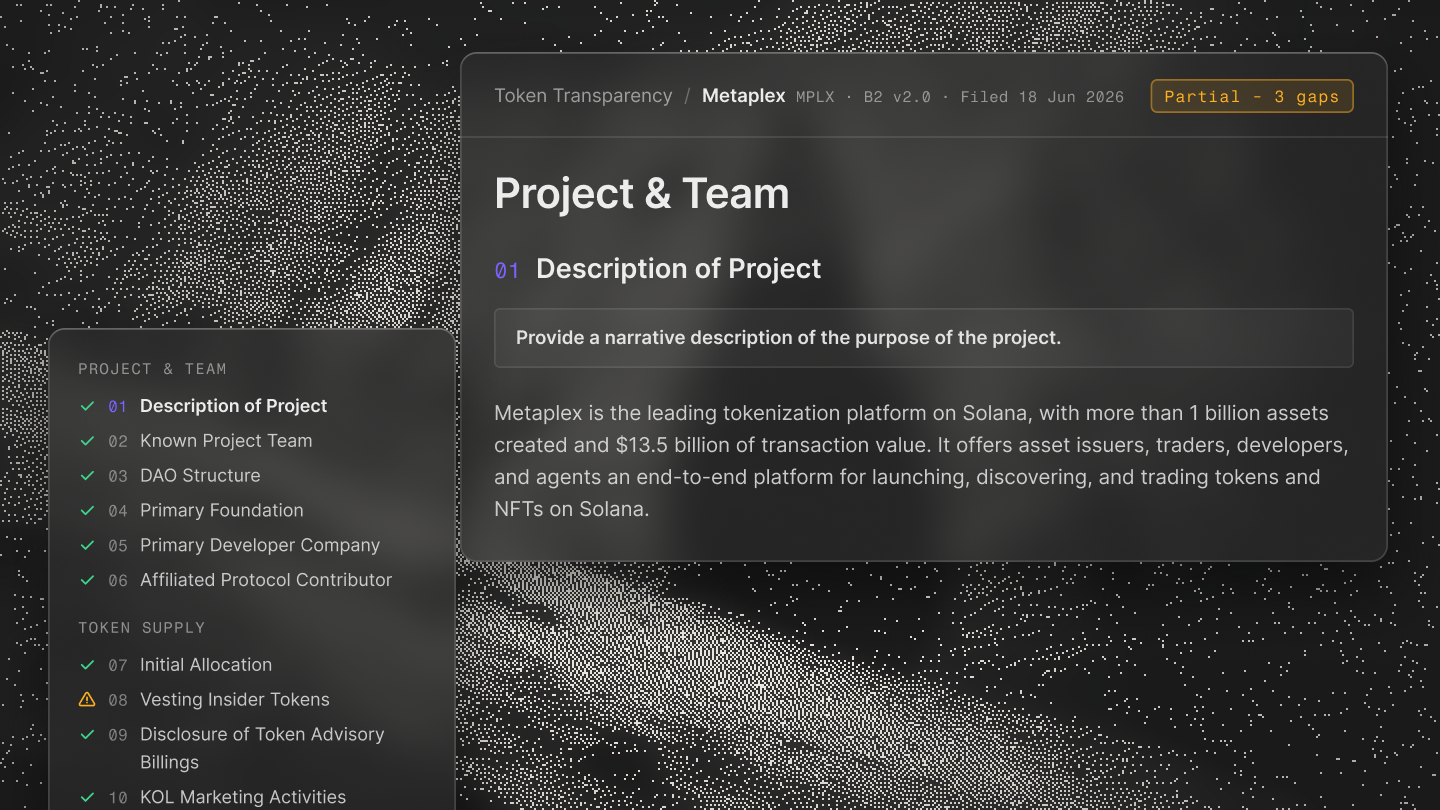
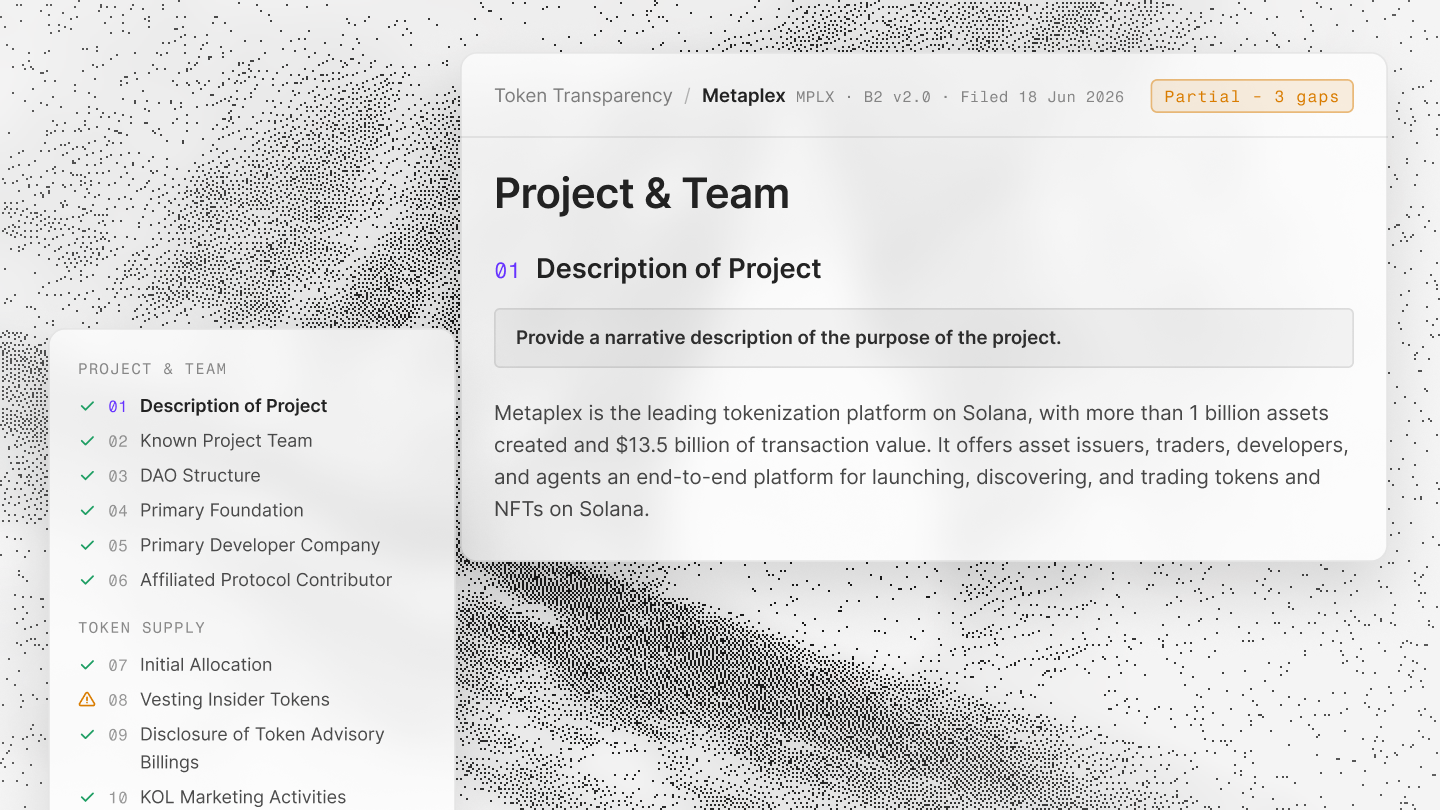
With millions of tokens out there, Mack says the hard part is getting attention onto quality projects. He backs the Token Transparency Framework because it surfaces what has historically been opaque, from the people and entities behind a project to where value flows, and gives sophisticated capital what its investment committees will ask for. Metaplex filed its first disclosure in September 2025 and updated it in June 2026. “We view it as a net good for the space,” Mack says.
What’s next
Mack is presenting at DAS London, which brings crypto-native teams together with traditional finance institutions taking a serious look at tokenization. “It puts a face to the name rather than being a PFP on crypto Twitter,” he says. He plans to use the stage to introduce Metaplex 3.0 to a much wider audience.
He wants to keep IR lean and expects that to be where Blockworks helps most, including IR conference calls, which are standard in traditional finance and rare in crypto. As Metaplex brings venture instruments, tokenized funds and private market assets onchain, he expects the data to matter more. “The partnership only gets stronger from here.”
While much of the industry has pulled back, Metaplex has kept investing. “This is the time to go on offense,” Mack says. He sees the same attitude at Blockworks, and says that’s part of why the two organizations have found such a mutually beneficial partnership.