What does ‘stablecoin summer’ look like?
Total stablecoin supply sits at $249 billion
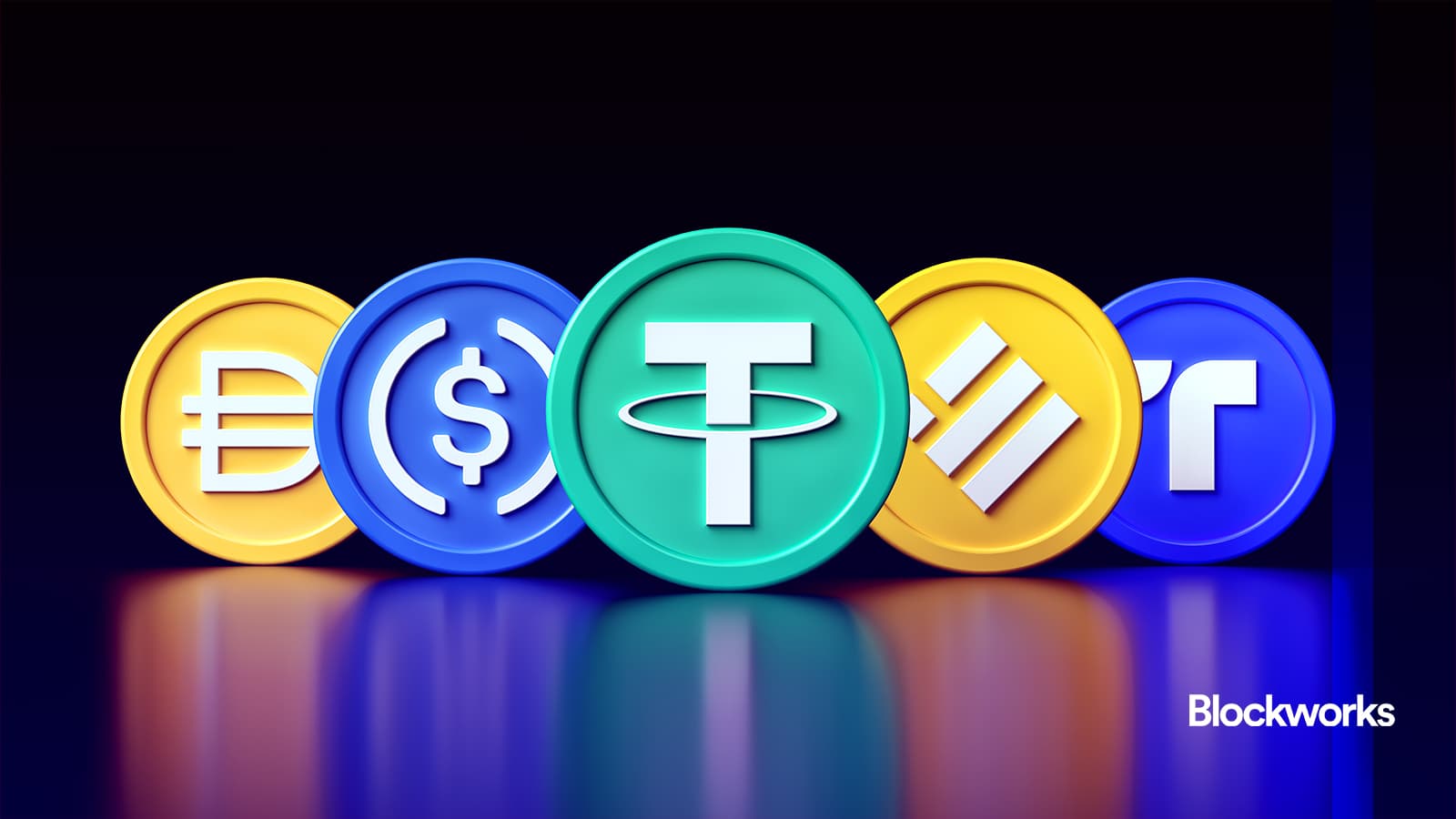
ddRender/Shutterstock and Adobe modified by Blockworks
This is a segment from the 0xResearch newsletter. To read full editions, subscribe.
In the wake of Circle’s IPO and Plasma’s token sale, stablecoins are undisputedly in vogue.
Meanwhile, the US Senate is going into a final vote on the landmark stablecoin bill, dubbed the GENIUS Act, this week.
What does the stablecoin landscape look like today?
First, total stablecoin supply remains up and to the right — $249 billion in the last week. USDT and USDC represent the lion’s share of stablecoins, about 88% ($218 billion) of the entire stablecoin market put together.
 Source: Blockworks Research
Okay, stablecoin supply is growing, but how are they being used?
B2B use cases drive the largest share of stablecoin usage today.
B2B cross-border payments tracked at nearly $3 billion in February 2025 alone, compared to $1.1 billion for card-based spending, $1.5 billion in peer-to-peer payments, or $275 million in B2C payments across the same time period.
 Source: Stablecoin.fyi
18% of small and medium US businesses “[that] are aware of cryptocurrency” use stablecoins for their business needs in 2025 — up from 8% in 2024, according to Coinbase’s State of Crypto 2025 report.
The chains facilitating the most stablecoin transfers? Ethereum, Base and Tron.
In May, Ethereum saw $1.2 trillion in volumes (29%), while Base had $1 trillion (26%) and Tron $687 billion (17%). Total stablecoin volumes in May came up to $4 trillion.
 Source: Artemis
Should the GENIUS Act come to pass, which players stand to gain the most?
If the GENIUS Act requires stablecoins to be backed by US dollars or Treasury bills, the answer is probably: TradFi regulated issuers such as Circle, traditional Fintech companies like PayPal, and banks and money market funds, Blockworks Research analyst Luke Leasure told me.
Decentralized stablecoins like Ethena’s USDe or Sky’s (previously Maker) USDS are not entirely backed by cash equivalents, so would not be compliant with GENIUS (unless registered in the US).
Yet, there are still downstream positive effects for DeFi from a burst in stablecoin growth.
In particular, money markets like Aave and Pendle stand to gain.
On Aave v3 alone (across all chains), stablecoins make up about $10.2 billion in TVL.
 Source: DefiLlama
What about Pendle?
Though Pendle is technically a “yield trading” app, it has cemented itself as a de facto go-to-market platform for all yield-bearing assets, particularly stablecoins.
High risk appetite users onchain don’t just want to stake and earn an underlying T-bill yield, they want to speculate on points.
A snapshot of Pendle’s $5.3 billion in TVL today demonstrates the business’s effectiveness in capturing the downstream growth of new yield-bearing stablecoin launches. About ~61% of it comprises Ethena’s USDe and eUSDe (a restaking token), Sky’s USDS and OpenEden’s USDO.
 Source: DefiLlama
A recent report from Spartan Group and Modular Capital found that Pendle has captured approximately 30% of the whole $11 billion yield-bearing stablecoin market — about 1.3% of total stablecoin supply.
Get the news in your inbox. Explore Blockworks newsletters:
- The Breakdown: Decoding crypto and the markets. Daily.
- 0xResearch: Alpha in your inbox. Think like an analyst.