Why a US crypto strategic reserve would need active management
Basic strategy might work if it’s only bitcoin, but otherwise it could get ugly fast

pixinoo/Shutterstock modified by Blockworks
This is a segment from the Empire newsletter. To read full editions, subscribe.
Here’s the thing about strategic reserves.
The name implies that whatever is in the reserve is a stockpile that can be utilized at some point in the future when the situation calls for it.
In the US, the government maintains a stockpile of one million barrels of diesel fuel spread between Massachusetts, New Jersey and Connecticut — a trove of oil to be released to heat homes and businesses should there be a supply disruption somewhere down the line.
A strategic grain reserve does much the same thing, but for a critical food ingredient.
They do not necessarily have to directly benefit the general public, either. At one point, the government was also stockpiling helium, hoarding it for use in military blimps, although these days the private sector handles that, and the helium instead is used for rockets and superconductors.
So what would a strategic crypto reserve actually be for? What future calamity could a portfolio of random coins help alleviate?
A bitcoin-only strategic reserve is the easiest to square. As far as coins go, it’s obviously the most resistant to major long-term corrections — it has always bounced back from its semi-regular 80% drawdowns.
BTC is also effectively uncorrelated with the rest of the crypto market — because it almost always leads it. That makes it the obvious choice for a strategic reserve.
After all, bitcoin’s primary modern use case is buying and holding long-term, which is about as close to an overarching goal for any strategic reserve as we’ve got right now. Maybe one day in the future, on some rainy day, the US could sell its bitcoin something, pay off some debt or otherwise fund initiatives for the common good.
As it stands, the nearest things we have to a US strategic crypto reserve are the $20 billion BTC seized through criminal cases over the years — which is still on track to be liquidated at some point, although perhaps not in the short term.
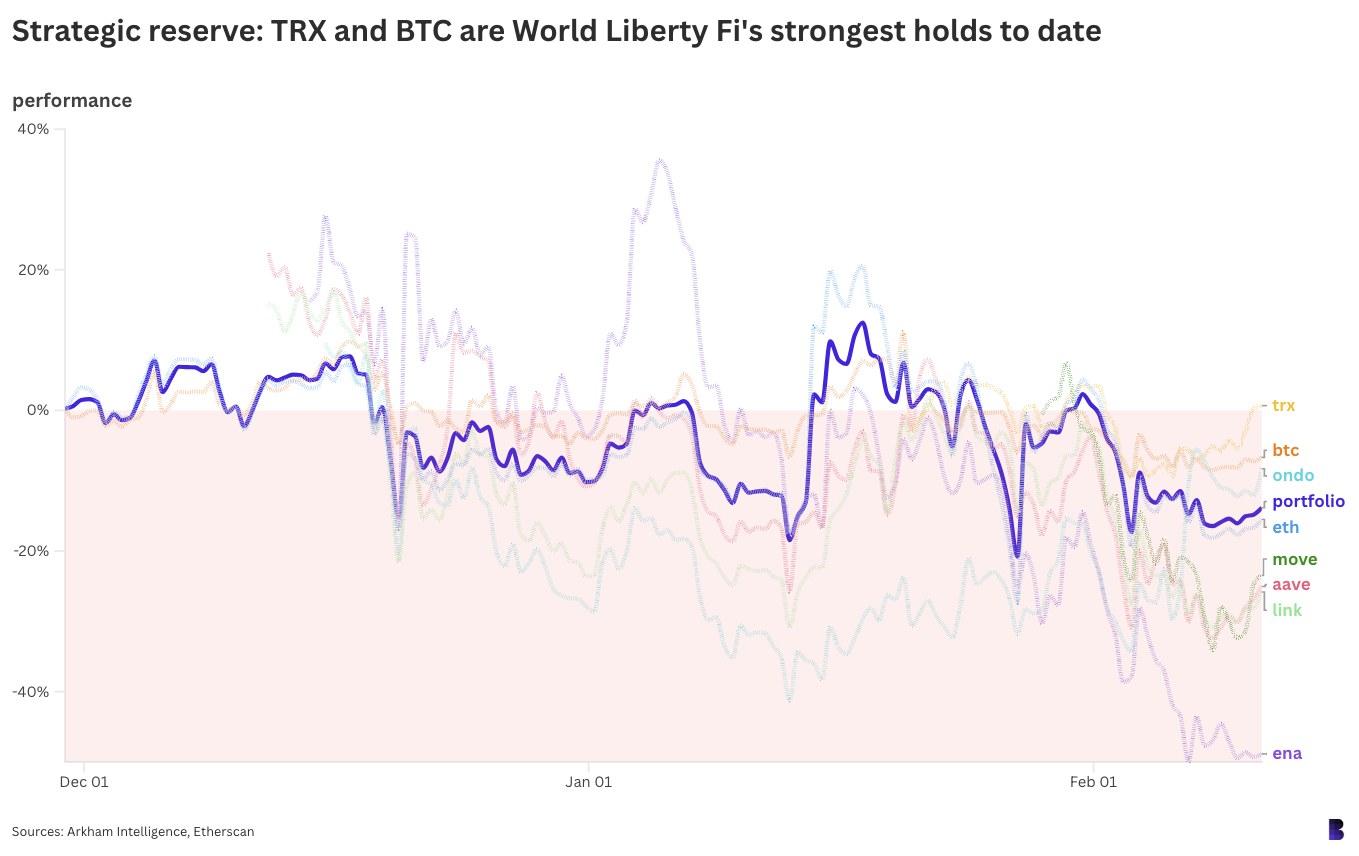
Then, there’s the growing strategic reserve maintained by Trump’s upcoming DeFi project World Liberty Fi. It’s so far spent $303 million on seven different coins since the end of November, as recently as last week, with nearly two-thirds of it going to ETH.
Tracking the value of World Liberty Fi’s reserve is more difficult after it moved most of it into Coinbase Prime custody earlier this month. But after piecing together the onchain data, I calculated that the portfolio was worth just over $261 million earlier this morning.
That puts it in the red by about 14% on all of its purchases to date (as shown by the blue line on the chart above, while the other lines show the overall performance of each position).
TRX is the only hold still green, but only barely, with ENA the worst — World Liberty Fi is down around $2.7 million on its ENA positions right now. The portfolio is largely being held up by bitcoin, with it down around $30 million in its ETH compared to $5 million on BTC.
Perhaps there’s no reason for World Liberty Fi’s strategic reserve to exist at all, other than basic treasury management common to many crypto projects, not to mention the reported token swap deals relayed by Lightspeed’s Jack Kubinec.
But if it really turns out that World Liberty Fi’s crypto portfolio is in fact Trump’s anticipated strategic reserve, then it will need to be actively managed, especially as we get closer to the next bear market.
If World Liberty Fi’s portfolio drops further, labeling it as “strategic” could get embarrassing.
Get the news in your inbox. Explore Blockworks newsletters:
- The Breakdown: Decoding crypto and the markets. Daily.
- 0xResearch: Alpha in your inbox. Think like an analyst.
