The good and bad of tokenized stocks
Tokenized stocks suffer from liquidity problems and off-hours price peg drift
VILTVART/Shutterstock and Adobe modified by Blockworks
This is a segment from the 0xResearch newsletter. To read full editions, subscribe.
You can finally trade traditional stocks on a blockchain!
That’s thanks to “xStocks”, the new tokenized stocks product brought to you by Kraken and Backed Finance (and soon Robinhood).
24/7 trading, instant settlement, tokens composable with decentralized finance, dividend payments flowing directly to your wallets and — best of all — a legal claim on the underlying stock.
Nice! Maybe my mom will finally understand the industry I work in.
But wait…there are nuances.
Anybody with a wallet can buy xStocks on Solana, yes.
But only qualified, KYC’d, non-US Kraken investors will be able to mint and redeem the underlying tokenized xStocks.
That’s because Backed issues each asset out of a Liechtenstein-domiciled SPV (special purpose vehicle). The SPV buys (or sells) the underlying shares on a regulated exchange during US market hours after a mint or burn request.
That takes us to the liquidity and price peg problems with tokenized stocks.
Stocks trade Monday to Friday, from 9:30 a.m. ET to 4 p.m.
But tokenized stocks trade 24/7.
While Wall Street is open, a primary-market arbitrage keeps xStocks pegged to the cash price.
What happens to the peg when the trading day closes?
If Tesla finishes Friday at $300 and TSLAx changes hands at $290 on Sunday, price convergence only happens when someone is willing to burn tokens for shares after the market reopens.
But since market makers can’t hedge a Sunday fill until the bell rings on Monday, they’ll have to protect themselves by quoting wide spreads and small size, as Dragonfly Capital’s Rob Hadick pointed out in an excellent tweet.
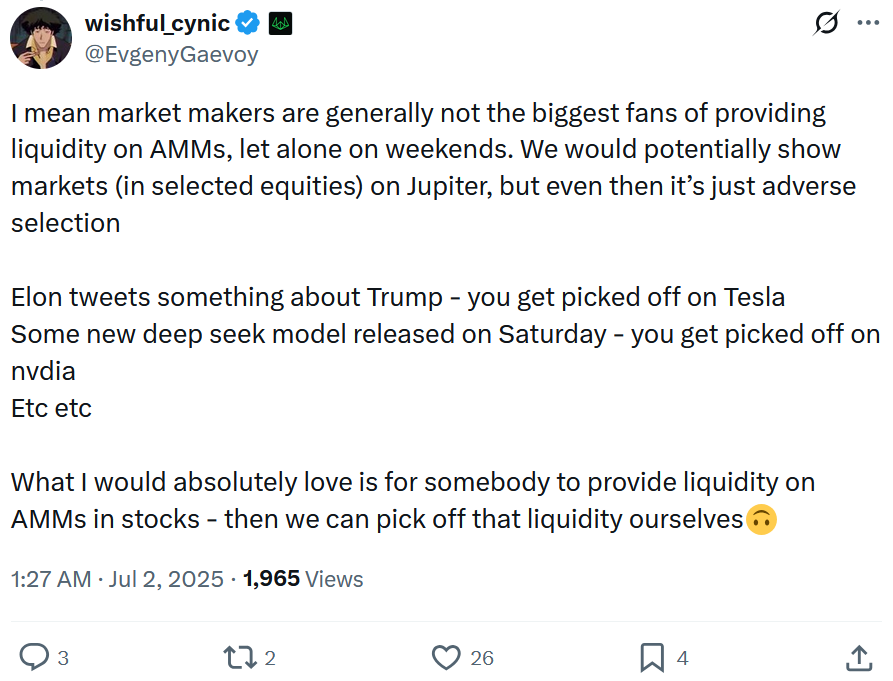
This is somewhat echoed by Wintermute CEO Evgeny Gaevoy, who acknowledges that market makers “are generally not the biggest fans of providing liquidity on AMMs, let alone on weekends.”
This probably won’t matter so much for smaller trades. But the current lack of liquidity undermines the value proposition of tokenized equities.
You can play around on Jupiter to see for yourself how a six-figure trade would eat a high price impact of up to a triple-digit BPS.
The silver lining is that equities are far less volatile than crypto, so maybe some market makers would be willing to stomach that risk.
But until these issues get better, you can probably get much better execution and cheaper delta exposure with synthetic perps using Ostium, a perps DEX on Arbitrum that I’ve touched on previously.
Ostium’s co-founder, Kaledora Linn, notes that opening a $250k TSLA position through Ostium’s synthetic perps is roughly 100x cheaper than what you’d pay for a tokenized stock right now.
The only trade-off is that Ostium’s synthetic assets don’t enjoy the same capital efficiency of tokenized stocks (because they’re tokenized!).
You can now put your tokenized stocks on a money market like Kamino and borrow stablecoins against them.
It’s not clear if Robinhood will enable that composability, though.
An early peek under the hood (thanks to Ren of Electric Capital) of Robinhood’s tokenized stock contracts reveals requirements of KYC/AML checks that limit transfers to approved addresses.
We’ll have to wait and see.
Get the news in your inbox. Explore Blockworks newsletters:
- The Breakdown: Decoding crypto and the markets. Daily.
- 0xResearch: Alpha in your inbox. Think like an analyst.