Project Open makes its case to the SEC
A newly submitted SEC pilot proposal aims to tokenize US equities
Project Open modified by Blockworks
This is a segment from the Lightspeed newsletter. To read full editions, subscribe.
Have you ever wondered why stock trades take days to settle? Have you ever looked at the UX nightmare that is fractional ownership and thought, How in the world is this still the norm? And why is it exactly that your shares must live inside custodial black boxes?
These design failures boil down to the fact that the US equity market is fundamentally outdated. It’s trapped inside legacy infrastructure, shackled by intermediaries and probably coded in COBOL.
Efforts to modernize the system are usually surface-level. We might get faster messaging or marginally updated interfaces, but the core always seems to remain untouched. Hence, we live in a holding pattern of settlement delays, bloated fees and an ecosystem that is as opaque as it is exclusionary.
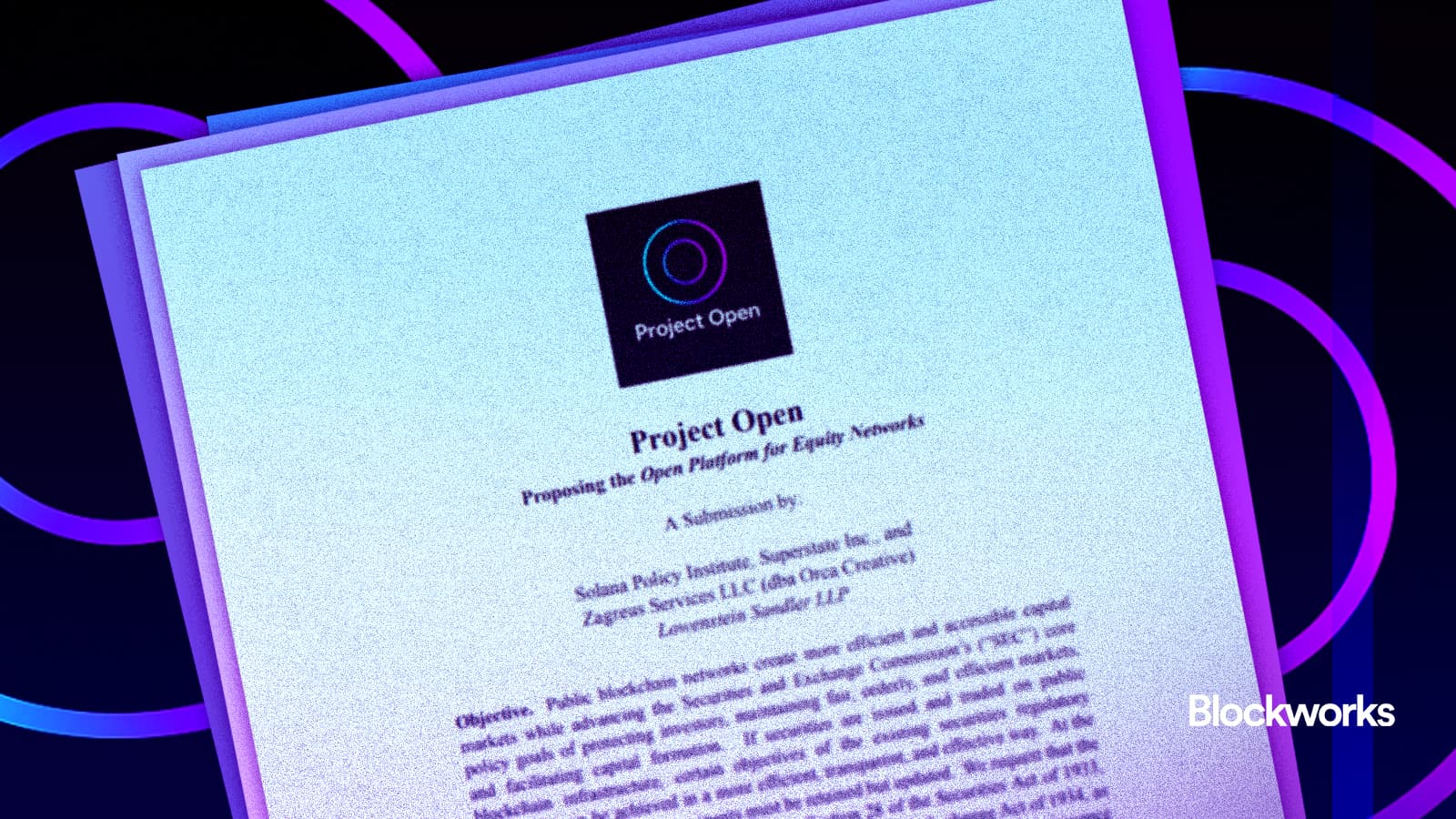
Enter Project Open, a newly submitted SEC pilot proposal with blockchain at its core. Jointly proposed by the Solana Policy Institute, Superstate and Orca (and with legal support from Lowenstein Sandler), Project Open is a request for exemptive relief that would allow equity securities to be issued, registered and traded directly on public blockchain networks like Solana.
The Solana Policy Institute, which launched at the end of March, is a non-partisan advocacy group aiming to help policymakers understand the role public blockchains can play in economic and social infrastructure. Project Open is its first major public action.
The group submitted a 20+ page legal framework to the SEC’s crypto task force this week, complete with registration pathways, KYC onboarding, smart contract-based settlement, investor education modules and blockchain-native transfer agent roles.
Issuers would file traditional-style registration statements, which is same-same with how we do things now. The main difference involves using a digital token class instead of paper shares. Transactions would settle instantly, wallet-to-wallet, onchain.
Project Open takes a head-on approach to compliance, proposing a pilot program with a gated issuer cohort, 18-month duration and SEC oversight baked in.
Investors would hold “Token Shares” in whitelisted wallets after passing KYC and educational onboarding. A registered transfer agent would track all shares using the blockchain as the system of record, with super-admin rights to fix errors, recover assets or enforce restrictions. No custodians. There wouldn’t be any net settlement. No post-trade ambiguity. Just delicious, deterministic finality.
Project Open proposes trading on rails using smart contracts (a la Orca AMM or bilateral P2P swaps) rather than traditional exchanges. The filing even outlines how tokenized trading mechanisms would navigate existing rules like Reg NMS and broker-dealer custody requirements — or bypass them via targeted exemptions.
It’s frankly an opportune time for this proposal to land, what with Gary Gensler out, the subsequent rollback of enforcement actions, and new SEC Chair Paul Atkins signaling openness to “huge benefits” from blockchain infra.
We’ve heard a similar song a lot lately. In his investor letter last month, BlackRock CEO Larry Fink said plainly:
“Every stock, every bond, every fund — every asset — can be tokenized. If they are, it will revolutionize investing. Markets wouldn’t need to close. Transactions that currently take days would clear in seconds. And billions of dollars currently immobilized by settlement delays could be reinvested immediately back into the economy, generating more growth.”
If he’s right, then Project Open may be the first serious attempt to give that future a regulatory foundation in the US.
The goal is for internet capital markets to settle in seconds, run on open infrastructure, and restore user-level control. Faster, fairer, cheaper, smarter, with the opacity dial thinned to nil.
Project Open reads like the culmination of years of onchain trial and error. It’s the sober recognition that blockchain tech is ready for real finance, not just DeFi.
If the SEC says yes, even conditionally, it would be a meaningful convergence of TradFi and crypto — on the scale of ETFs, and just as important as tokenized Treasurys onchain.
If it says no, the status quo holds…for a little longer, anyway.
Get the news in your inbox. Explore Blockworks newsletters:
- The Breakdown: Decoding crypto and the markets. Daily.
- 0xResearch: Alpha in your inbox. Think like an analyst.