Polymarket ‘politics’ markets surge, Celestia rethinks consensus
Also, Maple’s SyrupUSDC can’t stop growing

BEST-BACKGROUNDS/Shutterstock and Adobe modified by Blockworks
This is a segment from the 0xResearch newsletter. To read full editions, subscribe.
We’re kicking off this week with a collection of charts around political markets on Polymarket, Maple’s unstoppable SyrupUSDC growth, and an ambitious Celestia proposal to leave proof-of-stake behind.
Polymarket political markets
Polymarket is back in the limelight amid recent geopolitical conflicts.
In the last week, markets in the “Politics” category saw a jump from $3.9 million to $19.5 million in volumes, as denoted by the light blue bars in the chart below.
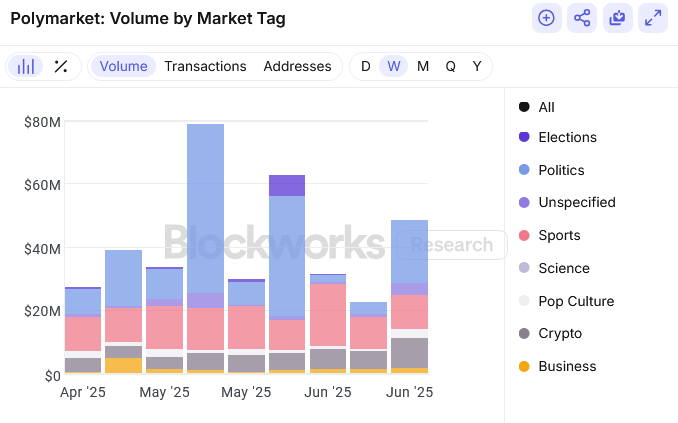 Source: Polymarket.
All eyes were focused on the “US military action against Iran before July?” market, which contract resolved yesterday following reports of US strikes on alleged Iran nuclear facilities. The market saw a total $29.9 million in trading volumes.
Just before the market surged to 99%+ near certainty, “Yes” shares on the market had been trading at $0.59, meaning markets were pricing in about a 59% probability of the US taking military action against Iran.
Celestia’s governance
Celestia should abandon proof-of-stake consensus for “proof-of-governance” (PoG), argues Celestia co-founder John Adler in an ambitious new governance proposal.
If passed, the following material changes will be enacted:
- TIA issuance will be cut by about 20x, or 95%.
- Delegated staking and liquid staking contracts will be phased out. No more onchain governance.
- All TIA issuance will be routed solely to validators as payment for running nodes.
- Validators would be picked by off-chain governance, because Celestia lacks general execution and is not suited to support onchain token voting.
- Network fees would be burned as a form of value accrual to TIA token holders. Celestia’s protocol fees amount to $100–$300 daily.
TL;DR: Reduce Celestia’s constant emissions in a bid to stave off its declining price action (see chart).
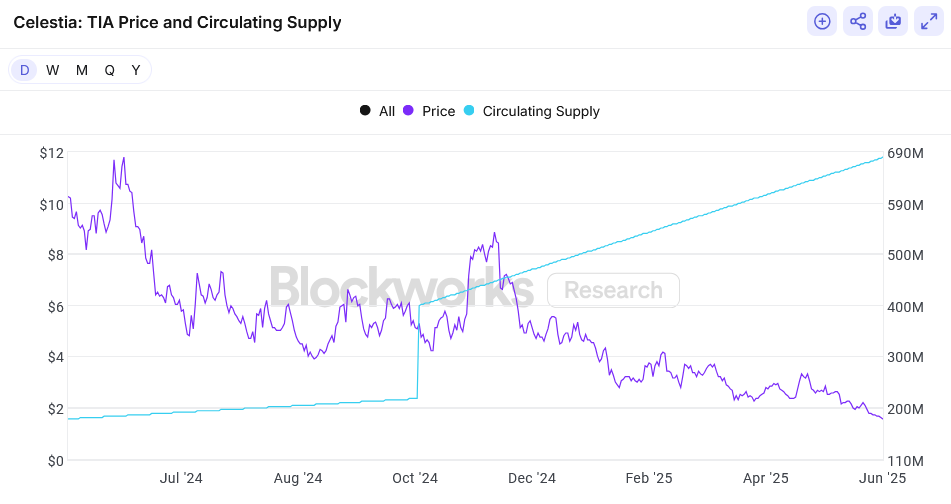 Source: Blockworks Research.
The proposal challenges many common sense “wisdoms” of Ethereum thought, namely where a chain’s “economic security” is derived from (not slashing), the framing of PoS as really permissioned “proof-of-authority,” and how to think about “blockchain profitability.” Expect Ethereum maxis to be triggered.
SyrupUSDC growth
Maple’s yield-bearing stablecoin SyrupUSDC is now at a market cap of $780 million, making it the fastest-growing stablecoin this year.
Users deposit USDC onto the platform, which is then used to issue overcollateralized loans to institutional borrowers. The interest charged on those loans is resulting in above average APYs of about 10% today (6.4% base yield +3.5% Drip points), driving SyrupUSDC’s rapid growth.
You can also forgo points to snag a 9.2% PT fixed yield on Pendle instead.
About $587 million is used across DeFi, mainly 55% in Spark and 19% in Pendle.
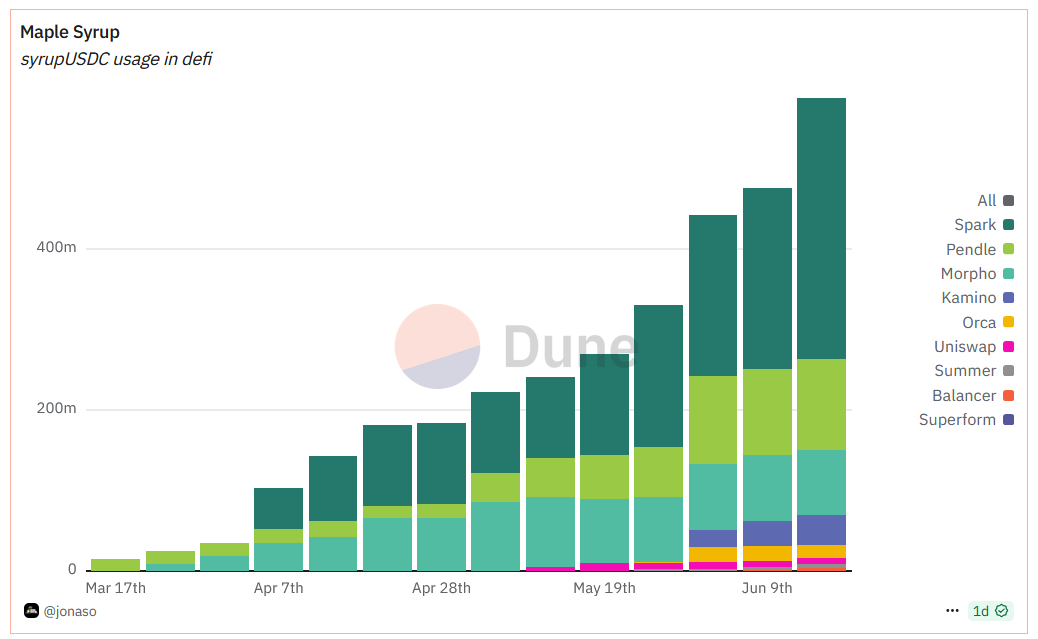 Source: Dune.
Get the news in your inbox. Explore Blockworks newsletters:
- The Breakdown: Decoding crypto and the markets. Daily.
- 0xResearch: Alpha in your inbox. Think like an analyst.
