Artwork by Crystal Le
This is a segment from the 0xResearch newsletter. To read full editions, subscribe.
It all starts with Ethereum. The L1 is too slow. Every node needs to redundantly re-execute transactions in a block to ensure validity, which limits scalability.
By 2020, the Ethereum community coalesced around rollups as the scaling solution. Vitalik’s 2021 landmark blog post on rollups explains how optimistic and zk rollups can scale Ethereum.
Zk rollups are technologically superior for scaling but the tech was still too expensive to use and far behind (more later).
So optimistic rollups broke into the market first. Optimistic rollups assume all transactions are valid until someone challenges it with a fraud proof within a seven-day challenge period.
Optimistic rollups worked, but they came with hidden costs. The challenge period meant longer transaction finality before users could withdraw funds. Locked liquidity meant capital efficiencies and a generally poorer UX, especially with chain interoperability.
Meanwhile, zk was catching up. At ETHCC 2022, Polygon, zkSync and Scroll all announced zkEVMs, which enable Solidity devs to write code and prove the execution of the EVM — effectively allowing Ethereum to leverage zero knowledge technology.
By 2023, zk rollups started to gain real traction.
Why exactly are zk proofs better than optimistic fraud proofs? Namely because zk proofs are much smaller (~1-10 KB) compared to raw transaction data (megabytes in size).
By using zk cryptography to prove Ethereum transactions, these highly compressed proofs meant lower data availability costs and better scalability.
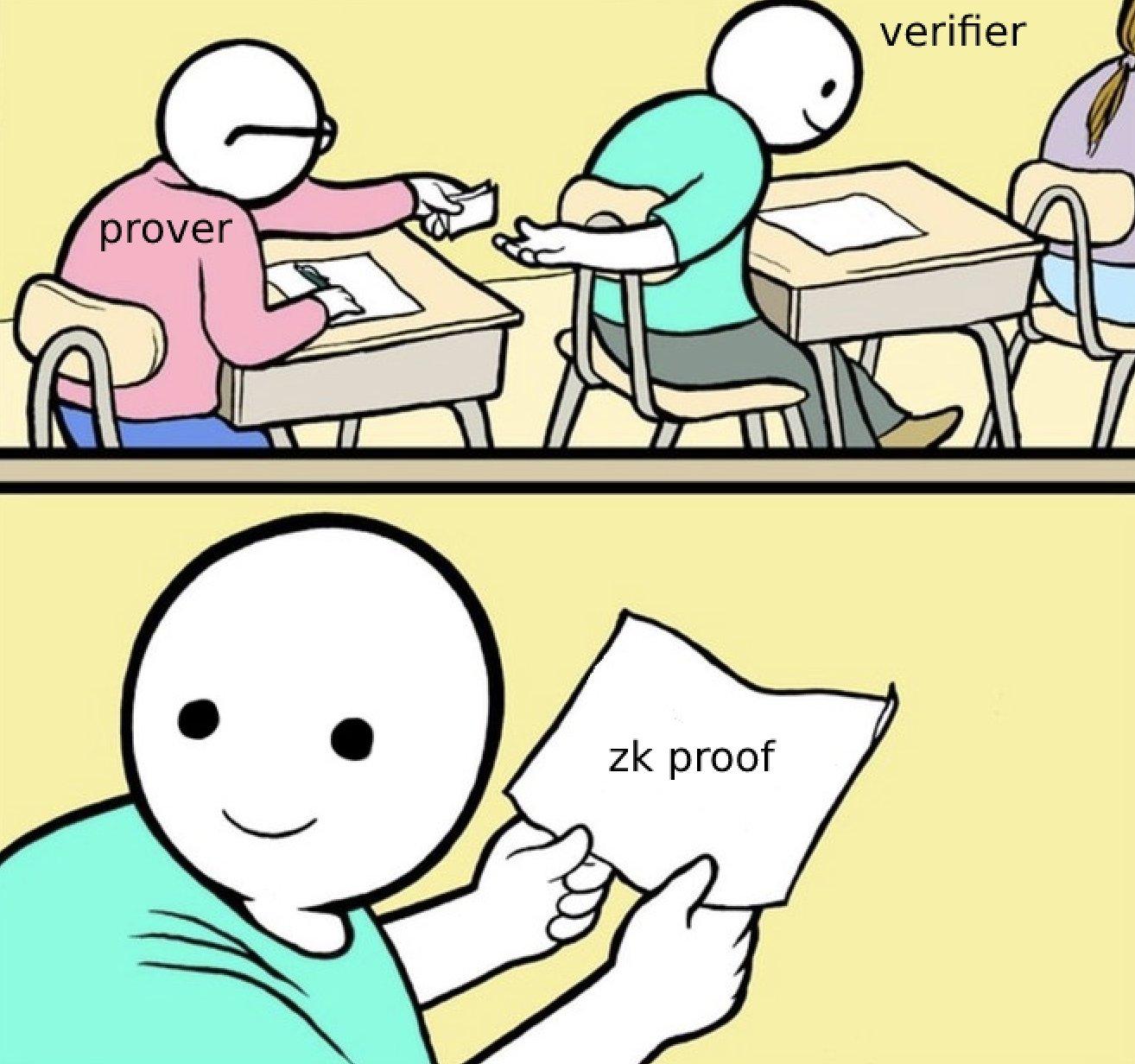 How zero knowledge works in a nutshell
Though zk was taking off, proof generation was still expensive. Based on zkstats.io, the average cost to generate a zk proof in December 2023 was $80.21.
Fast forward to 2025. Proof costs have dropped to $1.3 per proof, about a 98.4% improvement.
What changed?
Today, each of the core pieces of the zk rollup stack have been broken up.
Firstly, zkVMs are here. These specialized virtual machines speed up the zk development experience and make validity proof generation more efficient. Before zkVMs, developers needed to write complex, mathematical “circuits” to prove EVM execution.
ZkVMs like SP1, RISC Zero, Nexus and OpenVM today effectively democratize zk development for all developers (C++, Rust) without zk cryptographic expertise. In the past, zkEVMs only enabled Solidity development on zk rollups. Think of zkVMs as a more general concept than zkEVMs.
Second, the costs to generate proofs are going down because of market competition. Today, there are many competitive marketplaces operated by Risc Zero, Cysic, Lagrange and Succinct. Some are still in testnet, some are operational.
Zk L2s are also turning to proof aggregation techniques to amortize verification costs. The way this roughly works is by batching many proofs inside of one, which makes the final proof faster to verify.
These marketplaces are also permissionless, meaning anyone with a GPU rig can sign up, post a bond and generate zk proofs. Previously, zk rollups used “centralized provers,” meaning they rented GPU/FPGA hardware from Google or Amazon.
Better proof systems are also constantly launching. These proof systems (examples: Groth16, Halo2-KZG, STARK, Plonk, Expander) algorithmically define the rules as to how zk proofs are constructed and verified. They’re getting better, which means zk proofs are getting smaller and faster to verify. This in turn means increased zkVM performance gains.
Finally, there are zk co-processors built on top of zkVMs. These things basically allow onchain apps that do not exist in a zk execution environment to leverage the wonders of zk technology. The way it does so is by moving computation offchain, therefore running asynchronous to the blockchain’s execution. This enables apps to compute complex statistics offchain, prove it with zk, then post that proof onchain.
Apps like Frax, Azuki, Etherfi and Gearbox are using Lagrange’s zk co-processor to get around the limits of the Ethereum L1.
So there you have it. That’s why zk is the endgame.
Get the news in your inbox. Explore Blockworks newsletters:
- The Breakdown: Decoding crypto and the markets. Daily.
- 0xResearch: Alpha in your inbox. Think like an analyst.
