Happy ₿-Day: Bitcoin’s official Unicode symbol turns 8
Every movement needs a symbol, cryptocurrency or not
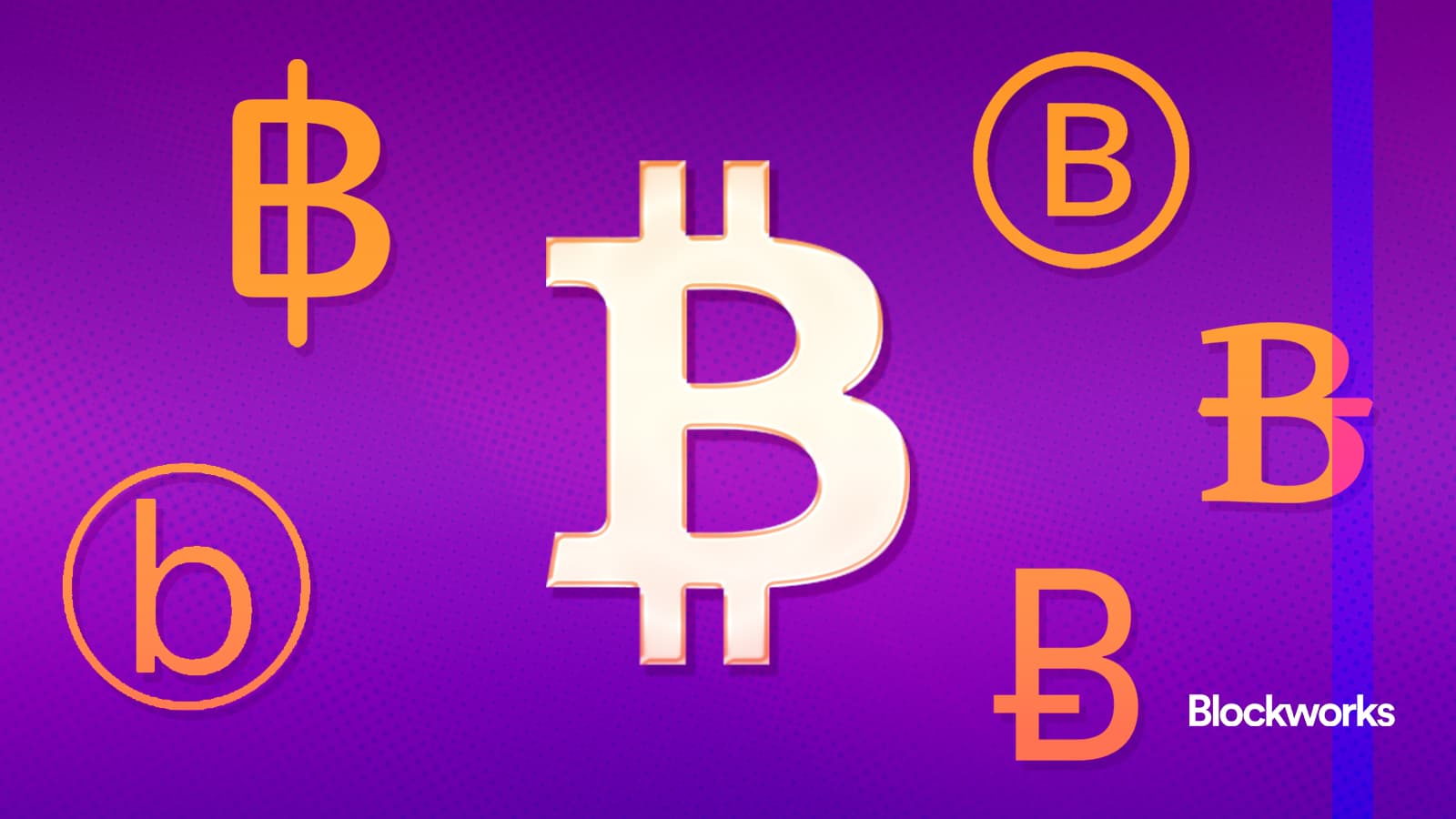
Robert Sanjeev Ross/Shutterstock and Adobe modified by Blockworks
This is a segment from the Supply Shock newsletter. To read full editions, subscribe.
Everybody knows the symbol for the almighty dollar. But no one knows exactly where it came from.
Our best guess for the origin of “$” is that it’s a relic of the Spanish colonial peso, or the Spanish dollar. These large silver coins were widely used across the Americas in the 18th century, long before the US created its own dollar currency.
Early Americans had used a shorthanded “Ps” to represent the Spanish peso in text. Those two letters would merge, placing the “P” on top of the “s,” eventually morphing into something that resembles the modern-day dollar symbol.
Luckily, we know exactly where Bitcoin’s Unicode symbol came from — and it became officially usable around the world eight years ago today.
On This Day
Unicode 10.0.0 was released on June 20, 2017, ferrying in 8,518 new characters to the universal typeset and bringing its total to 136,690.
Bitcoin’s symbol was finally among them. Unicode listed ₿ as an “important symbol addition” alongside 56 new emoji characters and a set of religious Typicon marks.
“It is described as ‘a capital letter B with two vertical lines going through’’ it, though the lines are only visible at the top and bottom,” the proposal reads.
This milestone had been a long time in the making. Infamous hardware hacker Ken Shirriff had submitted his formal proposal almost two years prior in October 2015.
It was Shirriff’s second such submission after a proposal for a group mark symbol earlier that year, which was also included in Unicode 10.0.
Shirriff is Bitcoin Legend material in his own right, having mined bitcoin with a pencil and paper, as well as on a 52-year-old machine that helped guide the Apollo spaceship to the moon.
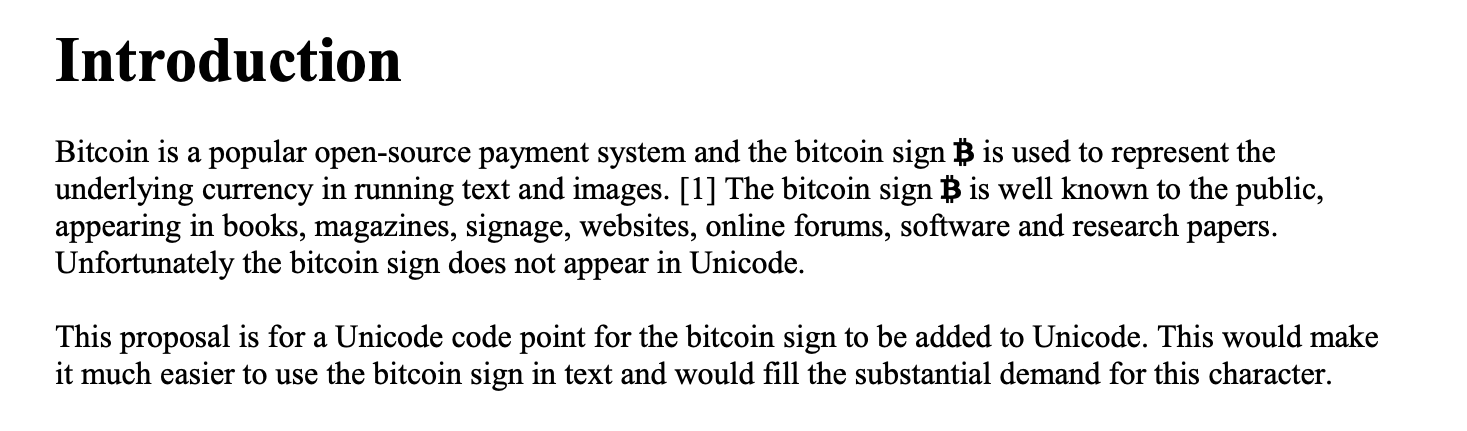 ₿ was already found in Wikipedia and Wired magazine years before the 2015 proposal, and was community used in bitcoin wallet and payment apps.
Bitcoiners had organized to push for an official symbol in June 2014, when the Bitcoin Foundation formed a volunteer Standards Committee to decide how it should look. Informal discussions had started in 2013, but the currency symbol had been a recurring topic since as early as February 2010.
Shirriff’s proposal had support of the Bitcoin Foundation and its Standards Committee, as well as Peter Todd, Eric Martindale, Justin Drake, Theo Chino, Michael Marquart (under theymos) and a string of early Bitcoin startups.
Unicode accepted the pitch after only one month, in November 2015, leaving the Bitcoin community to wait for half a halving epoch to really celebrate. It was the first new currency symbol in 24 years, since the Korean won (₩) was included in Unicode 1.1, released in June 1993.
Before all this, the community was somewhat split over how they should represent bitcoin. The Thai baht (฿) was a common suggestion, but didn’t go down well with everybody. “You cannot and should not just steal [a] symbol from [an] existing official currency of [an] independent country,” one Bitcointalk user wrote. Ƀ was another.
However, ₿ is the closest to resembling the symbol that Satoshi had designed as the icon for their original Bitcoin client, making it the obvious choice once the proposal was finalized.
₿ represents a whole bitcoin, with the symbol for an individual satoshi still up for debate (as is the term “satoshi” every now and then.)
While Unicode may recognize bitcoin, the International Organization of Standardization (ISO) doesn’t.
The organization is yet to include BTC or XBT in its ISO 4217 list of active currency codes. Bitcoin’s official code cannot start with a “B” because it clashes with Bhutan’s country code, BT.
A Bitcoin Foundation working group had been tasked with applying for ISO approval in October 2014, but apparently never succeeded.
No better time to revive those efforts than now.
Get the news in your inbox. Explore Blockworks newsletters:
- The Breakdown: Decoding crypto and the markets. Daily.
- 0xResearch: Alpha in your inbox. Think like an analyst.