Blog / Dashboard Primers
Uniswap: Data Dashboard Primer
Explore Uniswap's $3.4T lifetime volume, UNI burn mechanics, TVL, and ecosystem data in Blockworks' new dashboard tracking DeFi's largest DEX across 23 chains.
By Cristian Soto ·
Introduction
Uniswap is the largest decentralized exchange in DeFi. It has operated since November 2018 across four generations and every major EVM chain. At its core, it is an automated market maker: trades are priced against a shared pool of assets rather than an order book, and anyone can supply that liquidity. Each version kept that idea and extended it.
v1 launched in 2018 as the first pool model on Ethereum, with ETH on one side of every pair. v2 opened up direct token-to-token pairs, which became the widely copied standard. v3 brought concentrated liquidity, allowing providers to allocate capital to the price ranges where trading actually happens, so the same dollar does more work. v4 then moved every pool into a single contract and introduced hooks, which are external smart contracts that apply custom logic to a pool.
In December 2025, a governance vote passed UNIfication, turning on protocol fees for the first time: for a subset of pools, a portion of the swap fee now goes to the protocol and is used to burn UNI, while the rest continues to flow to liquidity providers. The same vote burned 100M UNI from the treasury, roughly a tenth of the original 1B supply. Today, almost all pools across all versions have a portion of the swap fee that contributes to the UNI burn. The dashboard that follows measures the protocol across five views, including headline activity, financials, liquidity, integration & ecosystem, and security.
Overview
Uniswap has settled $3.458T in lifetime volume across 23 tracked chains, with Ethereum alone accounting for $2.3T of that. Over 36.18M wallets have traded on Uniswap, which is 61% of all wallets that have ever touched a DEX.
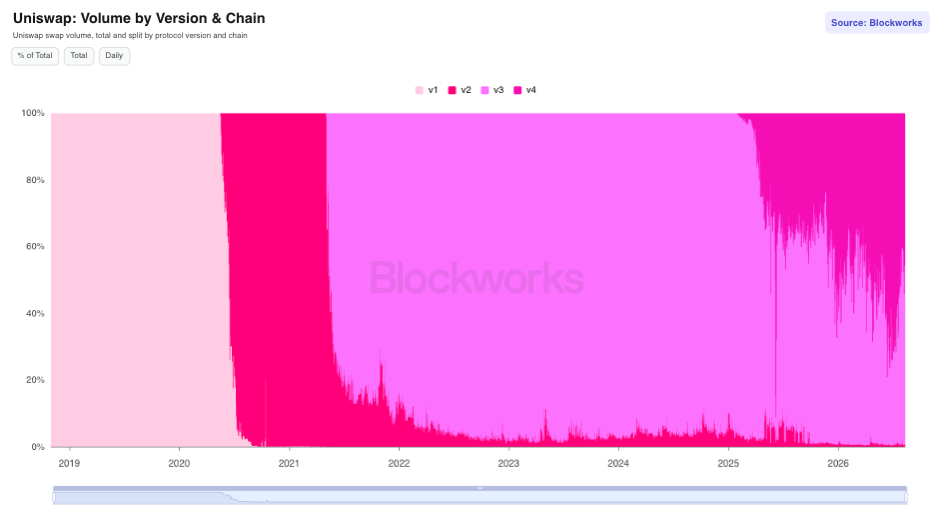
On a single day at the end of July, Uniswap processed $1.79B in volume across 3.5M swaps from 147,000 unique daily swappers. The dashboard breaks volume down by version, which is where the version shift shows up. v3 and v4 now carry almost all of that flow, while v1 and v2 now account for only a negligible share.
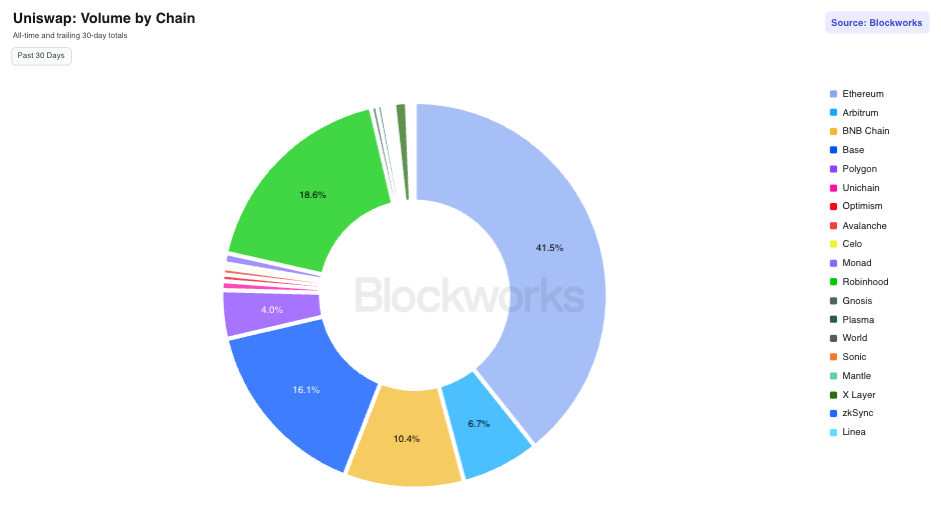
The dashboard also breaks volume down by chain, and the market-share view shows where Uniswap is gaining ground. On Ethereum, its share of DEX volume has climbed from around 40% to 60% since the start of the year. Arbitrum has held steady near 70%, while Base is close clearing 50% of swap volume on the chain. On Polygon, Uniswap sits comfortably above 80% most days. Over the last 30 days, Ethereum cleared roughly $19B, Base roughly $11B, and Robinhood Chain roughly $6.7B. Uniswap's share of Robinhood spot DEX volume is close to 95%.
Financials
Every swap on Uniswap pays a fee set at the pool level. Historically, that fee accrued entirely to liquidity providers. UNIfication changed this in December 2025, activating protocol fees that redirect a portion of LP fees to the protocol, where they are ultimately used to burn UNI.
The exact split varies by Uniswap version. For v2 and v3, the protocol takes a share of the existing LP fee. On v2, the protocol receives one-sixth of swap fees, meaning a 0.30% pool directs 0.25% to LPs and 0.05% to the protocol. On v3, the protocol receives one-quarter of fees on the 0.01% and 0.05% tiers and one-sixth on the 0.30% and 1% tiers. Uniswap v4 is more flexible, with an additive protocol fee on the trader side determined through a governance-controlled policy contract and configurable at the pool level.
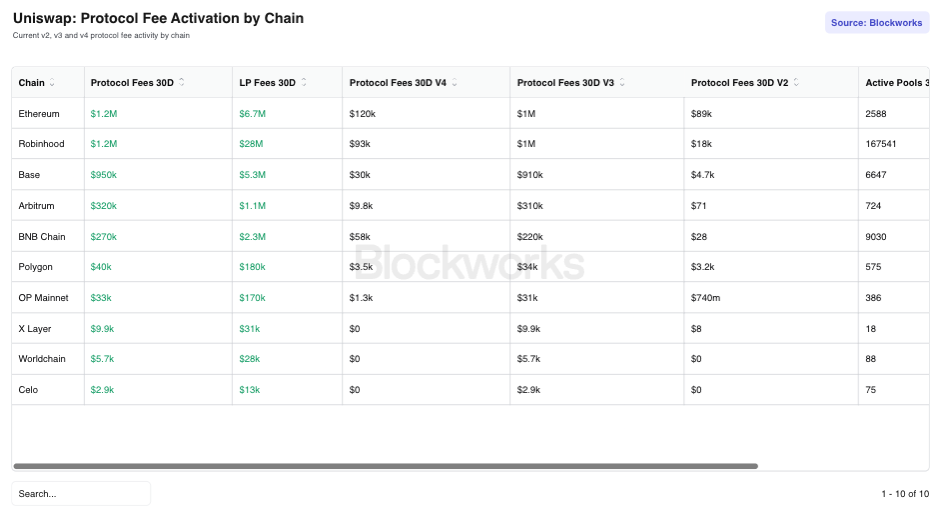
Protocol fee coverage has expanded steadily since activation. Ethereum was first, followed by Arbitrum, Base and OP Mainnet, before expanding to Soneium, X Layer, Worldchain, Zora, BNB Chain, Polygon and Celo. Robinhood Chain followed in July, while v4 fees were activated across roughly 229,000 pools in late July. Ten of the twelve authorized chains are now generating protocol fees.
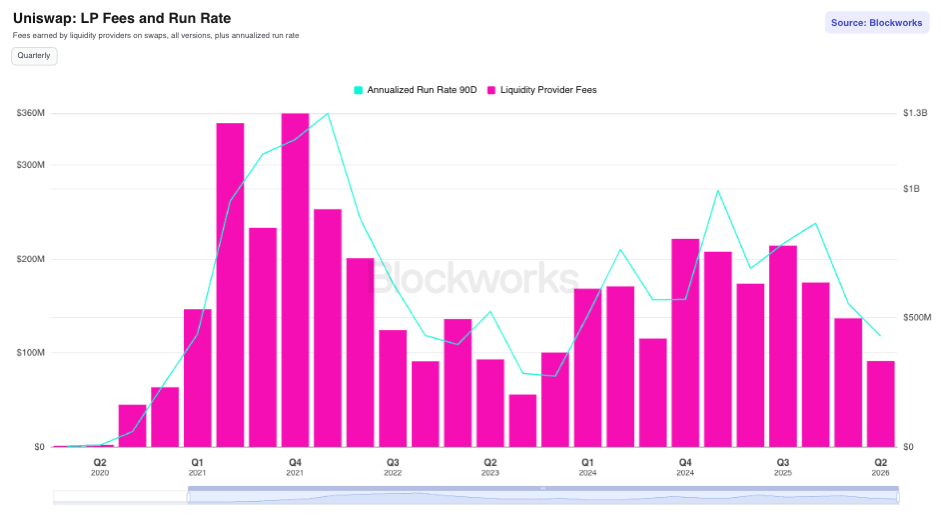
Liquidity providers still capture the vast majority of Uniswap's economics. LPs have earned approximately $4B since 2018 and $44M over the last 30 days, compared with just $4M accruing to the protocol over the same period. This is an important feature of the design: the protocol fee is small enough that LP economics remain largely intact, while still creating a recurring source of UNI burns.
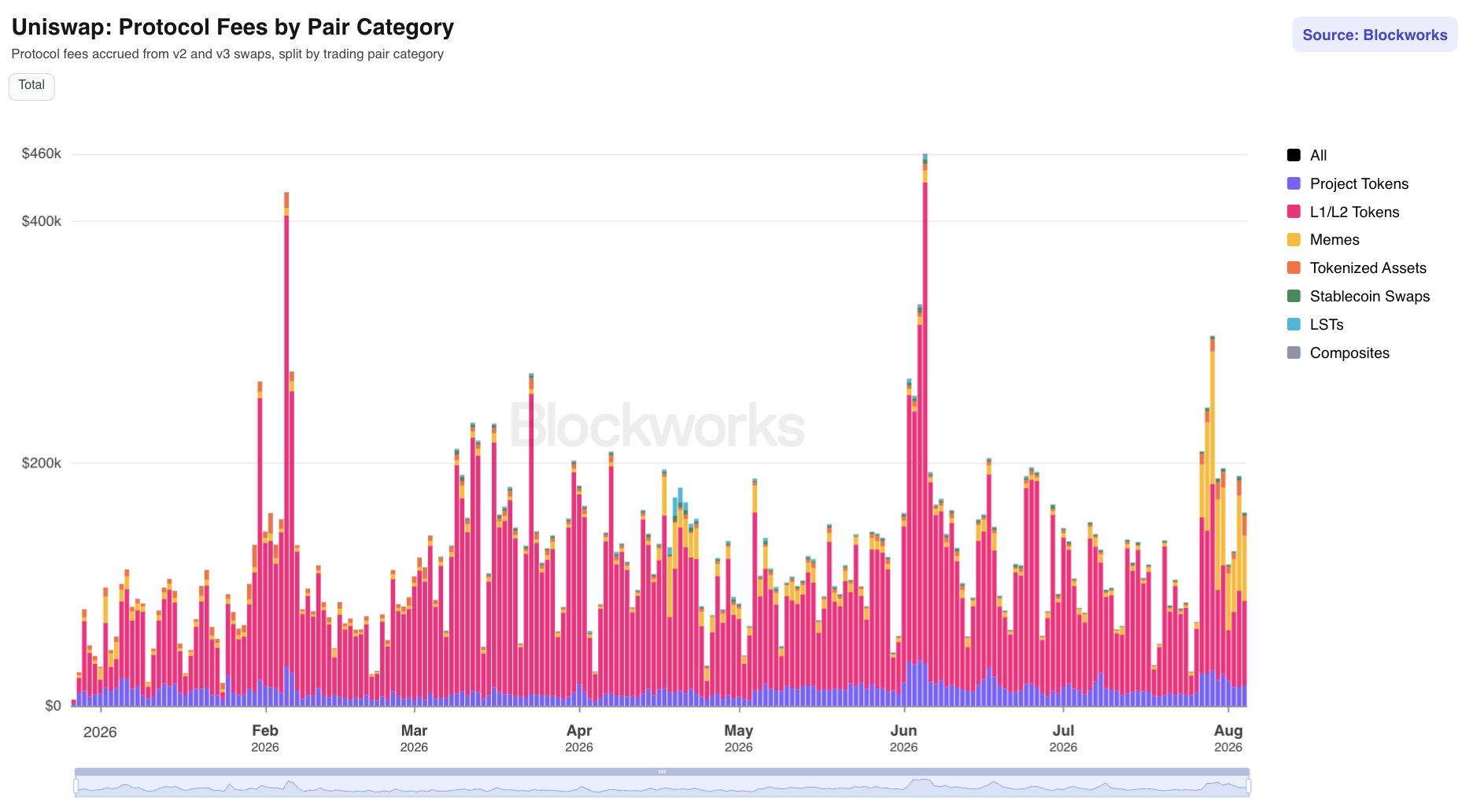
Protocol revenue is also highly concentrated among Uniswap's largest markets. Over the last 30 days, Ethereum ($1.11M), Robinhood Chain ($1.02M) and Base ($911K) generated $3.04M of the $3.64M collected through v2 and v3. v4 contributed an additional ~$300K in its first two weeks. By pair category, L1 and L2 tokens generated $2.25M, while memecoins contributed another $1.01M.
How the Burn Works
One important distinction is that Uniswap does not directly use protocol revenue to market-buy UNI. Instead, fees accumulate in the assets being traded and are held in TokenJar, an immutable vault deployed on each chain. These assets remain there until the vault becomes economically attractive for a third party, typically a searcher, to claim.
To claim the accumulated assets, the searcher must transfer a predetermined amount of UNI to the burn address in the same transaction: 4,000 UNI on Ethereum and 2,000 UNI on L2s. The searcher receives the assets accumulated in the vault, while the UNI is permanently removed from circulation.
This means burns occur in discrete steps rather than moving directly with protocol revenue. A vault is generally claimed once the value of accumulated fees exceeds the cost of acquiring the required UNI and paying gas fees. Higher protocol fees therefore lead to more frequent burns, while a lower UNI price also reduces the threshold required to make a claim economical.
So far, approximately 108.4M UNI, worth around $435M, has been burned. However, 100M UNI came from the one-time treasury burn approved alongside UNIfication. Excluding this, recurring protocol-fee-funded burns have removed approximately 8.67M UNI. Based on the last 30 days, that is currently annualizing at roughly 16.4M UNI, or ~$66M at current prices.
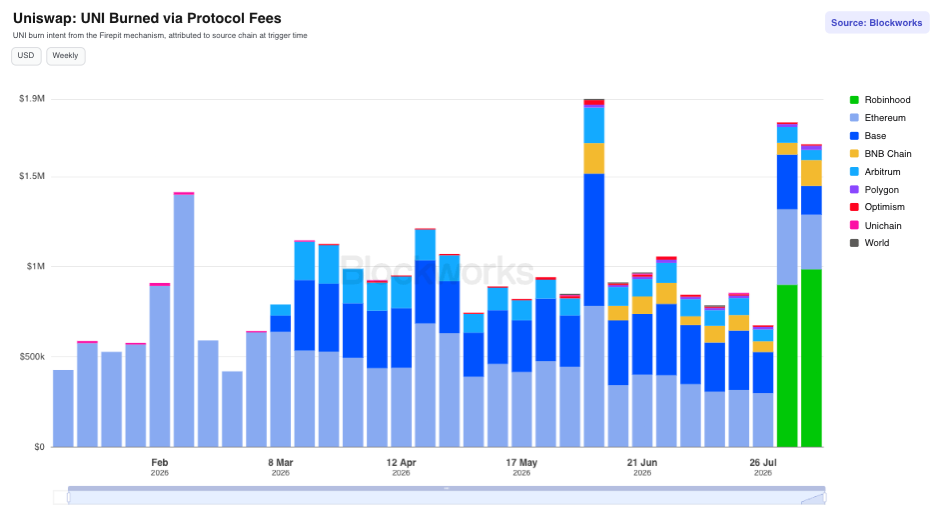
There is also a nuance in timing when interpreting the burn data. Burns initiated on L2s can appear onchain before they are finalized on Ethereum roughly a week later.
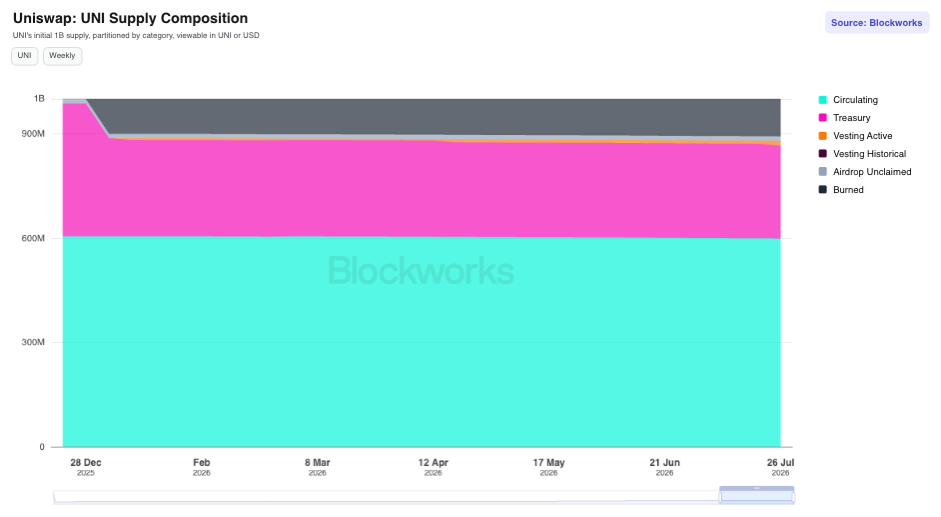
Protocol fees are used to burn UNI, 108.4M UNI has been permanently removed from circulation, about a tenth of the original 1B supply, worth around $430M at current prices. While the total includes the one-time 100M UNI governance burn, recurring fee-driven burns account for roughly 8M UNI and are now running at an annualized pace of 16M UNI.
On chains other than Ethereum, the burn is triggered locally but settles on mainnet only about a week later, so the dashboard tracks both the intended burn and the settled burn.
Liquidity
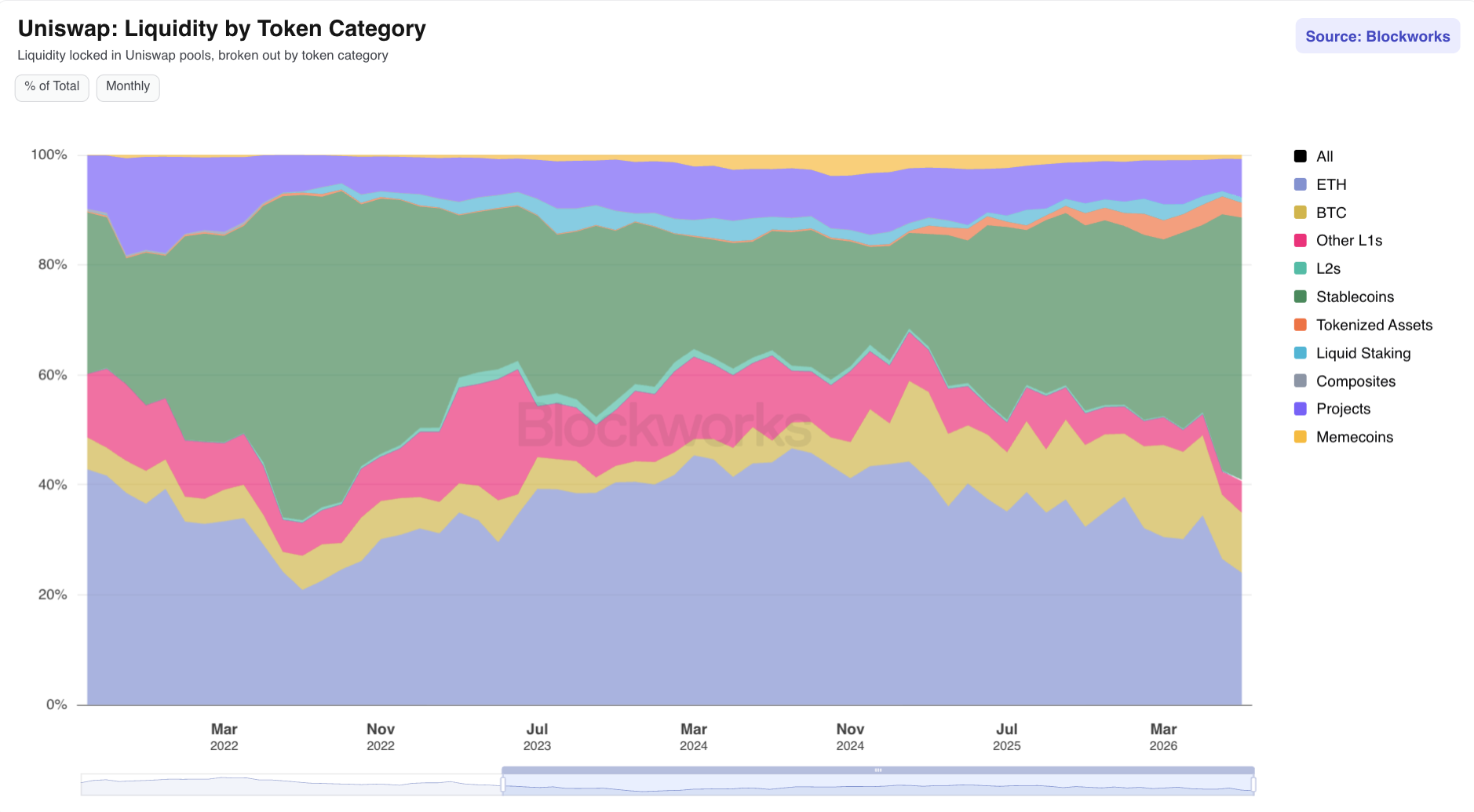
Liquidity depth is what makes a market usable, and Uniswap holds $2.2B in TVL, split across v4 (33.5%), v3 (48.7%), and v2 (17.7%). Ethereum has consistently accounted for roughly three-quarters of that liquidity. Stablecoins dominate the asset mix at ~41%, followed by ETH at ~28% and Bitcoin at ~11%. More than 5,000 pools carry at least $10K in liquidity.
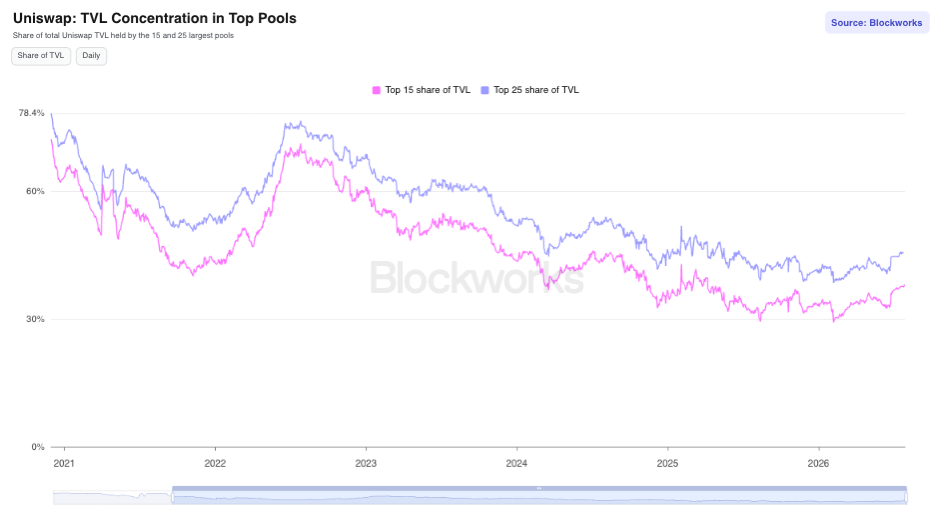
Liquidity has become far less concentrated, with the largest pools' share of TVL falling from roughly 75% in mid-2022 to 46% today. Second, liquidity provider profiles have shifted. A large share of positions is no longer held directly in wallets but managed by contracts, with roughly 627,000 owners today against about 1.0M wallet-custodied. Much of that contract-managed base appeared in a sharp step during 2025.
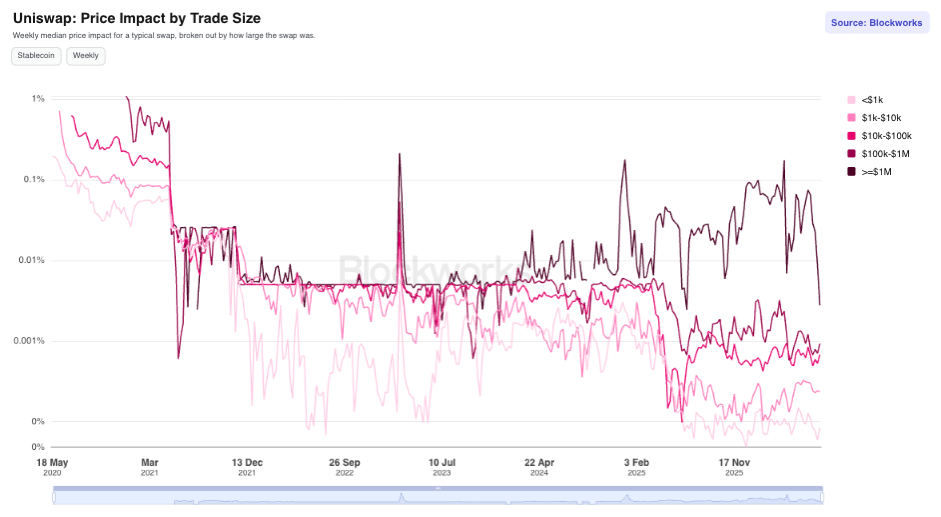
Depth is also reflected in price impact, which measures how much a trade moves the execution price against the trader. For stablecoin pairs, price impact is close to zero, with trades up to roughly $1M barely nudging the price. For memecoins, it is far higher, reaching around 4% in some cases, with even sub-$1,000 trades costing around 0.6%. L1 and L2 tokens dominate trading, accounting for nearly 70% of volume, while tokenized real-world assets have yet to gain meaningful traction.
Integrations & Ecosystem
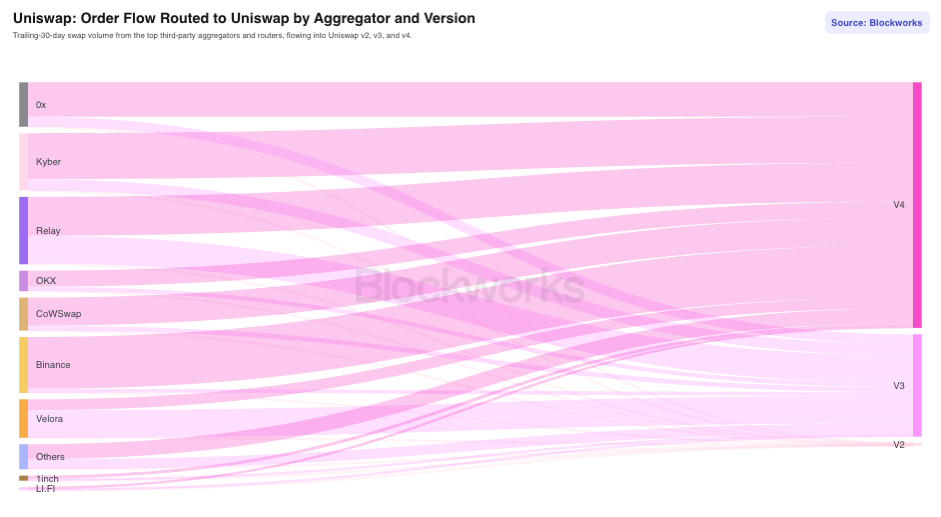
Uniswap is used far more widely than its own app. 36 third-party routers and aggregators tapped Uniswap's liquidity to process roughly $8.65B in swaps over the past 30 days. The field is diverse: Binance Wallet DEX leads at $2.692B, followed by Relay ($1.583B), KyberSwap ($1.132B), 0x ($914.70M), and CoW Protocol ($769.09M), alongside intent solvers and smart wallets. A clear majority of that routed flow, about $6.800B (78.6%), lands in v4.
The split between Uniswap's own routers and third-party integrations swings week to week, but third-party flow has held the larger share for most of the year. It currently sits near 60%, versus 40% for Uniswap Router. That pattern points to a protocol increasingly used as infrastructure by other products, not just a front end for retail swaps.
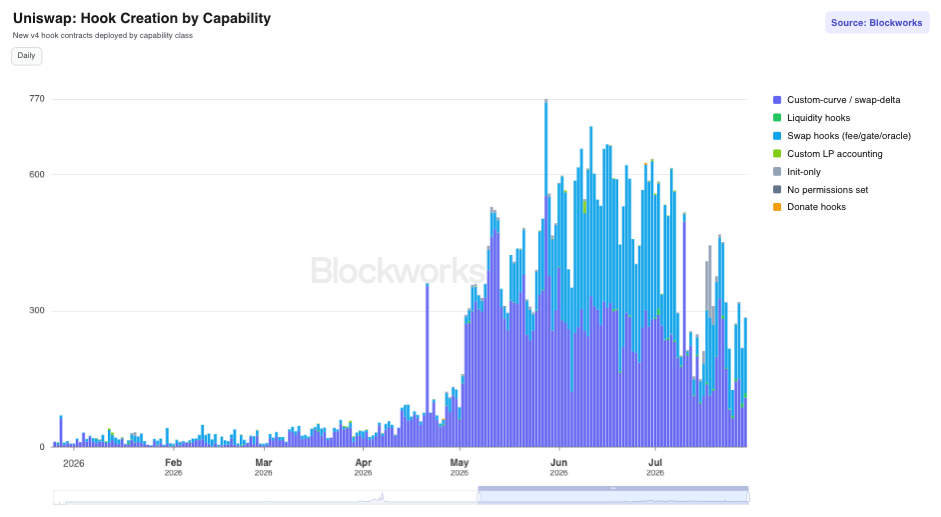
The next layer of innovation is hooks, which let developers add custom logic before, during, or after a Uniswap v4 swap. Around 66,000 have been deployed, and hook types span launchpads, aggregators, yield wrappers, lending, and derivatives. Aggregation and lauchpad hooks show the most consistent activity; one caveat is that attribution remains incomplete, as around 60% of hooked volume remains unclassified.
Continuous Clearing Auctions, a launch mechanism designed for sustained price discovery, has served hundreds of tokens since it was first introduced in 2025. With more than $68M raised, most notable auctions include AZTEC with $58.94M raised from 21,218 bids and 16,741 bidders, CAP ($3.84M) and Octra ($2.72M).
Security
Security is worth examining separately, particularly in a sector where smart contract exploits remain a persistent risk.
Uniswap's smart contracts have operated without a serious incident since 2018.
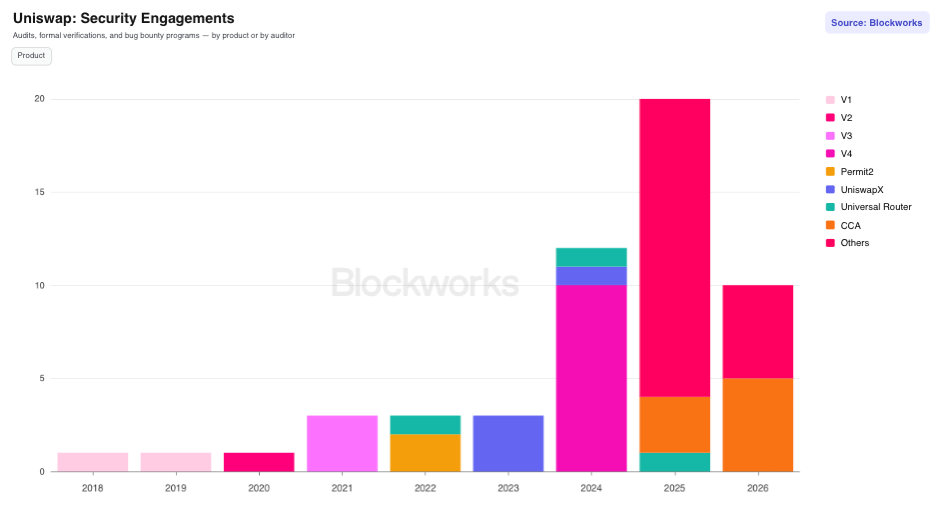
Uniswap products carry 51 audits and formal verifications, 10 of them covering v4, drawn from the protocol's public repositories, plus an ongoing bug bounty worth up to $15.5M. The registry lists each engagement by product, version, method, and report link.
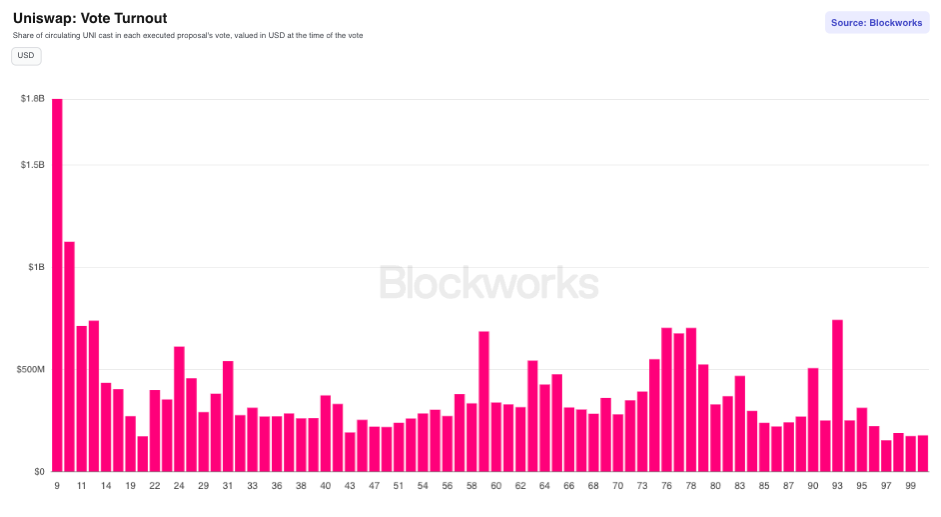
Governance carries its own economic security. Roughly 211M UNI, worth several hundred million dollars, is delegated to active voters, and executed proposals have drawn large turnout. The more value is tied to governance, the more expensive any attempt to capture it becomes.
The information contained in this report and by Blockworks Inc. and related affiliates is for general informational purposes only and is not intended to provide legal, financial, or investment advice. The report should not be construed as an offer or solicitation to buy or sell any security, token, or financial instrument and does not represent any recommendation or endorsement of any investment or financial product or service. Blockworks Inc. and related affiliates are not registered as a securities broker-dealer or an investment advisor in any jurisdiction or country.
Back to Blog
Markets, protocols, and policy, read by 200K+ professionals.