Blog / Dashboard Primers
Olympus: Data Dashboard Primer
Track Olympus' $172M in total backing, $133M in Cooler loans, and $65K in weekly revenue in Blockworks' new dashboard covering OHM's backing, lending, and issuance.
By Jack Mandin ·
Introduction
Olympus is a DeFi protocol built around OHM, a free-floating token with backing derived from the protocol’s treasury reserves, protocol-owned liquidity, and Cooler loan receivables. Unlike a stablecoin, OHM does not target a fixed exchange rate, and its market price can trade independently of the value of assets and receivables attributed to each backed OHM.
At a high level, Olympus consists of a treasury that holds reserve assets and funds protocol activities, the Cooler lending facility that lends treasury assets against gOHM collateral, and issuance and repurchase mechanisms that manage changes in OHM supply. The Olympus dashboard tracks the relationship between OHM and its backing alongside the protocol’s treasury, revenue, lending activity, supply mechanics, and risk exposures.
Dashboard Overview
Our Olympus dashboard is organized into seven tabs covering OHM’s price and supply, protocol financials, Cooler lending, issuance mechanics, backing risk, and security review coverage.
- Overview: Backing per OHM against market price, and the components that make up backing.
- OHM Token: Price, market cap, premium to backing, supply, and holder metrics for OHM and gOHM.
- Financials: Treasury revenue by source, OHM repurchases, yield by asset, and onchain financial statements.
- Cooler Loans: Collateral, debt, rates, and book health for Olympus’s gOHM-collateralized lending facility.
- Supply & Issuance: OHM issuance and burns, Convertible Deposit activity, and the conditions that gate new issuance.
- Risk & Solvency: Backing by component and counterparty, chain concentration, and Cooler default stress testing.
- Security & Audits: Published security reviews by protocol component, reviewer, and date, with a summary of coverage across components.
OHM Token
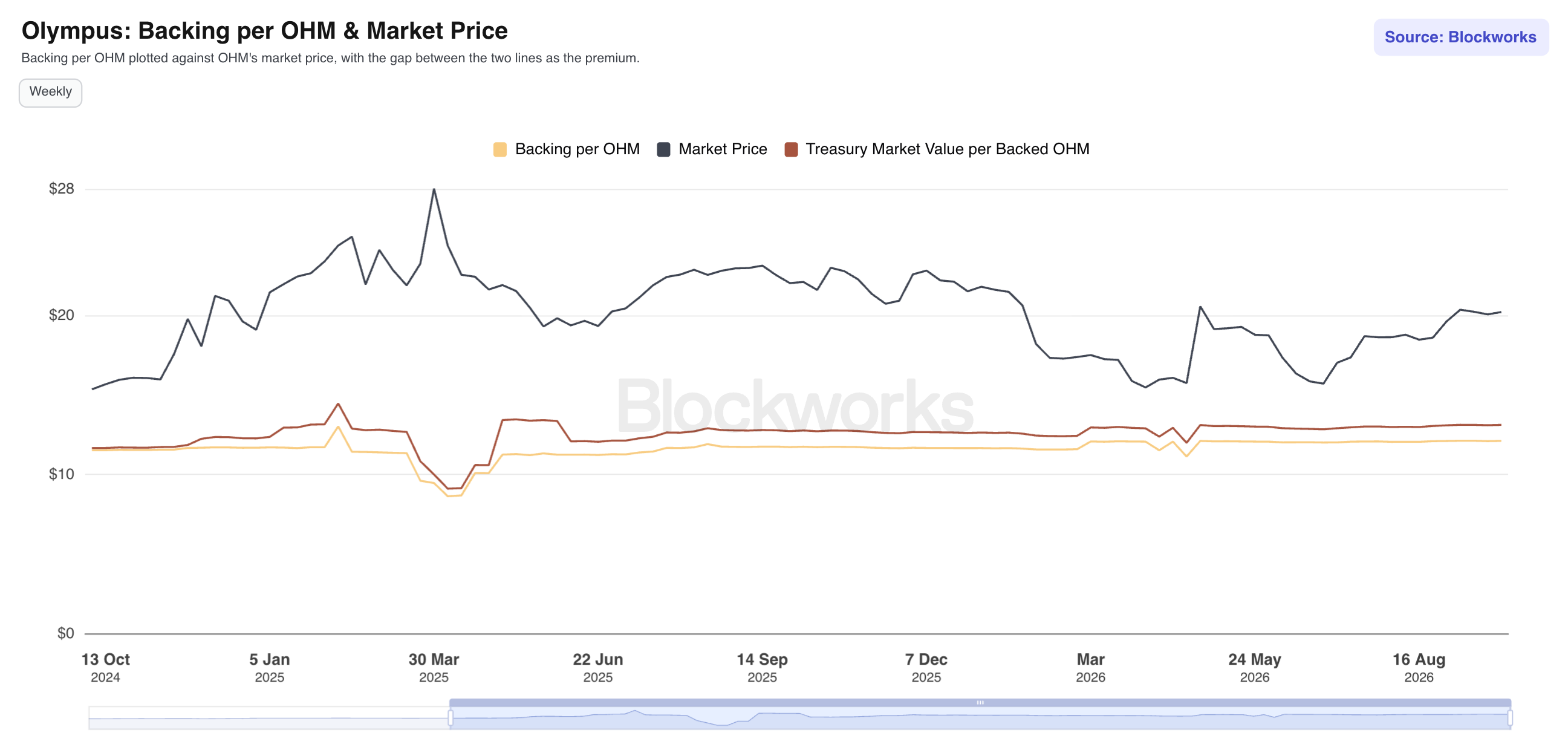
Backing per OHM & Market Price: Backing per OHM compares the value of assets and receivables attributed to backed supply with the number of backed OHM outstanding. It currently sits at approximately $12.09, while OHM trades just above $20, roughly 67% higher. The chart also shows treasury market value per backed OHM, currently about $13.13, which includes additional treasury holdings beyond those captured by the backing measure. The backing measure itself consists primarily of stablecoin reserves, the non-OHM share of protocol-owned liquidity, and Cooler loan receivables. Both are accounting measures of attributed value, not immediately available cash or a redemption price.
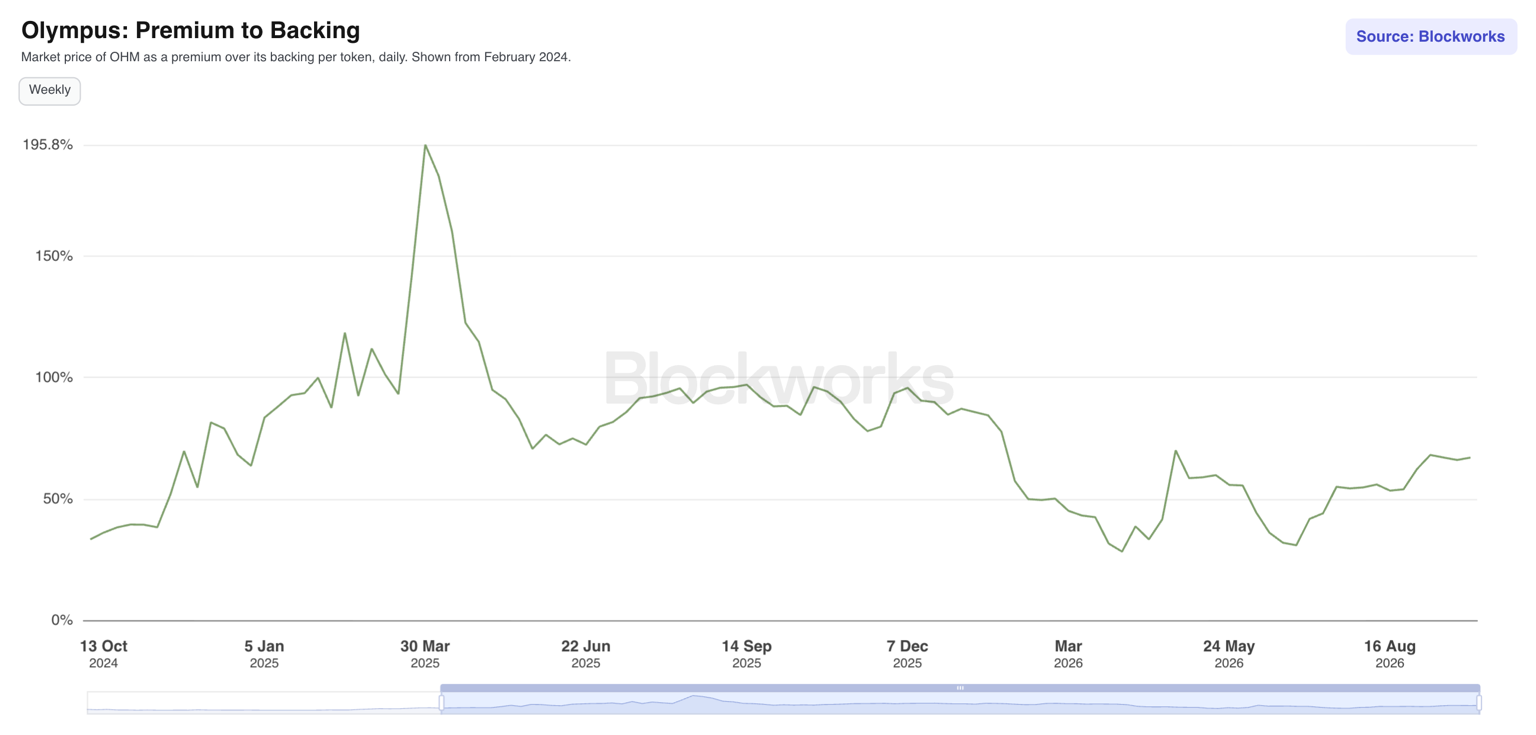
Premium to Backing: Building on the relationship between OHM’s backing and market price, the dashboard shows the historical premium at which OHM has traded relative to its backing. OHM’s premium currently sits at roughly 67%, after peaking at roughly 200% in March 2025.
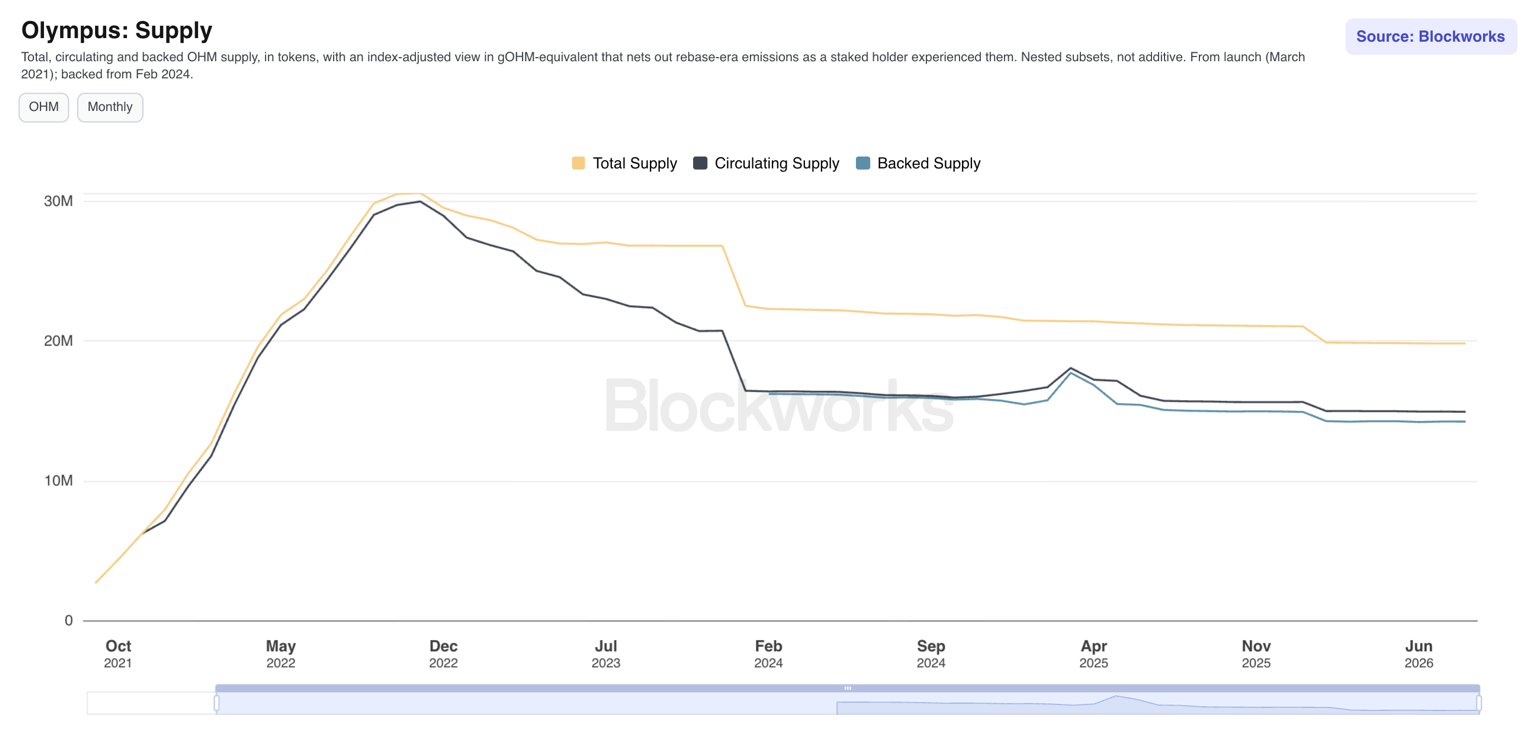
Supply: The dashboard tracks total, circulating, and backed OHM supply as nested measures. Total and circulating supply peaked near 30M in late 2022 and now sit roughly 35% and 50% below those highs. Backed supply, shown from February 2024, has declined from about 16M to 14.2M and serves as the denominator in the backing-per-OHM calculation.
The roughly 4.9M gap between total and circulating supply represents OHM held by the treasury rather than pending issuance, with the Supply Ladder on the Supply & Issuance tab providing a more detailed reconciliation. The chart can also be viewed in staking-index-adjusted, gOHM-equivalent units, which removes the effect of rebase-era staking emissions.
Financials
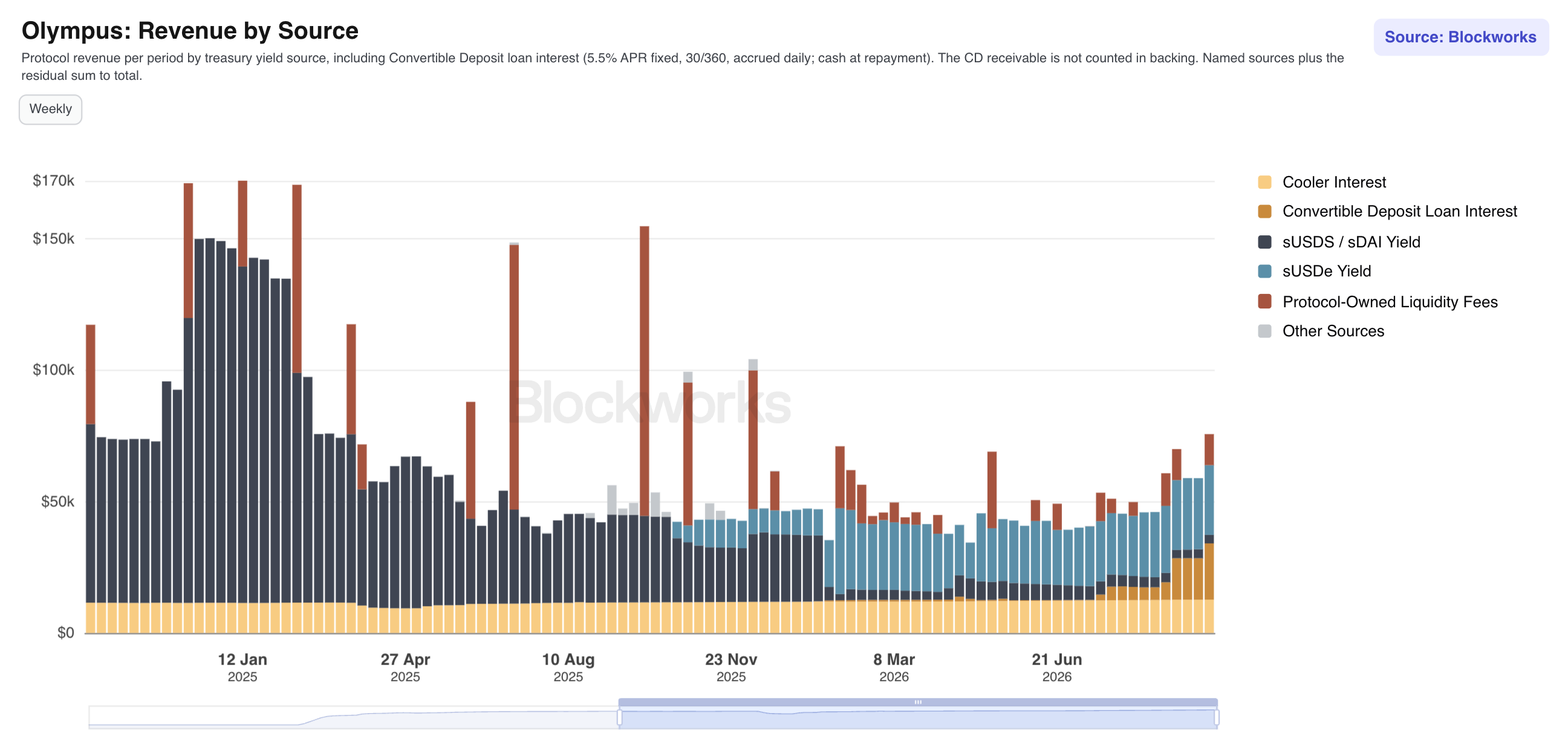
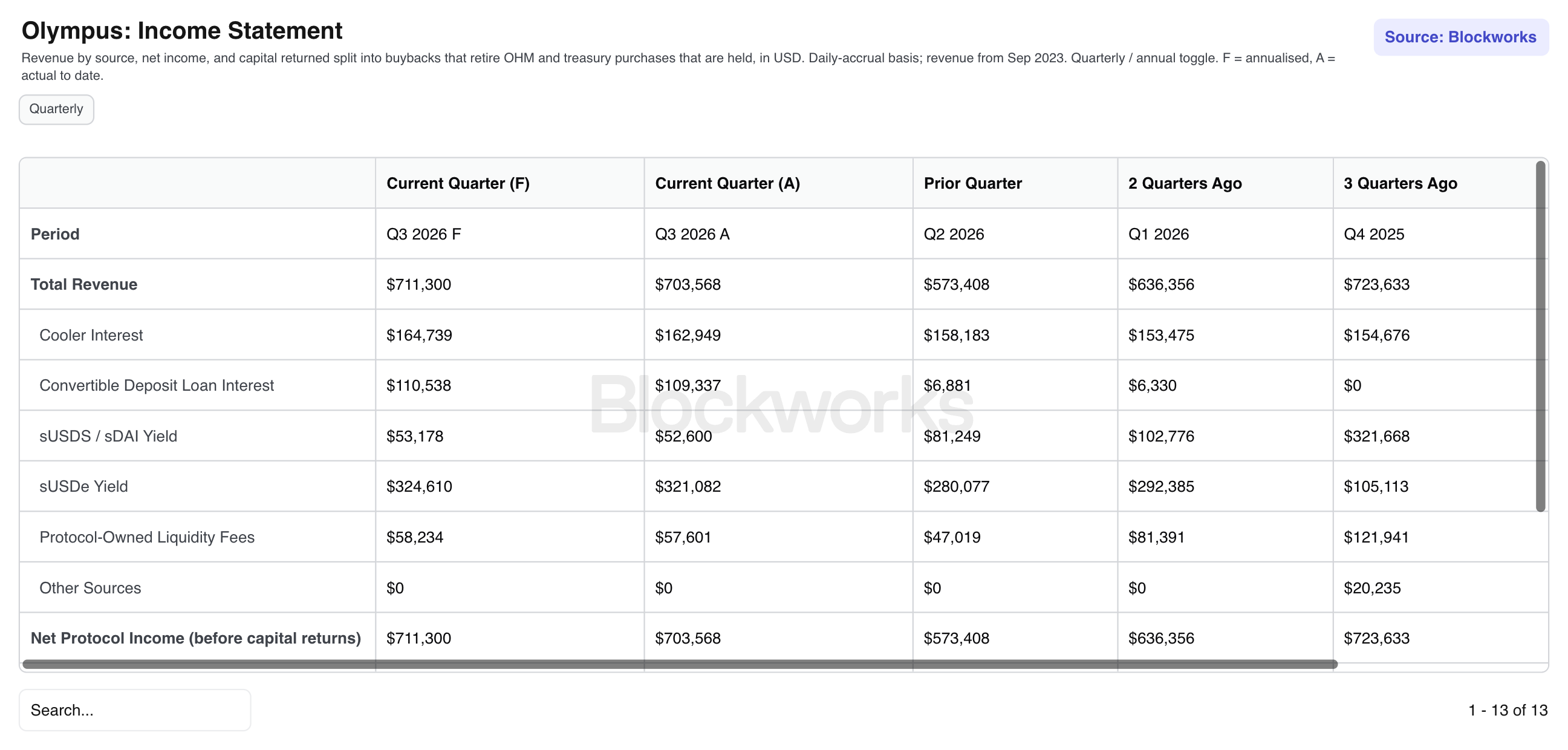
Revenue by Source: Protocol revenue currently runs around $65,000 per week from several key sources: sUSDe and sUSDS/sDAI reserve yield, Cooler interest, interest on loans against Convertible Deposit redemptions, and protocol-owned liquidity fees. sUSDS generated most revenue from late 2024 through much of 2025 before sUSDe became the largest source as treasury composition changed. CD loan interest has become a material contributor since the CD loan book expanded in August 2026, rising from near zero to roughly $22,000 per week. The dashboard accrues this interest daily at a fixed 5.5% annual rate, while cash is received when the loans are repaid.
Income Statement: The Income Statement reorganizes onchain financial data into quarterly and annual periods. Operating expenses are not attributed, so net protocol income equals revenue before Capital Returned, which the dashboard reports separately as Yield Repurchase Facility purchases that are burned and treasury purchases where the acquired OHM is held. These purchases can draw on treasury reserves as well as current-period revenue. For YRF purchases, gross spending should not be read as an equivalent reduction in backing per OHM: treasury assets are spent to acquire OHM, while burning the acquired OHM reduces backed supply.
Cooler Loans
Cooler is Olympus’s protocol-native lending facility, where borrowers pledge gOHM and borrow stablecoins funded by the treasury. Cooler V2 charges a governance-set fixed rate, while borrowing capacity is determined by a governance-defined USDS-per-gOHM parameter informed by OHM backing rather than gOHM’s market price. Positions are therefore not liquidated in response to market-price movements, though loans remain subject to default under the facility’s own terms.
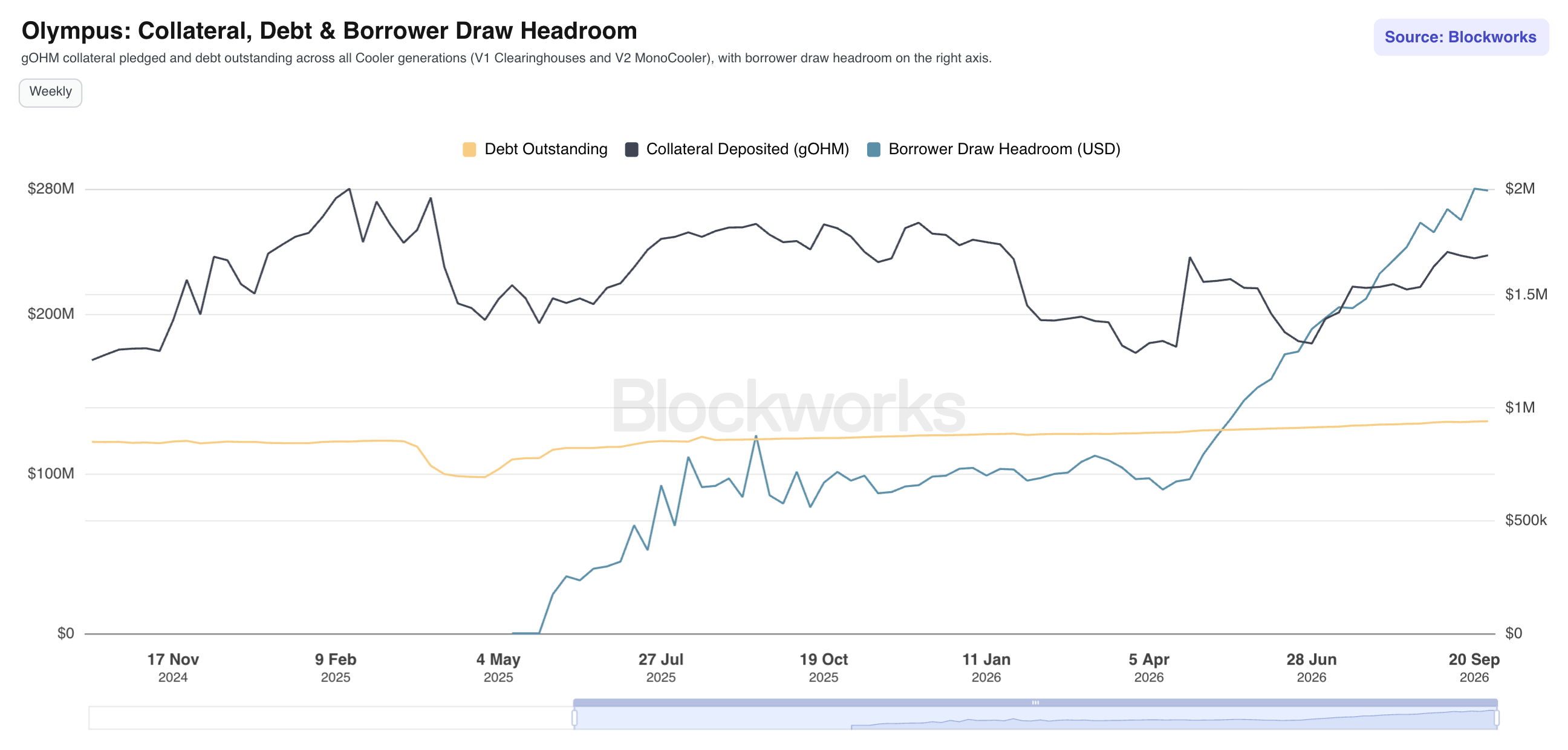
Collateral, Debt, and Headroom: Cooler debt currently stands near $133M against approximately $236M of gOHM collateral, having recovered from a dip below $100M in early 2025. Borrower draw headroom — the additional amount existing borrowers can draw under the current origination parameter — remained below $1M for much of the period following MonoCooler’s May 2025 launch before rising to roughly $2M. The recent increase reflects a scheduled adjustment to the origination parameter approved under OIP-194, which reaches its target on October 27, 2026 and will not continue without a further governance update. Headroom measures unused borrowing capacity against posted collateral, not treasury reserves available to fund additional loans.
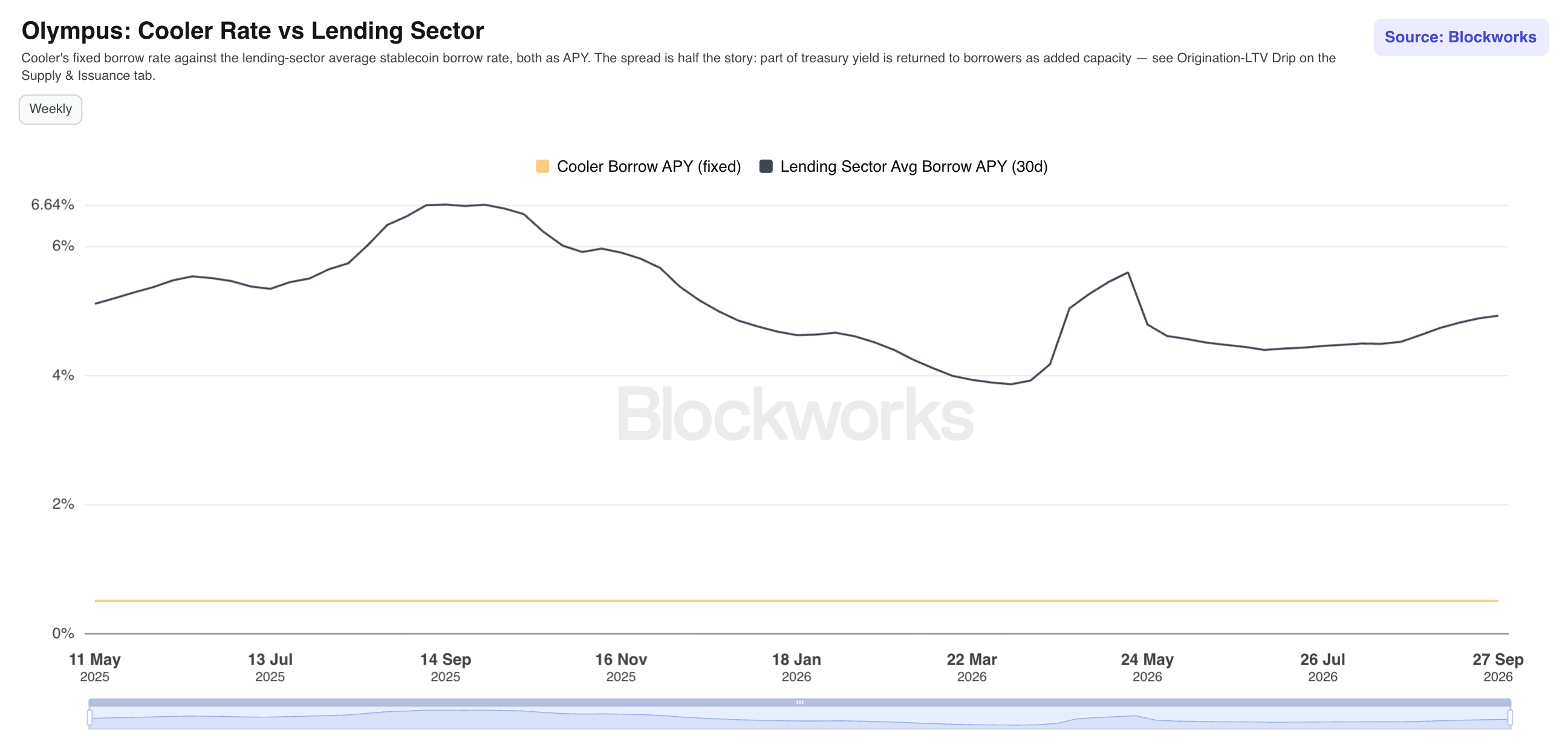
Cooler Rate vs. Lending Sector: Cooler’s borrow rate is fixed by governance at 0.50% APY. Over the same period, the dashboard’s average stablecoin borrowing rate across the broader lending sector has ranged from roughly 3.8% to 6.7% and currently sits near 4.9%, placing Cooler roughly 4.4 percentage points below the current sector average. The comparison contextualizes the rate available to Cooler borrowers, but the underlying lending products differ in collateral, risk structure, and rate-setting mechanisms.
Supply & Issuance
OHM’s supply mechanics are partly governed by its market price relative to protocol-defined backing parameters. A sufficient premium allows new Convertible Deposit auctions to be opened, creating a pathway for new OHM issuance, while protocol yield can be used to repurchase and burn OHM through the Yield Repurchase Facility.
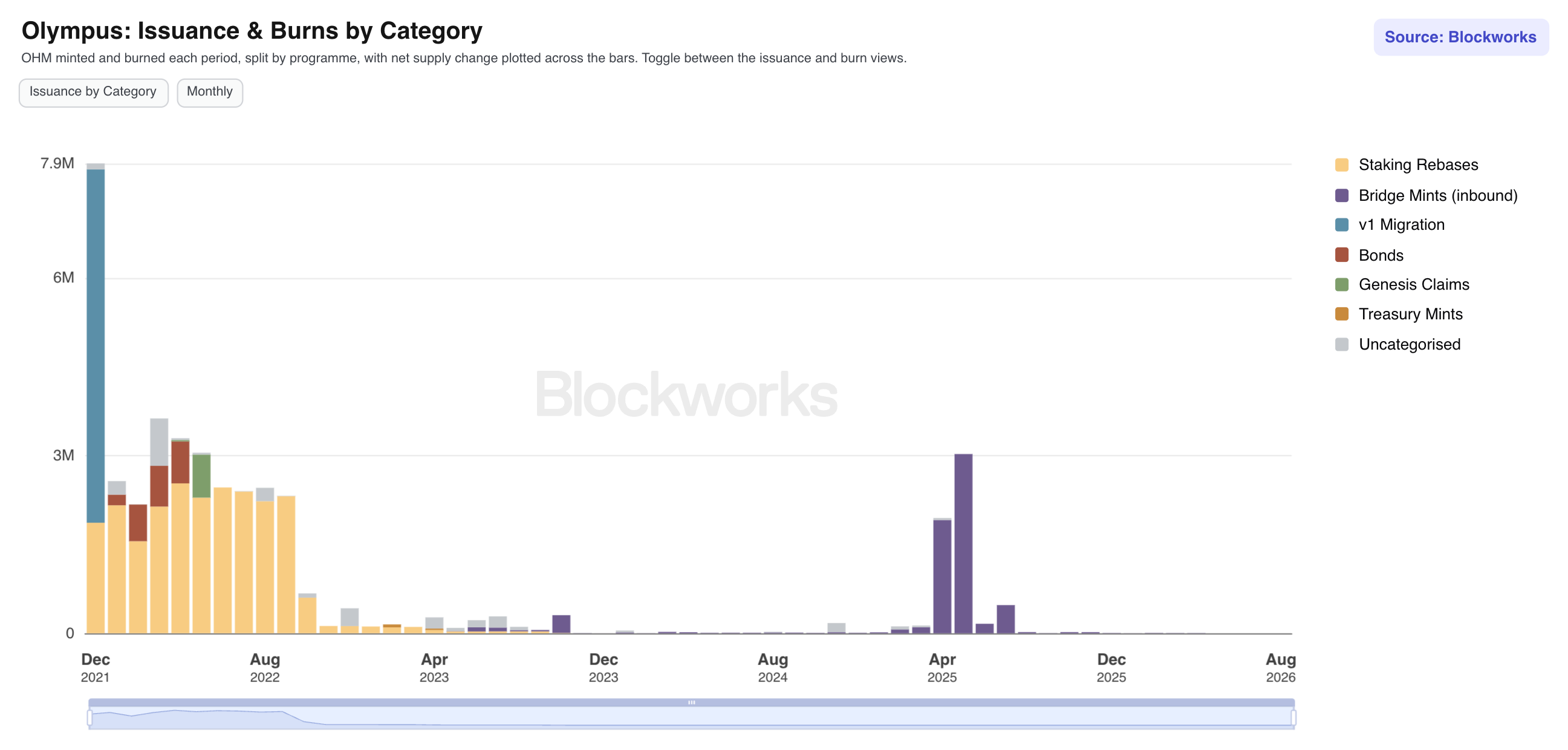
Issuance and Burns by Category: Most historical OHM issuance occurred in 2021–2022 through staking rebases, bonds, and migration, with issuance declining substantially after rebases wound down. More recent minting has been substantially smaller and includes cross-chain bridge activity, where mints on the destination chain are matched by burns on the source chain and therefore do not increase aggregate OHM supply. Separating issuance and burns by mechanism helps distinguish changes in total supply from transfers across chains.
Convertible Deposits: Convertible Deposit auctions are the primary pathway for new OHM issuance today. Depositors place USDS and receive the right to convert it into OHM at a strike price set by the auction. OHM is minted only if and when that right is exercised; deposits that are not converted can be redeemed at the end of the term. The dashboard’s Auction Activity view tracks conversion rights sold and gross deposits received, while interest on loans made against CD redemptions is reported as revenue in the Financials tab.
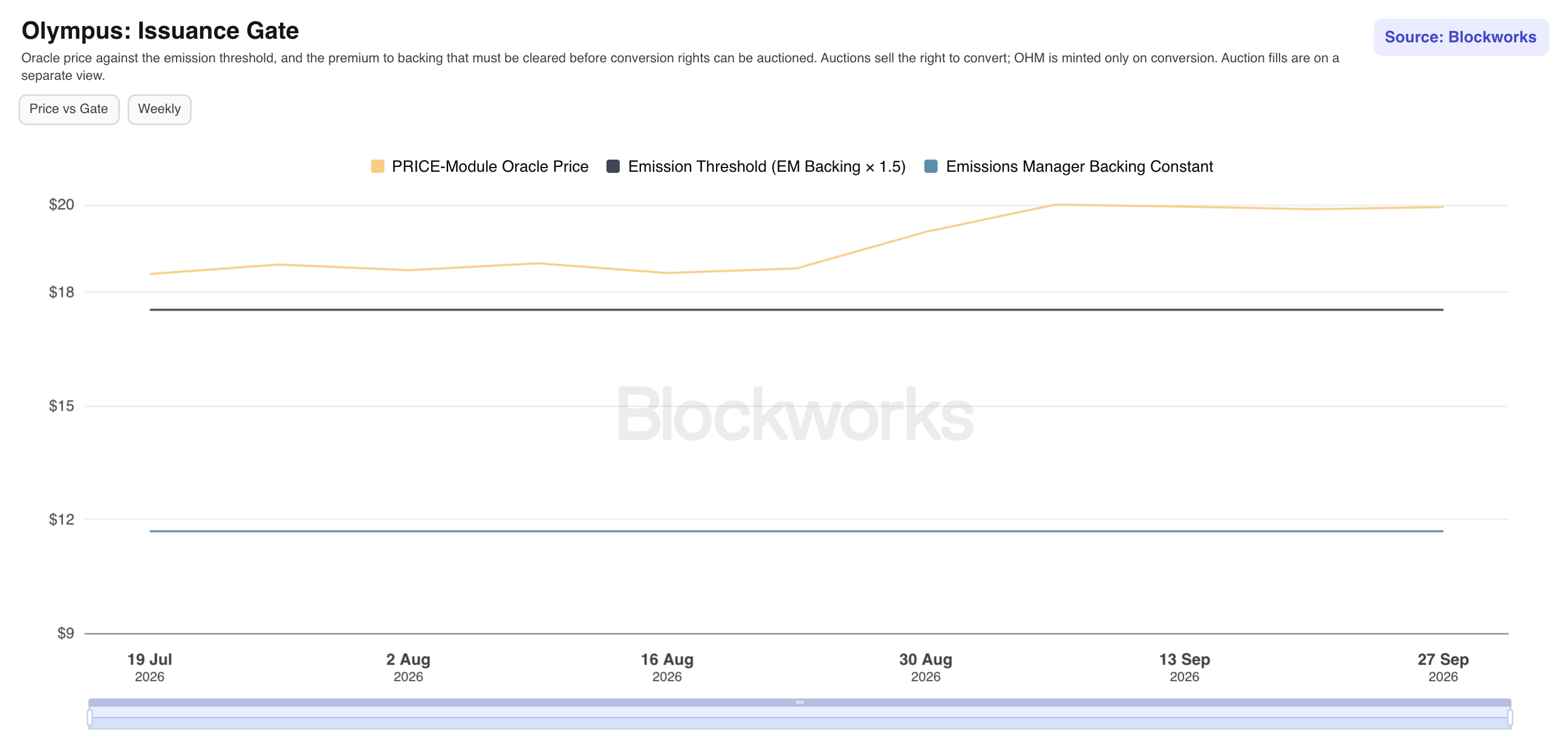
Issuance Gate: The Emissions Manager uses a governance-set backing parameter and minimum premium to determine when new Convertible Deposit auctions may be opened. The current threshold is approximately 1.5x its backing parameter, or roughly $17.55 against a parameter near $11.70, and the oracle price has remained above that level throughout the period shown. This contract parameter is distinct from the dashboard’s calculated backing per OHM, and the gate is separate from the strike price set within each auction. An open gate means new auctions are permitted, not that OHM has been minted. Conversion rights already sold can also remain exercisable after the gate closes.
Risk & Solvency
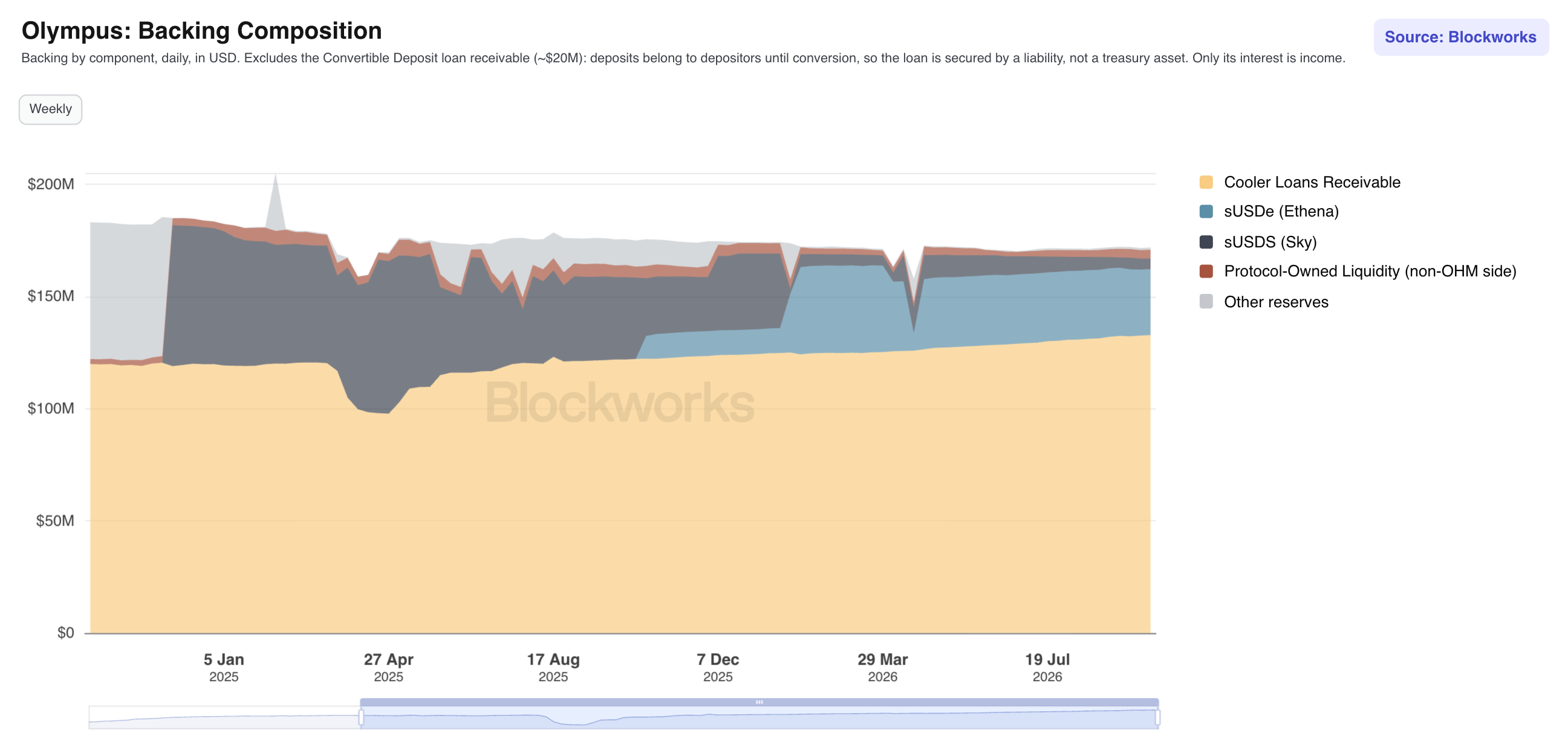
Backing Composition: Total backing currently sits near $172M, of which approximately $133M, or roughly three-quarters, is represented by Cooler loan receivables. The remainder consists primarily of stablecoin reserves and the non-OHM share of protocol-owned liquidity. This distinction matters when interpreting the headline figure: Cooler loans are receivables owed to the protocol rather than immediately deployable treasury reserves. Unlike an unsecured loan book, however, the loans are backed by gOHM collateral, with the underlying OHM available to be retired against the associated debt.
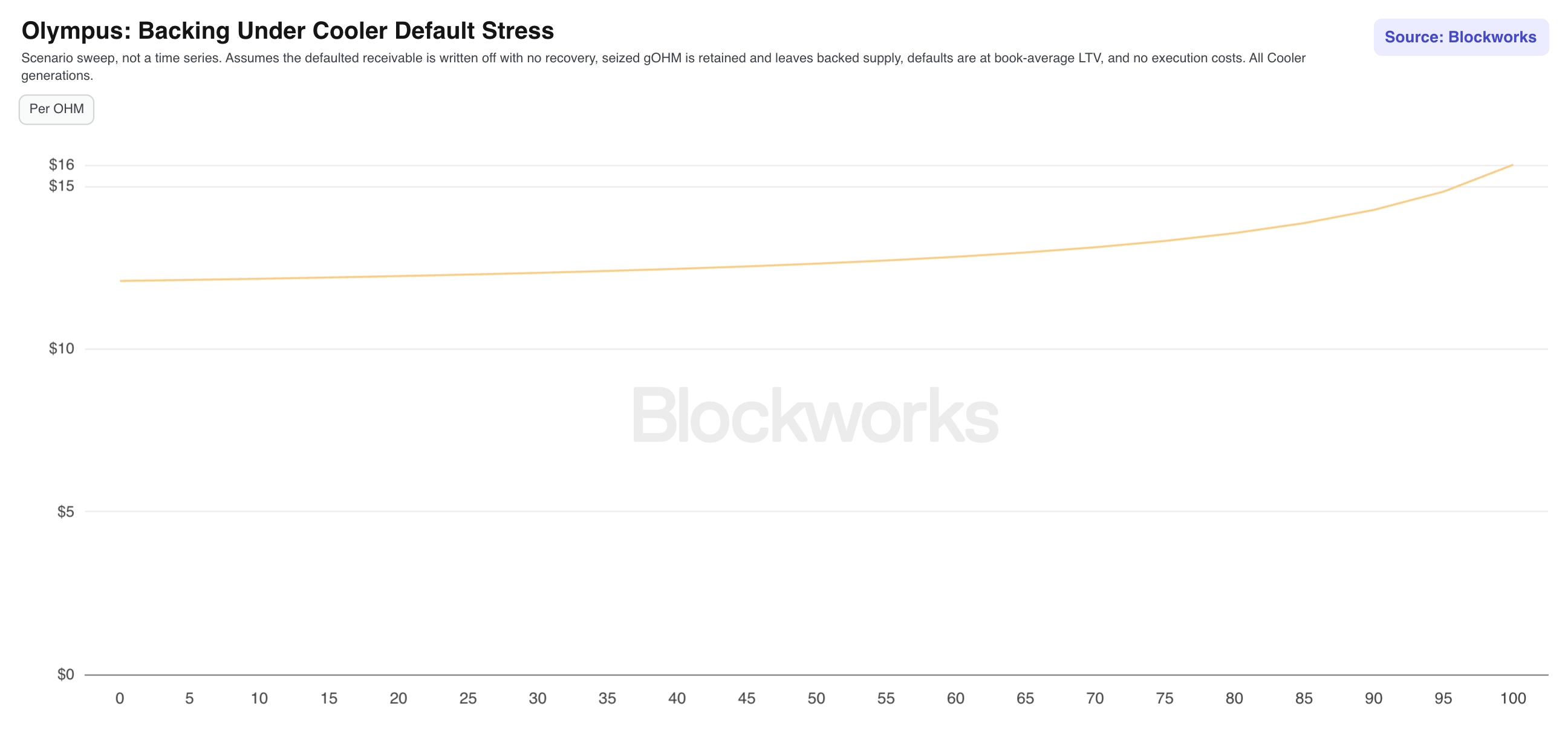
Backing Under Cooler Default Stress: The stress test models how backing per OHM would change under hypothetical Cooler default rates from 0% to 100%. Under current parameters, it rises from roughly $12.09 with no defaults to about $12.60 at 50% and $15.70 at 100%.
The result is counterintuitive but mechanical. Because Cooler loans are originated below the backing value of their gOHM collateral, the collateral associated with defaulted loans is retired alongside the underlying backed OHM, so backed supply falls faster than backing value. Backing per remaining OHM therefore rises even as total backing declines; the higher figure reflects a smaller denominator, not new revenue or an increase in treasury assets. The model assumes no recovery on defaulted receivables and no execution costs and should be read as a scenario rather than a prediction.
Security & Audits
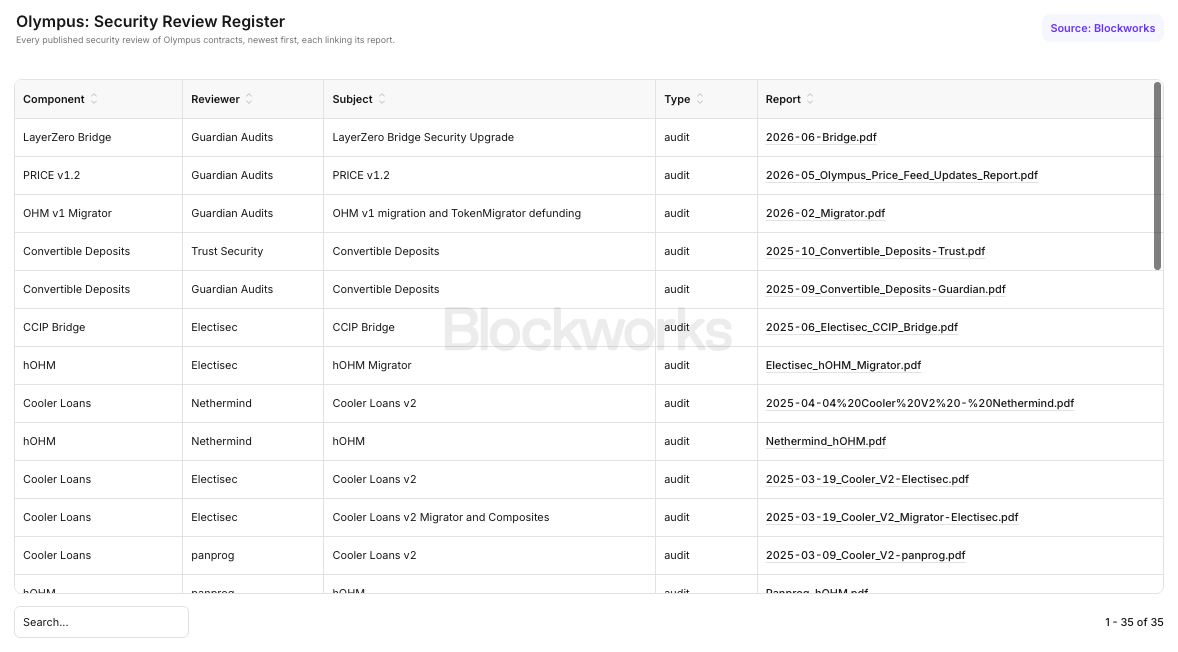
Security Review Coverage: The dashboard catalogs 35 published security reviews from April 2021 through June 2026 and aggregates them across 16 protocol components. Cooler Loans has the broadest published coverage in the dataset, with six reviews from five reviewers, while several components have one listed review. Review count, reviewer count, and recency make the protocol’s disclosed security history easier to inspect, but they are descriptive measures of coverage rather than measures of contract safety.
Dashboard figures referenced in this primer are as of September 2026.
The information contained in this report and by Blockworks Inc. and related affiliates is for general informational purposes only and is not intended to provide legal, financial, or investment advice. The report should not be construed as an offer or solicitation to buy or sell any security, token, or financial instrument and does not represent any recommendation or endorsement of any investment or financial product or service. Blockworks Inc. and related affiliates are not registered as a securities broker-dealer or an investment advisor in any jurisdiction or country.
Back to Blog
Markets, protocols, and policy, read by 200K+ professionals.