Bitcoin’s journey to the mainstream started 15 years ago
Bitcoin’s runaway success was partly driven by Slashdot

Anatolii Stoiko/Shutterstock modified by Blockworks
This is a segment from the Supply Shock newsletter. To read full editions, subscribe.
Fifteen years ago exactly, Satoshi released Bitcoin v0.3. Well, it was really yesterday, but it was in the evening, so it counts.
The version was Satoshi’s sixth going by this archive of the official bitcoin mailing list. It was bundled with a Mac OS X version built by Laszlo Hanycez and extra features including control of the nodes via the command line and a “hashmeter” performance display for mining, which was still being done with CPUs across the board.
The update notably came with 20% faster hashing. But whatever competitive edge was quickly dulled by the arrival of the first GPU miners on the network less than two weeks later.
GPUs were capable of much more than 20% — but that’s for another time.
In any case, you could tell Satoshi was excited. Their announcement post had two exclamation points, and there was even an extra one in the title: “Bitcoin 0.3 released!” It also featured arguably the most appealing tagline in Bitcoin history:
“Escape the arbitrary inflation risk of centrally managed currencies!”
Still, there wasn’t much initial fanfare. The Bitcointalk thread only received four replies, the same amount seen on the Bitcoin.org forum (that version of the thread gathered about 500 views in total).
We can infer from the post below that Satoshi intended v0.3 to be Bitcoin’s first official version, under v1.0. Early adopter Andrew “teppy” Tepper had crowdsourced feedback on his proposed submission to Slashdot in the days leading up to the version’s release, but Satoshi walked back Bitcoin’s graduation from beta status in a reply:
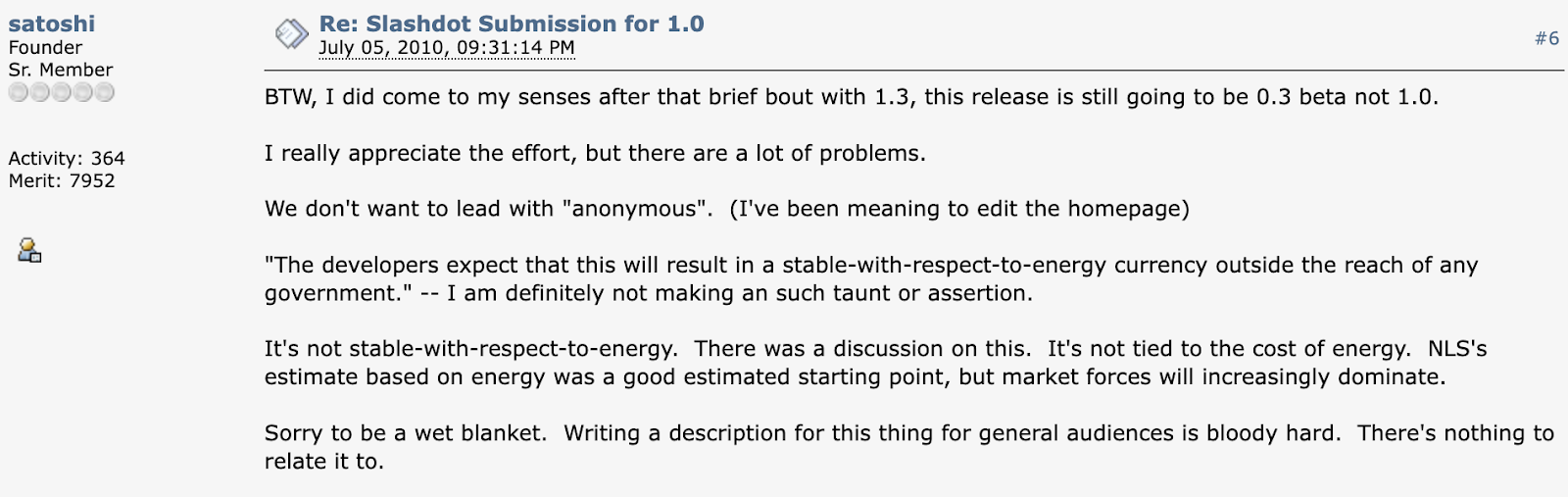 Satoshi wasn’t a big fan of teppy’s first draft
It worked. Slashdot featured teppy’s submission on its front page on July 11, 2010 — widely regarded as the first instance of a major media platform publicizing Bitcoin (it’s even in Slashdot’s Wiki entry). Bitcoins were trading for about $0.05 at the time.
“How’s this for a disruptive technology? Bitcoin is a peer-to-peer, network-based digital currency with no central bank, and no transaction fees. Using a proof-of-work concept, nodes burn CPU cycles searching for bundles of coins, broadcasting their findings to the network.”
“Analysis of energy usage indicates that the market value of Bitcoins is already above the value of the energy needed to generate them, indicating healthy demand. The community is hopeful the currency will remain outside the reach of any government.”
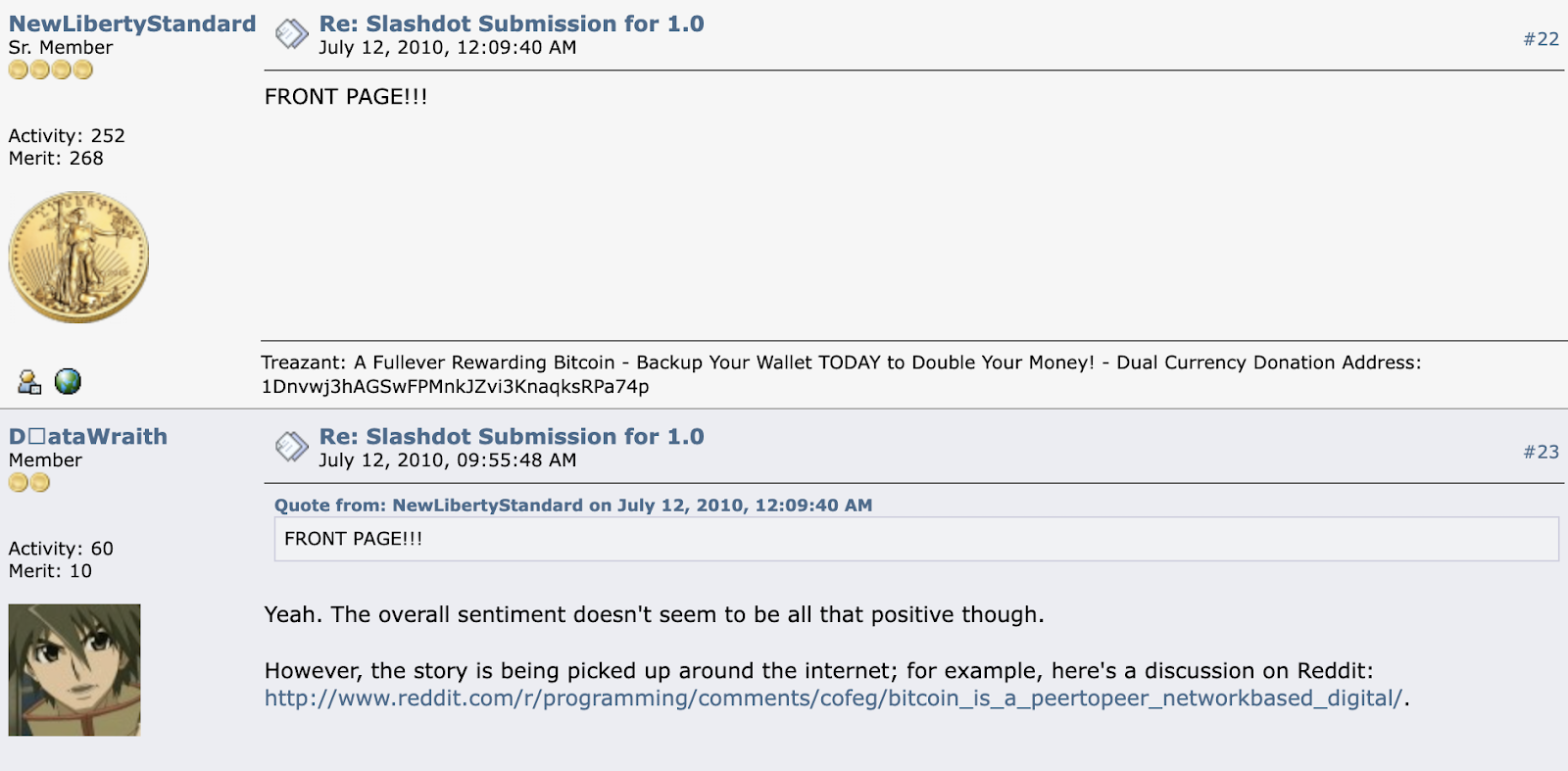 This was Bitcoin’s equivalent of Nirvana releasing Nevermind in 1991, feat. Smells Like Teen Spirit. It would quickly make the band a household name.
Bitcoin’s price began its first major bull run about three months following the Slashdot post, in October 2010, and would reach dollar parity by February 2011.
Slashdot also celebrated that milestone with another front-page feature, which when played back-to-back showed just how important Bitcoin’s first few fans really were.
Get the news in your inbox. Explore Blockworks newsletters:
- The Breakdown: Decoding crypto and the markets. Daily.
- 0xResearch: Alpha in your inbox. Think like an analyst.
