Kazakhstan’s AFSA pilots stablecoin payments for regulatory fees
Astana regulator begins trial accepting USD-backed stablecoins for payments through Bybit integration
Parilov/Shutterstock and Adobe modified by Blockworks
The Astana Financial Services Authority (AFSA), regulator of the Astana International Financial Centre (AIFC), has launched a pilot project allowing firms to pay regulatory fees using US dollar-pegged stablecoins.
Announced on Thursday, during Astana Finance Days, the initiative introduces stablecoin settlement for license and supervision charges, and looks to position Kazakhstan as a regional hub for digital finance innovation.
The program operates under a multilateral memorandum of understanding, with Bybit as the first participant. AFSA noted that other firms can join the pilot if they meet eligibility requirements, and their participation will be disclosed on the regulator’s website.
AFSA specified that only Digital Asset Service Providers licensed to offer money services in relation to digital assets or operate trading facilities can participate in the pilot as Providers. These entities act as agents, executing payments in stablecoins on behalf of firms and then remitting the equivalent amount in fiat currency to AFSA’s designated bank account.
“This initiative represents a first-of-its-kind regulatory framework for payments in stablecoins in the region,” AFSA CEO Evgeniya Bogdanova said.
Bybit COO Mazurka Zeng added that the exchange is “proud to contribute to expanding the payment ecosystem at the beating heart of financial innovation in Kazakhstan, the AIFC.”
Kazakhstan has been gradually expanding its digital asset oversight. In January 2024, AFSA introduced a Stablecoin Framework and later issued the country’s first fiat-backed stablecoin license to AnchorX.KZ Limited. At the national level, the government is also developing a regulatory sandbox and is actively progressing a digital tenge pilot, with the first retail transaction completed in November 2023 and full implementation planned by the end of 2025.
The pilot marks a practical step in shifting regulatory payments away from traditional bank transfers, which are often slow and costly, toward blockchain-based solutions that promise speed, efficiency and transparency. While the project remains experimental, it reflects Kazakhstan’s ambition to grow the AIFC into a hub for fintech and digital asset services, even as questions about risk, custody, and long-term regulatory harmonization remain.
Blockworks Research data shows that stablecoins remain the dominant onchain settlement instrument, with daily transfer volumes on Ethereum alone ranging between $30 billion and $70 billion and occasional spikes above $100 billion.
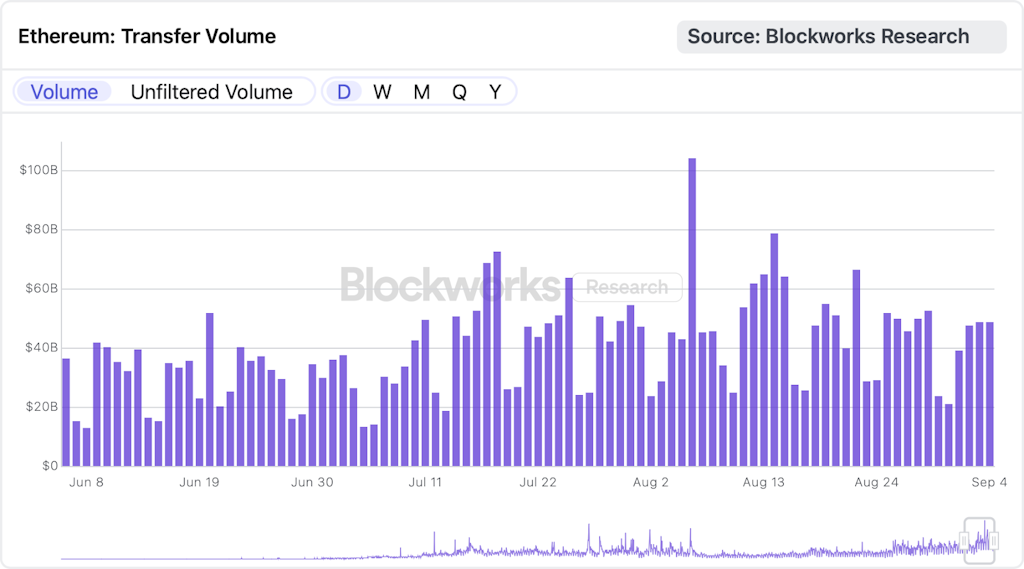 Daily transfer volumes on Ethereum | Source: Blockworks Research
Despite recent slowdowns in decentralized exchange activity, stablecoin liquidity continues to climb, anchored on Ethereum but increasingly shifting toward Solana, which has grown from about $2 billion in late 2023 to more than $10 billion by mid-2025.
A Blockworks Research report from Q1 2025 suggested that emerging issuers such as Ethena’s USDe are expanding quickly, while legacy decentralized options like Maker’s DAI have stagnated. That shift reflects rising demand for yield-linked or synthetic dollar exposure — a dynamic that could influence Kazakhstan’s stablecoin policy as it seeks to favorably position the Astana International Financial Centre.
Updated 9/05/2025 at 11:53 a.m. ET to include figures on stablecoins and transfer volume.
This article was generated with the assistance of AI and reviewed by editor Jeffrey Albus before publication.
Get the news in your inbox. Explore Blockworks newsletters:
- The Breakdown: Decoding crypto and the markets. Daily.
- 0xResearch: Alpha in your inbox. Think like an analyst.