The most important Ethereum developers are the most underpaid
Client engineers and coordinators earn far less than researchers, despite playing key roles in network stability
Accogliente Design/Shutterstock and Adobe modified by Blockworks
A new compensation report from the Protocol Guild paints a clear picture of the tradeoffs Ethereum core developers face: Many are underpaid in fiat terms and receive no upside exposure to tokens, yet continue to maintain Ethereum’s most critical infrastructure.
For this cohort, Protocol Guild (PG) has become the sole source of “equity-like” compensation, filling a structural void that traditional employers can’t — or won’t — bridge.
The numbers are striking. The median Ethereum core developer earns $140,000 in fiat compensation from their employer, while the median external offer stands at $300,000, creating a 114% gap. PG distributions, which are streamed via a transparent, onchain vesting schedule, add another $67,121 at the median, boosting total compensation to $207,121. That still falls short of market, but helps close the gap and represents nearly one-third of total income for the average developer.
Where PG’s role is most pronounced is in risk compensation. Only 37% of surveyed contributors receive any equity or token grants from their employers. PG fills that gap with a mechanism that behaves more like early-stage equity than salary: long-dated, ecosystem-aligned, and tied to the long-term health of Ethereum itself.
In the past year, 38% of surveyed members received employment offers — typically from L2s or other L1s — often with token or equity components. Reports from a small but revealing subsample indicate the median grants amount to 6.5% of tokens/equity, indicating substantial upside potential unavailable to most core Ethereum contributors.
Compensation disparities arise not only between ecosystems, but within Ethereum itself.
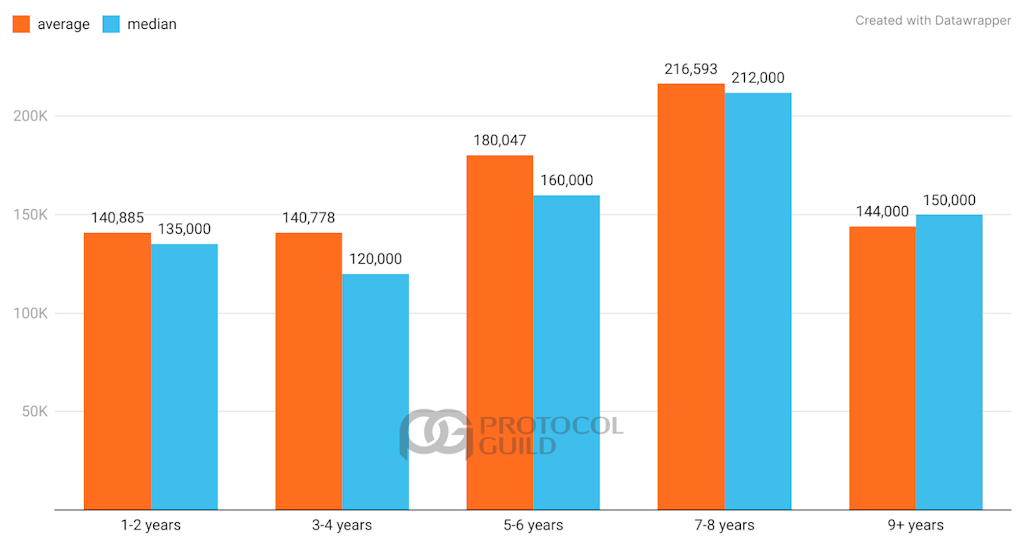
For example, the report shows Research roles carry a $215,000 median cash package, while client development and coordination sit at $130,000 — despite the latter being indispensable to the protocol’s functioning. Similarly, developers with 7–8 years of experience earn a median $212,000, outpacing the $150,000 median for those with 9+ years, hinting at lagging raises or under-leveled roles for some of Ethereum’s most seasoned contributors.
 Source: Protocol Guild
The implication is there’s real retention risk, and 59% of respondents rate Protocol Guild as “very” or “extremely” important to their decision to stay in Ethereum core development. Since its May 2022 pilot, PG has distributed over $32 million to contributors, funded by ecosystem projects pledging 1% of their token supply. But the donor base is concentrated: Just three foundations account for nearly the entire current vesting pipeline, underscoring the need for broader buy-in if the model is to scale.
Protocol Guild operates as a shared funding mechanism. Participating projects commit 1% of their token supply to a vesting contract that streams funds to Guild members over four years. These distributions are governed by a transparent, onchain allocation system based on each contributor’s tenure and role weight. Importantly, Protocol Guild doesn’t employ developers directly; it supplements their existing compensation with an “equity-like” stream that reflects Ethereum’s long-term success and ecosystem-wide commitment to credible neutrality. Contributions and vesting schedules are fully auditable on platforms like Dune.
PG’s designers emphasize that this is not charity, it’s a form of economic infrastructure. The four-year vesting stream aligns incentives with Ethereum’s roadmap, without compromising the credible neutrality core developers are meant to uphold. In effect, PG has become the equity package for contributors working outside of traditional corporate structures.
The question is: Can Ethereum scale this mechanism to keep valuable human capital around for the long-haul?
Get the news in your inbox. Explore Blockworks newsletters:
- The Breakdown: Decoding crypto and the markets. Daily.
- 0xResearch: Alpha in your inbox. Think like an analyst.