Muhammed AKAN/Shutterstock modified by Blockworks
Today, enjoy the 0xResearch newsletter on Blockworks.co. Tomorrow, get the news delivered directly to your inbox. Subscribe to the 0xResearch newsletter.
Uniswap Labs is launching its own L2 chain, Unichain.
Unichain will be built on Optimism’s interconnected network of rollups, dubbed the Superchain.
Why Unichain? Uniswap Labs claims block times will see an initial speed of one second, after which they will fall to 200-250 millisecond block times — a vast improvement over the 12-second block time on Ethereum mainnet.
As part of the Optimism Superchain, users on the new Unichain will also enjoy native cross-chain interoperability of assets across the Superchain’s network of blockchains.
For L2s outside of Optimism’s Superchain, Uniswap Labs plans to leverage ERC-7683, a cross-chain intent standard co-developed with Across Protocol, that will effectively enable users’ trading orders to be fulfilled by intermediary relayers/solvers regardless of what chain they’re on.
This potentially obviates the need for Uniswap to “port” its massive pool of liquidity it enjoys on the Ethereum L1 to Unichain, and thereby abstract away the hurdles of moving its existing user base to a different chain.
Hayden Adams, CEO of Uniswap Labs, said of the launch: “Unichain will deliver the speed and cost savings already enabled by L2s, but with better access to liquidity across chains and more decentralization.”
Unichain will also leverage new technical innovations, like a trusted execution environment (TEE) for block building, and a “community validation network.” Both features are developed with Flashbots.
Unichain’s validation network will be open to any node operators staking UNI, but only a “limited number of validators with the highest UNI stake-weight will be considered the active set,” according to the Unichain white paper. It suggests that the largest UNI token holders, such as the Uniswap Foundation and early investors, will likely be the only initial validators on the network.
Ethereum’s largest DEX moving to an L2 can be taken as a great or terrible piece of news, depending on whether you approve of Ethereum’s roadmap.
For Ethereum-aligned users who are onboard with its rollup-centric roadmap, Unichain makes perfect sense. From Uniswap’s perspective, this is a win-win for both the protocol and its users: Uniswap retains its MEV, and users enjoy cheaper gas fees.
From Ethereum’s perspective, that was obviously always part of the plan.
On the flip side, this looks to accelerate the ongoing complaints about Ethereum L2s being “parasitic” to the L1, and the lack of value accrual to ETH (the asset).
Uniswap is the largest gas guzzler on the Ethereum L1 today (see below), which means that ETH spent as gas fees on the L1 is contributing to a non-trivial portion of ETH burn and value accrual to ETH, thanks to EIP-1559.
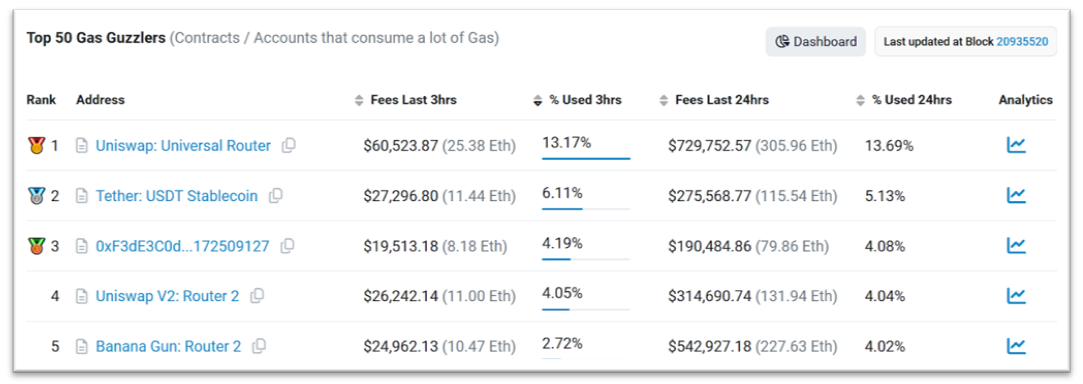 Source: Etherscan
Additionally, MEV that’s accruing to the Ethereum L1 will now be “leaked” to the Unichain L2 in the form of sequencer revenues — further reducing ETH’s value accrual.
A reversal of fortune for Ethereum largely depends on the “induced demand” its core developers believe would eventually emerge from having a multitude of cheaper L2 execution environments. The idea is that faster blockchain speeds would significantly drive more transactions on L2s, which in turn would increase settlement fees paid to the L1. So far, that hasn’t happened yet.
The UNI token has rallied 11.9% in the last 24 hours, according to CoinGecko.
Chart of the Day
There’s a tsuinami coming:
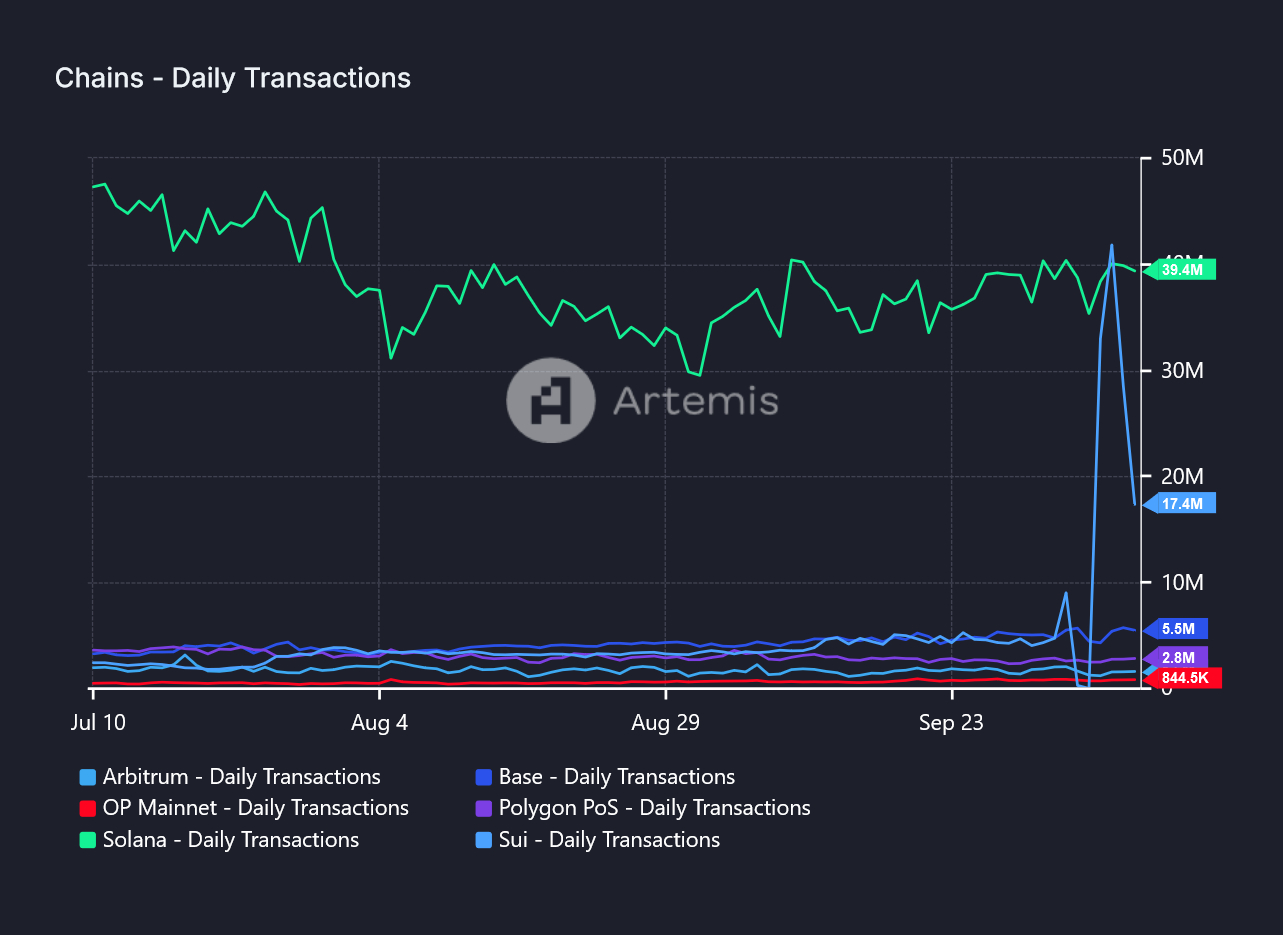 Source: Artemis
The MoveVM-based L1 blockchain Sui briefly flipped Solana in daily transactions earlier this week. Sui saw 41.8 million transactions against Solana’s 40.1 million on Monday, though it has since fallen back down. Just as Solana once posed itself as an “ETH killer,” Sui looks to do the same to Solana.
Get the news in your inbox. Explore Blockworks newsletters:
- The Breakdown: Decoding crypto and the markets. Daily.
- 0xResearch: Alpha in your inbox. Think like an analyst.
