EigenLayer’s biggest node operator promises revenue-sharing
Plus, crypto VC funding in Q3 is still lagging

CryptoFX/Shutterstock modified by Blockworks
Today, enjoy the 0xResearch newsletter on Blockworks.co. Tomorrow, get the news delivered directly to your inbox. Subscribe to the 0xResearch newsletter.
Here’s a simplified explanation of how restaking works today:
- Bob deposits ETH/stETH into a liquid restaking protocol like Ether.Fi, Puffer, Eigenpie or Renzo.
- The liquid restaking protocol delegates Bob’s assets to an EigenLayer operator.
- The EigenLayer operator uses Bob’s asset to secure one or many AVSs to return some yield to Bob.
- Bob is happy because his ETH is a yield-bearing productive asset, and he enjoys a liquid ETH derivative that he can use to dabble in other degenerate DeFi activities.
About 299 active EigenLayer operators compete for $11.2 billion in TVL in EigenLayer, so competition is pretty stiff.
EigenLayer operators compete for user attention in one of many ways.
Technical competency is one obvious factor, namely keeping a consistent uptime and fulfilling specific responsibilities for the AVSs they validate.
Operators also try to validate as many AVSs as they can so as to compound yield returns to users (and slashing risks), or promise to share any potential airdrops with delegators. You can see many such explicit advertisements on the EigenLayer operator page.
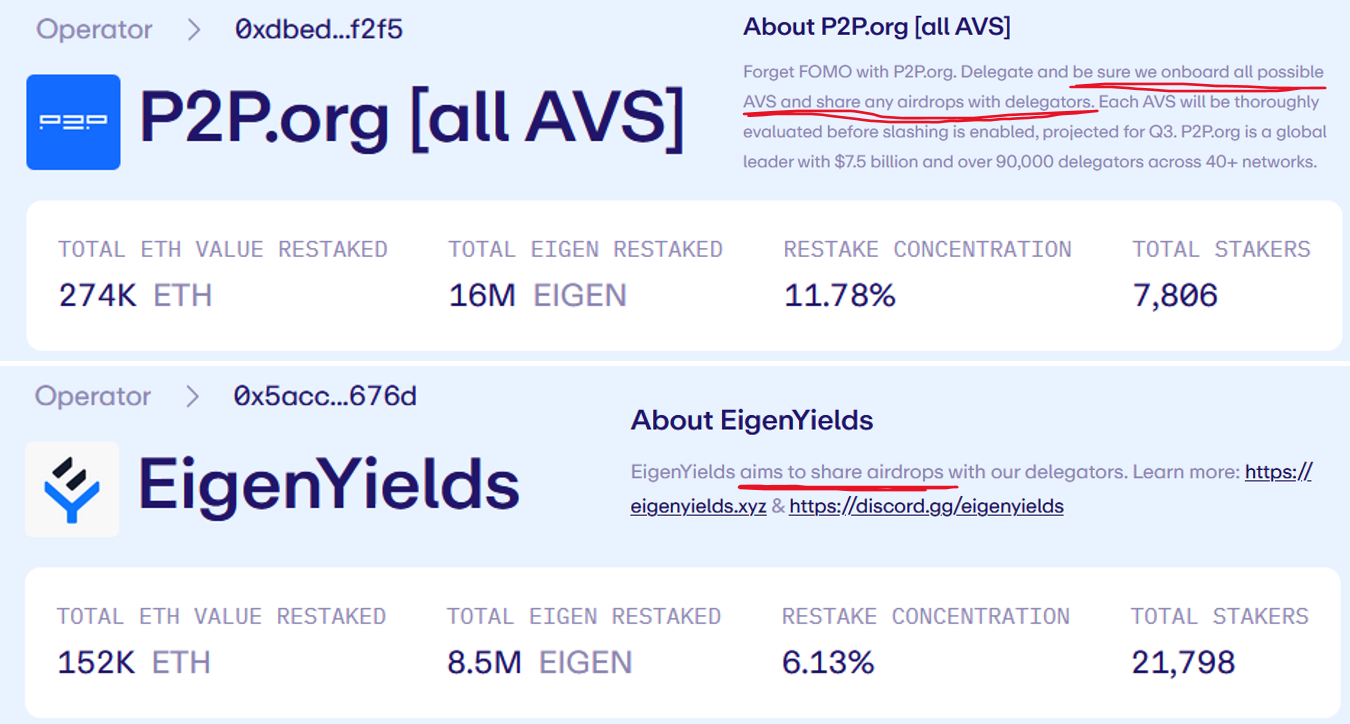 Source: EigenLayer
Another way that EigenLayer operators could compete, of course, is to simply promise more of their cut to delegators. That has not been the case, until today.
P2P.org, the largest EigenLayer operator by total ETH restaked (at 274,000 ETH), announced Wednesday that it would launch revenue distribution to users delegating ETH to them.
As part of a “new structure [to] reward long-term trust and engagement,” all delegators staking with P2P.org prior to Aug. 15 will be eligible for the revenue share.
It’s a bold move — and not one you’d typically expect from a leader at the top.
It’s not clear how much revenue that actually translates into for P2P.org delegators, but here’s some napkin math from Blockworks Research Analyst Marc Arjoon.
P2P has about 274,000 ETH and 8.53 million EIGEN staked on EigenLayer across ~8k stakers.
As part of its “programmatic incentives” program, EigenLayer is allocating 67 million EIGEN through the first year, with 3/4 going to ETH stakers and another 1/4 to EIGEN stakers and operators.
For P2P, that comes up to about ~3.63 million of EIGEN incentives (worth $12 million today).
Assuming today’s EIGEN price of $3.3, each staker would receive about $1,500, excluding any AVS yield.
Not a bad reward.
Chart of the Day
Crypto VC funding still lagging:
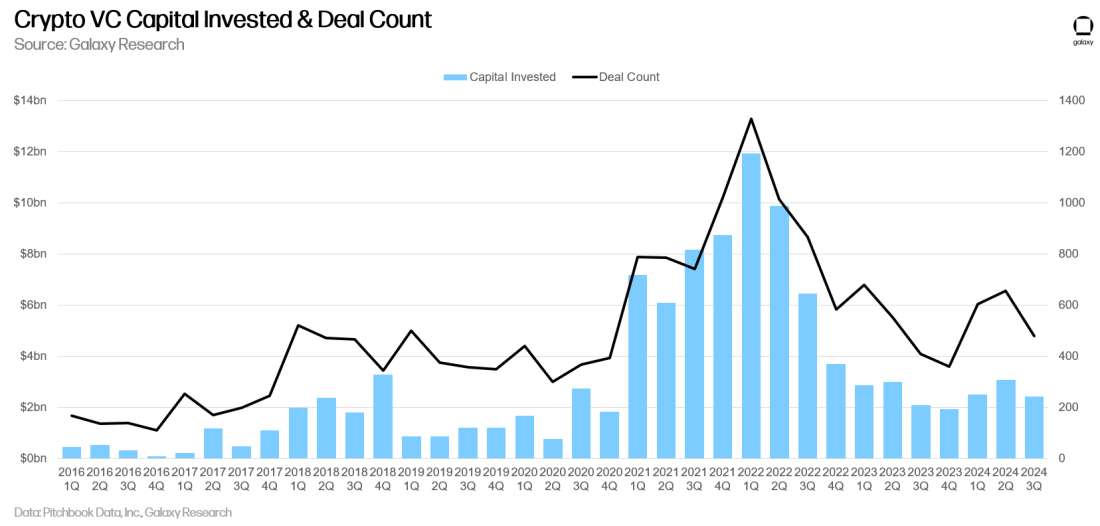 Source: Galaxy Research
According to Galaxy Research, crypto venture capital funds invested about $2.4 billion across 478 deals in Q3 2024. That’s 20% capital invested and 17% fewer deals than the previous quarter.
Within Q3, companies in the “trading/exchange/investing/lending” category raised the most, at $462 million. Cryptospherex and Figure markets raised $200 million and $73.3 million, respectively.
In a sign that the L1 trade isn’t going away, the second-largest raise came from L1 projects — about $341 million in total.
Get the news in your inbox. Explore Blockworks newsletters:
- The Breakdown: Decoding crypto and the markets. Daily.
- 0xResearch: Alpha in your inbox. Think like an analyst.
