Only crypto can stop the bad bots
Sometimes you need to know what actual humans think, and not just simulated humans
So happy 59/Shutterstock modified by Blockworks
This is a segment from The Breakdown newsletter. To read full editions, subscribe.
“The great enemy of communication, we find, is the illusion of it.”
— William Whyte
A recent study of web-based surveys reports that AI bots have a preference for “risky sexual behavior.”
That, at least, is what the bots say in those surveys, but surveys are self-reporting and therefore not conclusive. Who knows what they really get up to behind closed doors?
Either way, it’s a problem, because survey-answering bots are making it increasingly difficult to find out what people are getting up to.
Researchers in fields like economics, public health, consumer habits and political science have long relied on surveys to understand human behavior.
Now, because no one picks up the phone anymore, these surveys are conducted almost entirely online.
Bots, however, have proven much happier than humans to fill out online surveys.
Why would they bother?
Money, for one thing.
To offset falling response rates, researchers have resorted to paying people to respond to their questions online — sometimes as much as $5 per survey.
This has caused a problem with people in low-income countries, where $5 still goes a long way, pretending to be the people in high-income countries that researchers are usually asking about.
It might take, say, 15 or 20 minutes to fill out a $5 survey, but if you’re doing it for the money, you might spend another 45 minutes looking for a survey that pays, so the hourly return is not great.
Unless you’re a bot, that is, in which case the whole process takes only seconds, and the $5 reward will be many multiples of what it costs for a few seconds of data center compute.
More speculatively, bots might also respond to surveys to affect elections by skewing the polls, or just to muddy the informational waters for a geopolitical rival.
Or maybe the bots just want to make themselves heard. Who knows?
Whatever their motivations, bots are now estimated to account for as much as 30% of the responses to online surveys — more than enough to invalidate their results.
Worse yet, 37% of all internet traffic is attributable to “bad bots” operating with “malicious” intentions.
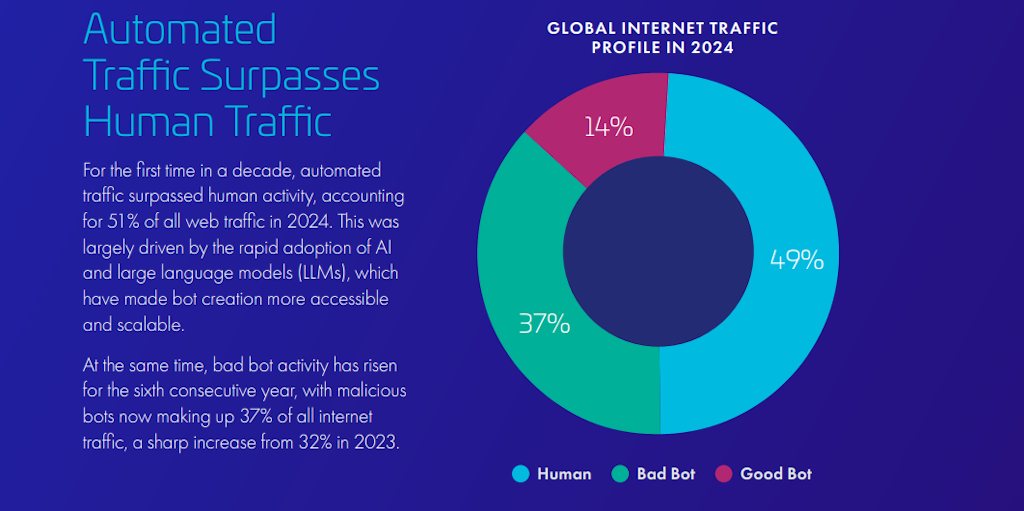
37% represents a lot of bad bots, and because CAPTCHAs don’t trip them up anymore, the $120 billion market-research industry is at risk of being overrun.
There are other defenses survey researchers can try, like excluding results from respondents that answer “honeypot questions” (invisible to humans), or filtering for inhumanly fast response times.
But that is a game of cat and mouse that the bots will surely adapt to.
A more decisive approach is to stop looking for humans altogether: Artificial Societies replaces human survey respondents with AIs trained to imitate them.
This replaces bad (or indifferent) bots with bots specially designed to predict how targeted groups of humans would respond — “collectives of AI personas that allow you to run experiments in minutes, not months.”
I’m sure that works for testing out a new marketing campaign, or predicting how a new flavor of Pringles might go over in the Midwest (pumpkin spice, maybe?).
But what about for events where the stakes are a bit higher, such as a presidential election?
It’s a question worth pondering because, with telephone response rates now below 5%, online surveys have become the primary means of understanding 1) how people are going to vote and 2) why they’re going to vote that way.
A lot has been made of prediction markets’ uncanny ability to predict elections better than traditional pollsters, so you might not think we need the polls anymore.
But prediction markets are themselves based on polls: The French trading whale who made Polymarket so accurate by betting big on Trump did so only only after commissioning his own private polling.
Those polls were conducted online, of course — and by 2028, that kind of data could well be so corrupted by bots that it’s unusable, which would make prediction markets unusable, too.
More importantly, if pollsters can’t determine what motivates people to vote the way they do, politicians will have a harder time representing them.
Creating collectives of AI personas seems unlikely to help with this because how would they capture what people are thinking right now?
AIs can only be trained on data that already exists, which seems ill-suited to catching the kind of new information that always seems to make one election different from the last.
For something as consequential as deciding a presidential election, only communicating directly with humans will do.
Soon, there might be only one way to do it: blockchain-based cryptography.
Cryptographic proof-of-humanity has been disappointingly slow to catch on. People have not rushed to scan their retinas with World, for example, perhaps because they don’t care much whether the internet content they consume was created by a human or a bot.
But survey-makers do care: Sometimes you need to know what actual humans think, and not just simulated humans.
If online surveys are a form of mass communication, AI-simulated surveys are only the illusion of it.
Crypto-enabled proof-of-humanity could enable the real thing — a way to know what real people are thinking again (to the extent that was ever possible).
It’s probably still a long way off.
It would have to become near ubiquitous: A survey of only people who have scanned their retinas in return for crypto tokens won’t be too representative of the general population.
It would also have to be trusted enough that we’re not afraid to tell them what we get up to behind closed doors.
Until we do, humans may find it increasingly difficult to communicate with one another.
Get the news in your inbox. Explore Blockworks newsletters:
- The Breakdown: Decoding crypto and the markets. Daily.
- 0xResearch: Alpha in your inbox. Think like an analyst.