Introducing Agentic Detection : Asset monitoring built for the AI EraLearn More
Insights / Dashboard Primers
Origin: Data Dashboard Primer
Track Origin Protocol's $25.6M in gross yield, $3.6B in ARM Vault swap volume, and 111M OGN bought back in Blockworks' new dashboard covering its rebasing tokens and ARM Vaults.
By San Yong ·
Introduction
Origin Protocol builds yield infrastructure on Ethereum and Base. Its two main product lines are rebasing tokens and ARM Vaults. The rebasing tokens deploy deposited collateral into yield-generating strategies such as lending and native staking, with the resulting yield passed to holders as a growing balance: OETH on Ethereum, superOETHb on Base, and OUSD, a yield-bearing dollar. ARM Vaults, meanwhile, provide liquidity for redeemable assets and monetize redemption spreads by acquiring assets below their redemption value and capturing the difference when they are redeemed. The recently launched WETH ARM consolidates liquidity across stETH, wstETH, eETH, and weETH, allowing a single WETH vault to monetize redemption opportunities across all four assets.
Both product lines charge a performance fee on the yield they generate, and that fee is used to buy OGN on the open market. The OGN purchased through these buybacks is distributed to OGN stakers, creating a direct link between product performance, protocol revenue, and value accruing to stakers. The dashboard tracks this structure directly: the yield generated by the products, the portion retained by the protocol as revenue, and how that revenue flows back to OGN stakers.
Dashboard Overview
- Overview: protocol revenue, product TVLs, product APYs.
- Financials: gross yield, revenue, margins.
- Rebasing Tokens: token supply, collateral, rebasing APYs.
- ARM Vaults: vault balances, allocations and vault APYs.
- OGN Token: supply, staking, buybacks.
- DeFi Integrations: how Origin's tokens are used inside Morpho, Pendle and Fusion.
- Risk: collateral strategy, withdrawal queues and peg deviation.
Financials
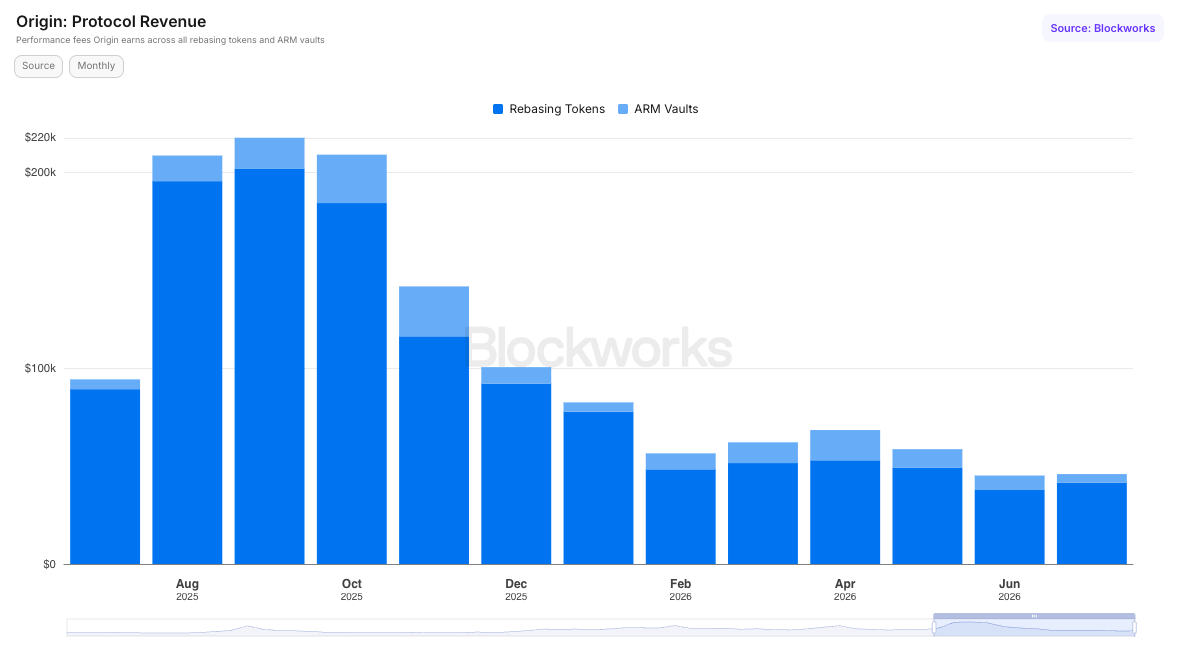
Origin: Protocol Revenue
Protocol revenue consists of the performance fees Origin retains from both product lines: rebasing tokens and ARM Vaults. This chart measures those performance fees, split between the two product lines. Origin has retained roughly $4.20M since February 2021, and the trailing 30 days contributed ~$45.8K, of which ~$41.6K came from rebasing tokens and ~$4.2K from ARM.
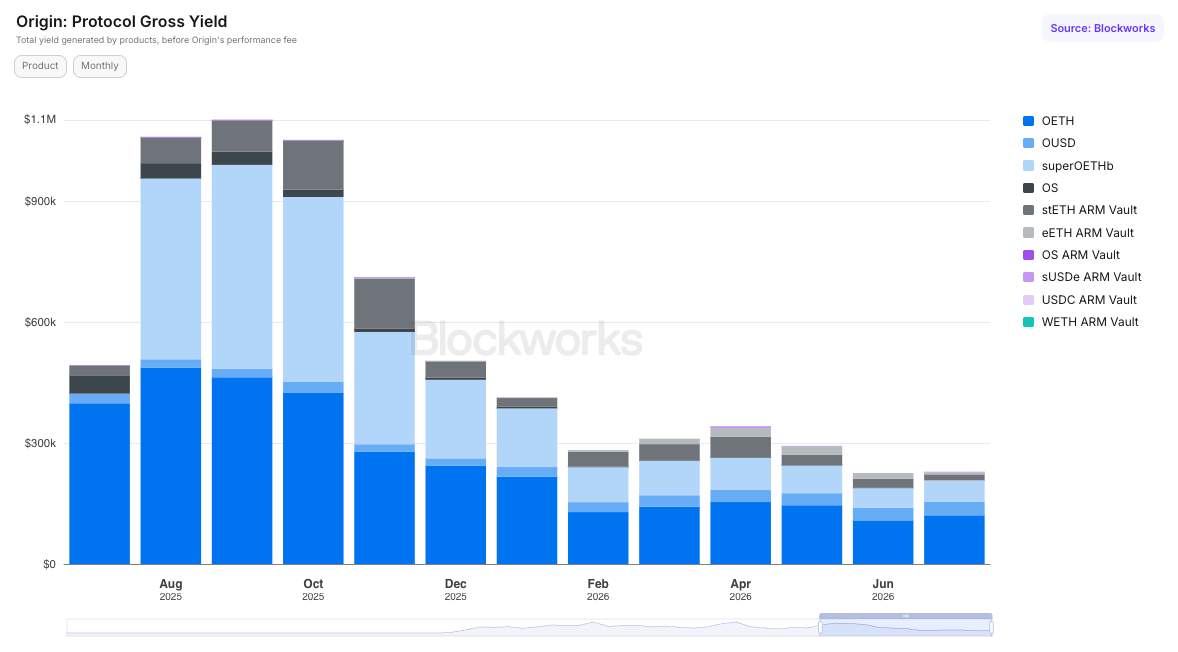
Origin: Protocol Gross Yield
Gross yield is the total return the products generate before fees. Origin has generated roughly $25.6M of gross yield since February 2021, against the ~$4.20M retained as protocol revenue. Over the trailing 30 days, the products generated approximately $229K of gross yield, with ~$208K from rebasing tokens and ~$21K from ARM. Gross yield is ultimately split between the yield distributed to holders and the performance fee retained by the protocol.
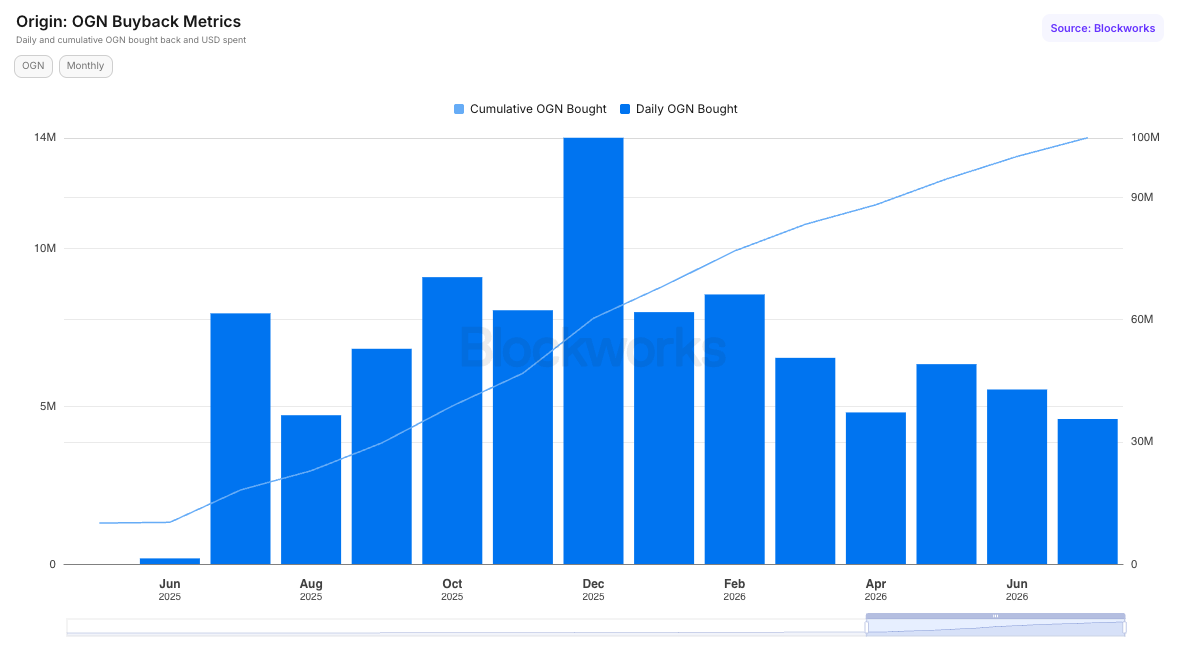
Origin: Daily and Cumulative OGN Buyback
Protocol revenue is directed toward open-market OGN purchases, with the resulting buybacks tracked here in both dollars spent and OGN acquired. Origin has repurchased ~111.4M OGN for ~$4.59M cumulatively, equal to ~14.3% of the ~780.7M circulating supply. Origin surpassed 100M OGN bought back in June 2026, marking a significant milestone in its ongoing buyback program.
Rebasing Tokens
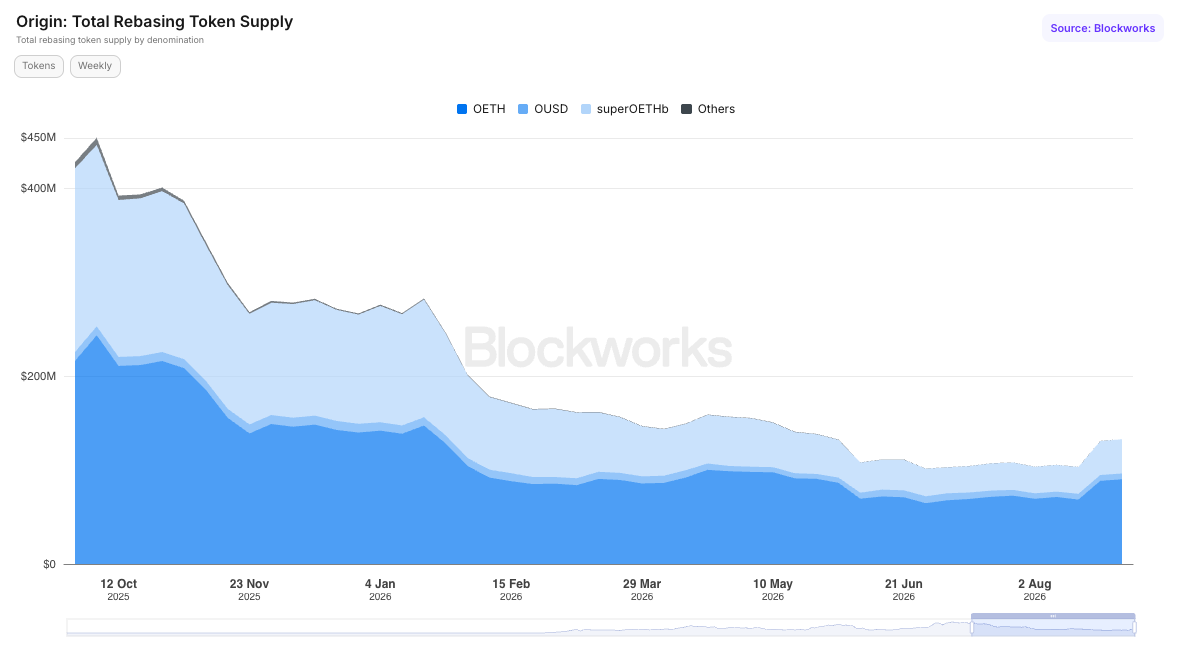
Origin: Total Rebasing Token Supply
This chart tracks the circulating supply of the three rebasing tokens in USD. OETH stands at ~$90.2M, superOETHb at ~$36.5M and OUSD at ~$6.2M, for ~$132.9M combined. One methodology point matters for reading this tab: a meaningful share of rebasing token supply is minted by Origin's AMO for liquidity purposes rather than deposited by users. Currently, this represents ~35% of OETH and ~41% of superOETHb supply.
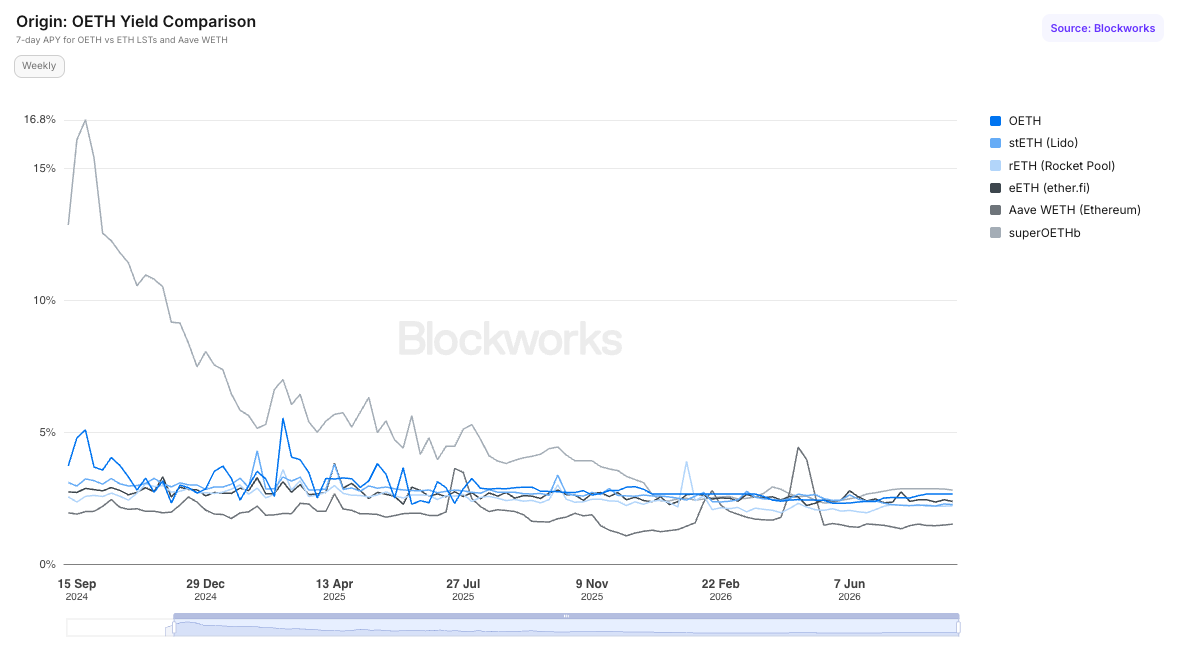
Origin: OETH Yield Comparison
This chart benchmarks the 7-day trailing net APY paid to OETH and superOETHb holders against major ETH liquid staking tokens. As of August 30, superOETHb paid ~2.80% and OETH ~2.65%, against weETH at ~2.37%, wstETH at ~2.25%, and rETH at ~2.20%.
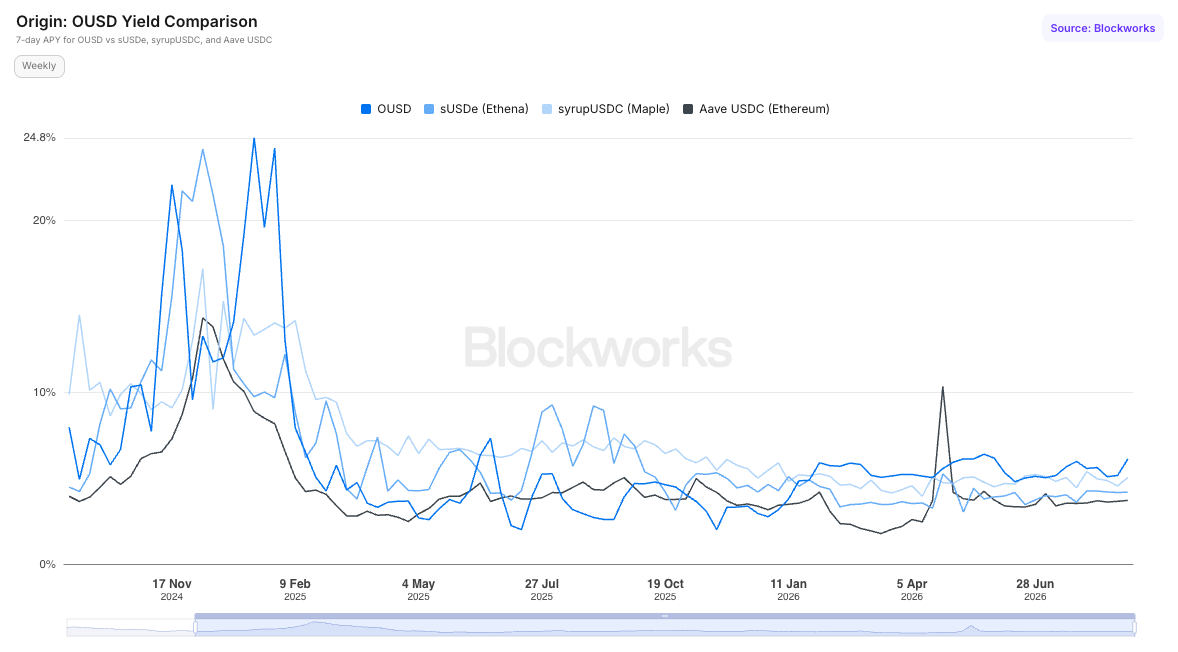
Origin: OUSD Yield Comparison
The same construction for OUSD against yield-bearing dollar peers. OUSD paid ~6.11% versus syrupUSDC at ~5.03%, sUSDe at ~4.18%, and Aave V3 USDC at ~3.70%.
ARM Vaults
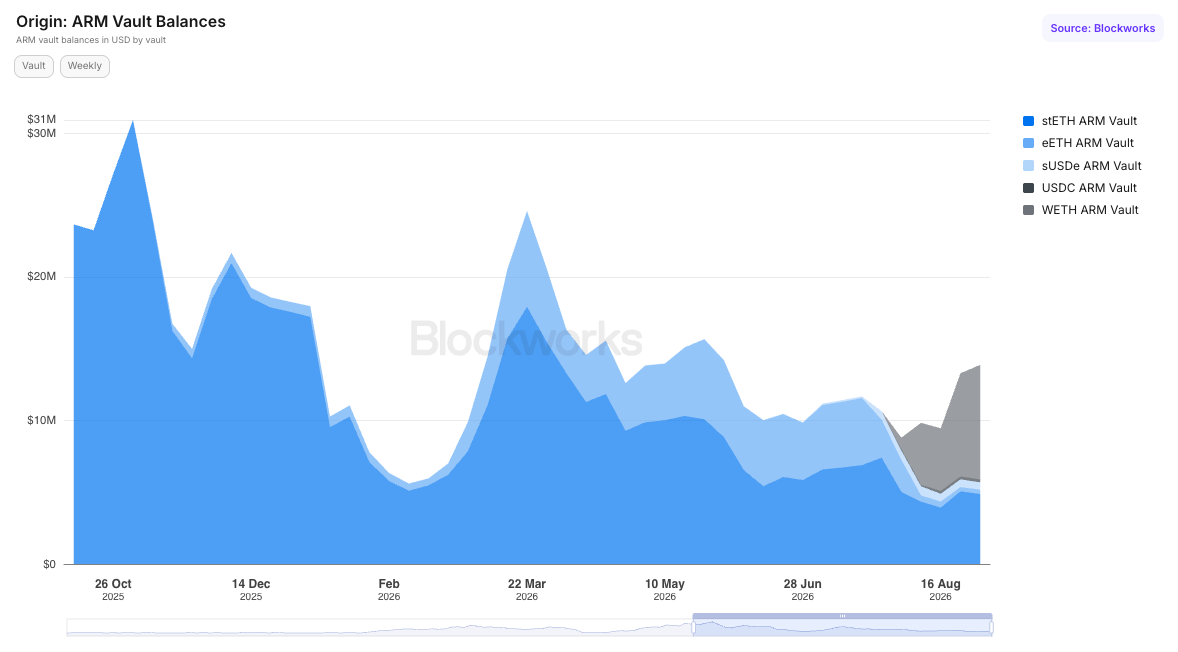
Origin: ARM Vault Balances
The amount of capital in an ARM Vault determines how much redemption flow it can support. This chart shows capital deployed across each vault, totaling ~$13.9M. The WETH ARM Vault, launched on July 27, is now the largest at ~$7.98M, followed by the stETH ARM Vault at ~$4.88M. The sUSDe ARM Vault holds ~$510K, while the USDC ARM Vault holds ~$201K and remains in beta.
The WETH ARM Vault expands the accessible market by supporting four markets: eETH, weETH, stETH, and wstETH, all quoted against WETH in a single vault. This reduces liquidity fragmentation while retaining separate risk controls for each market, including limits, pricing, pending redemption tracking, and adapters.
Origin: ARM Vault Swap Volume
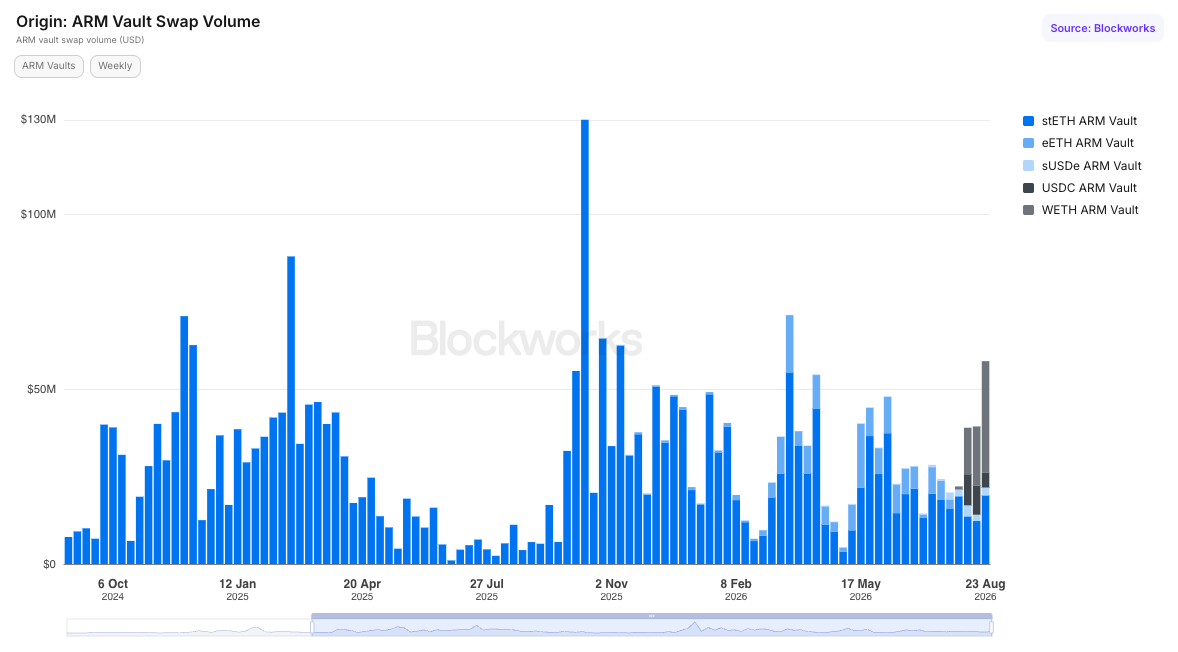
Swap volume is the redemption flow routed through each vault, and it drives ARM revenue more directly than vault size does. Lifetime volume across all vaults is ~$3.61B, with stETH ARM Vault accounting for ~$3.23B of it. Over the trailing 30 days, WETH ARM Vault handled ~$84.9M and stETH ARM Vault ~$64.8M.
The 30-day turnover ratio, volume divided by average TVL, shows how hard each vault works its capital. The sUSDe, WETH and stETH ARM Vaults turn over roughly 14x to 17x, while the USDC ARM Vault reaches ~140x on a ~$170K average base. Curve's comparable pools sit lower across the board: the sUSDe/reUSD pool clears ~16x and eETH/WETH ~7.7x, while the largest stETH/ETH pool turns over only ~1.3x against ~$86M of average TVL. The pattern reflects the difference in design, since an ARM Vault holds only the inventory needed to service redemption flow rather than the standing depth a pool needs to quote continuously.
Origin: ARM Vault APY
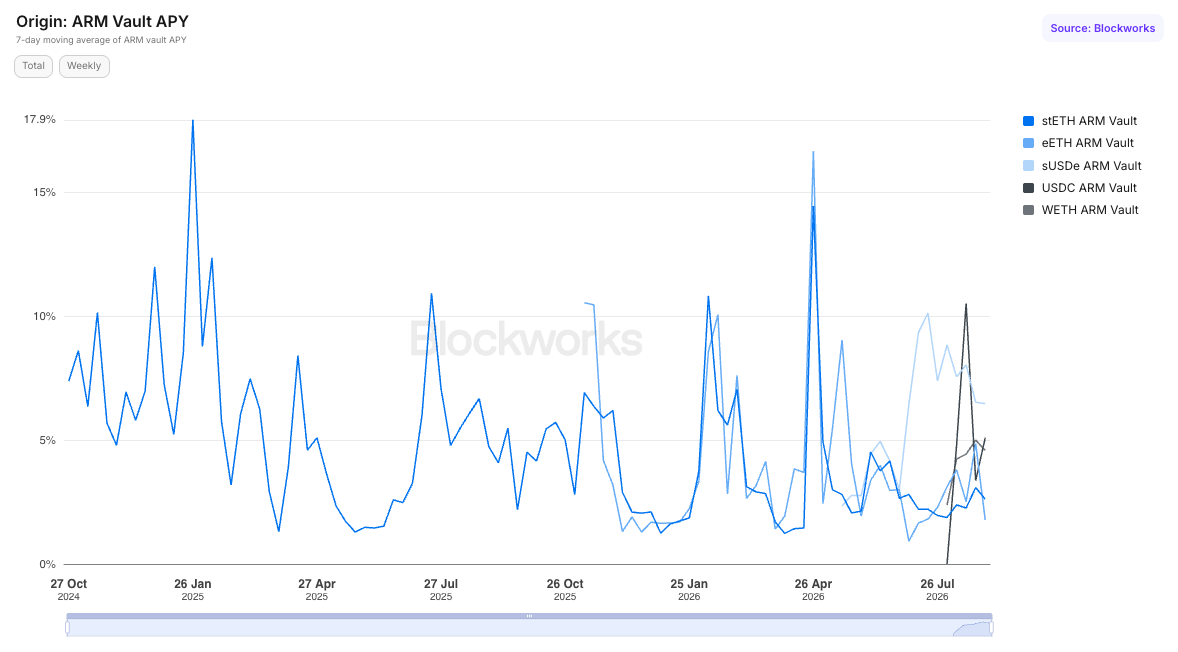
Each ARM Vault reports two APY series: base yield, representing the yield generated by the underlying redemption strategy, and total yield, which includes Merkl incentives when applicable. One Merkl campaign is currently running, on the WETH ARM Vault, which offers ~4.0% total APY versus ~2.9% base yield. The other vaults show a single line, with base and total yield identical: ~5.9% for the USDC ARM Vault, ~5.1% for the sUSDe ARM Vault, and ~2.5% for the stETH ARM Vault.
DeFi Integrations
Origin: Rebasing Token DeFi TVL
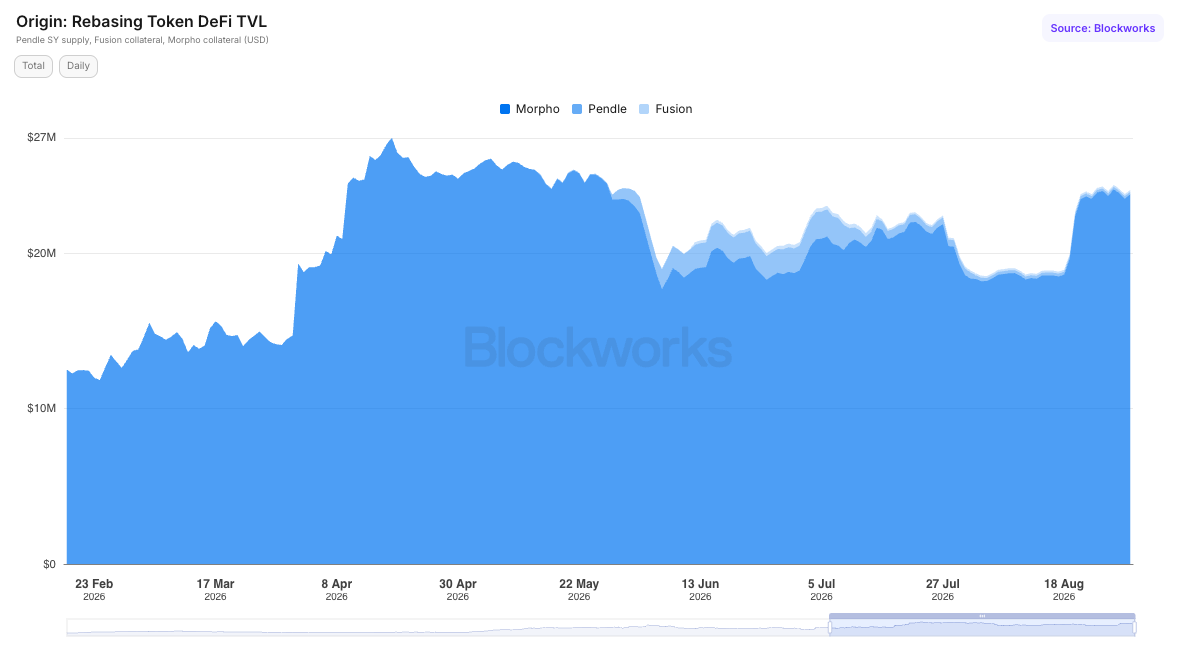
This chart measures Origin's tokens deployed inside DeFi protocols, ~$24.0M in total. Composition is highly concentrated: ~98.8% sits in Morpho as posted collateral, with Pendle at ~$158K and Fusion at ~$130K. By token, ~95% of deployed collateral is OETH and ~4% is superOETHb. Fusion by IPOR builds a leveraged position using the underlying WOUSD/USDC market, so a portion of its TVL overlaps with the underlying market.
Origin: Morpho Market Deposits, Collateral and Loans
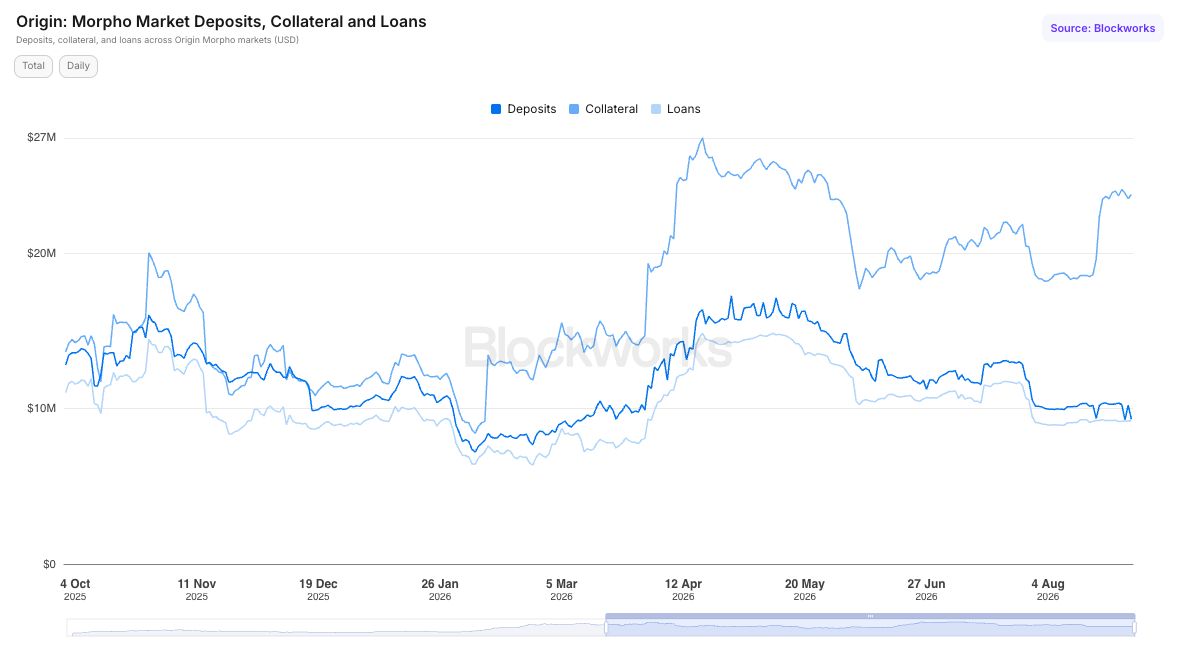
A breakdown of Origin collateral and borrowing per Morpho market. The USDC/OETH market at 86% LLTV dominates: ~$22.8M of OETH collateral against ~$8.75M borrowed across 30 borrowers, at ~38% current LTV and ~99.7% utilization. USDC/superOETHb on Base holds ~$835K collateral against ~$366K of loans across 39 borrowers, implying ~44% LTV. Both markets sit at roughly half their liquidation thresholds, leaving substantial headroom before liquidations begin. USDC/WOUSD sits at a higher ~67% LTV against a 91.5% threshold on ~$130K of collateral, though both sides of the market are dollar-denominated, which removes the price risk present in the ETH-collateralized markets.
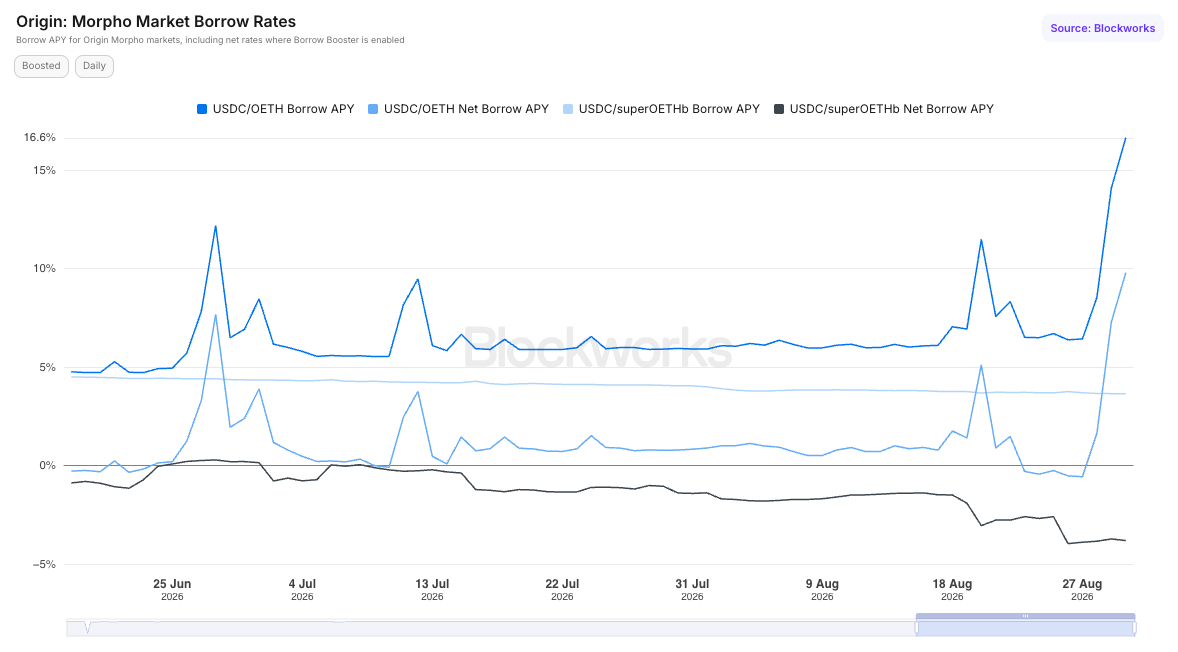
Origin: Morpho Market Borrow Rates
This chart plots the borrow APY on Origin's two incentivized Morpho markets, showing each market's native borrow rate alongside the net rate after Borrow Booster incentives. Borrow Booster uses the yield earned by the rebasing token to subsidize the borrower's interest, with the difference between the two rates representing the rebate: ~6.86% on USDC/OETH and ~7.46% on USDC/superOETHb as of August 30. Because these rebates can exceed the underlying borrow cost, the net borrow rate can fall below zero, meaning the borrower effectively earns a net yield on the borrowed position.
As of August 30, USDC/superOETHb sits at ~-3.81% against a ~3.65% native rate, while USDC/OETH sits at ~+9.78% against a ~16.64% native rate at ~99.7% utilization. Over the past month USDC/superOETHb has been negative on all 30 days, averaging ~-2.2%, while USDC/OETH has averaged ~+1.4% and was negative on 5 of 30 days.
Origin operates two yield businesses, rebasing tokens and ARM Vaults, both charging a performance fee that funds OGN buybacks distributed to stakers. Track all of these metrics on the Blockworks Origin dashboard.
The information contained in this report and by Blockworks Inc. and related affiliates is for general informational purposes only and is not intended to provide legal, financial, or investment advice. The report should not be construed as an offer or solicitation to buy or sell any security, token, or financial instrument and does not represent any recommendation or endorsement of any investment or financial product or service. Blockworks Inc. and related affiliates are not registered as a securities broker-dealer or an investment advisor in any jurisdiction or country.
Back to Insights
Newsletter
The Breakdown
Decoding crypto and the markets. Daily, with Byron Gilliam.
Blockworks Research
Unlock crypto's most powerful research platform.
Our research packs a punch and gives you actionable takeaways for each topic.
Blockworks Inc.
133 W 19th St., New York, NY 10011
Blockworks Network