Introducing Agentic Detection : Asset monitoring built for the AI EraLearn More
Insights / Dashboard Primers
Fluent: Data Dashboard Primer
Track Fluent's onchain metrics with Blockworks' data dashboard: network revenue, transaction activity, USDnr stablecoin supply, treasury yield, and BLEND buybacks.
By Victor Pham ·
Introduction
Fluent is a chain built for consumer crypto, and its April 24, 2026 launch lineup reflected that: Vena, a lending protocol whose rates adjust to borrower history; Flux, a liquidity layer supporting both SPL20 and ERC20 tokens; Pulse Predictor, an onchain polling protocol. Most integrate Prints, Fluent's programmable reputation layer, which lets applications price credit and other consumer products off a user's onchain and offchain reputation.
The product carrying the network's economics, though, is their stablecoin dollar. Nerona, another Fluent native application, issues USDnr, a stablecoin built with Nerona on M0 infrastructure and backed by short-term US Treasury bills. USDnr doesn't rebase; the yield its reserves generate accrues to the protocol, and holders who want yield stake into sUSDnr. This structure gives Fluent a flywheel: consumer apps bring users, users hold USDnr, the reserves earn Treasury yield, and that yield funds BLEND buybacks. The dashboard is designed to measure each stage of that loop.
Under the hood, Fluent is built on blended execution: EVM and WebAssembly apps share one execution environment and state, compiling down to the ZK-friendly rWASM instruction set, with Solana VM support on the roadmap. Gas is paid in ETH, transaction data posts to Ethereum as blobs, and validity proofs (via SP1) aren't live in production yet, so batches currently finalize on a time delay. Fluent Labs raised $11.2M across a Polychain-led seed, a testnet round, and an April public sale on Coinbase's Sonar platform.
Dashboard Overview
Our Fluent dashboard is organized into three tabs spanning network financials, onchain usage, and the USDnr stablecoin ecosystem:
- Financials: The network's income statement: network revenue, L1 costs, USDnr program yield, and gross profit.
- Onchain Activity: Transactions, active addresses, fees, gas throughput, and the contracts driving usage.
- Stablecoins: USDnr and sUSDnr supply, vault flows, depositor yield, and BLEND buybacks.
Data coverage begins mid-March 2026, several weeks before public launch, when the chain first produced blocks. As of early August, the network processes roughly 3,000 transactions a day and carries an $11.5M combined stablecoin float, with $9.3M of it in the yield vault. These are early-stage figures, and at this size the composition of activity is more informative than the totals.
Financials
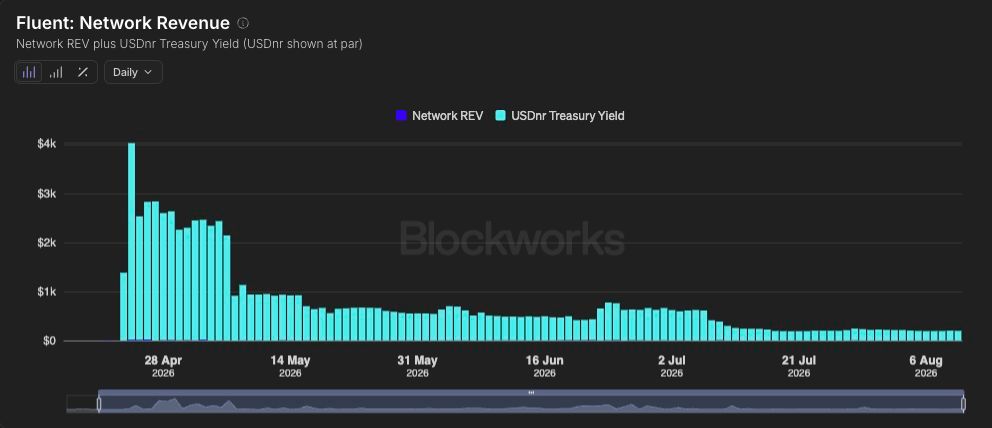
Fluent: Network Revenue: Combines the network's two revenue streams: Execution fees and USDnr treasury yield. The fee component is intentionally negligible, about $1.2K since mid-March at single-digit dollars per day, against roughly $3.3K paid to Ethereum for blob data and settlement (shown in Fluent: L1 Operator Payments). Nearly all of the top line comes from treasury yield. This is intentional for a consumer chain, where fees stay near zero for users and revenue comes from the stablecoin base.
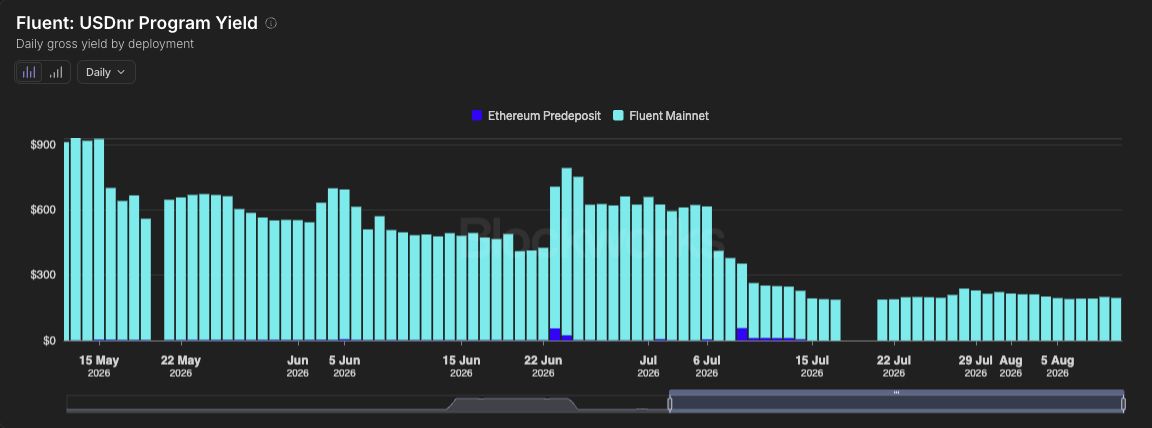
Fluent: USDnr Program Yield: USDnr reserves sit in Treasury bills, the interest they generate accrues to the protocol: roughly $186K since the January predeposit campaign on Ethereum, of which about $79K has been earned since Fluent mainnet went live. That mainnet-era yield alone is more than sixty times what transaction fees have brought in. Because this line scales with the stablecoin float rather than gas usage, growth in USDnr supply shows up here before it shows up anywhere else.
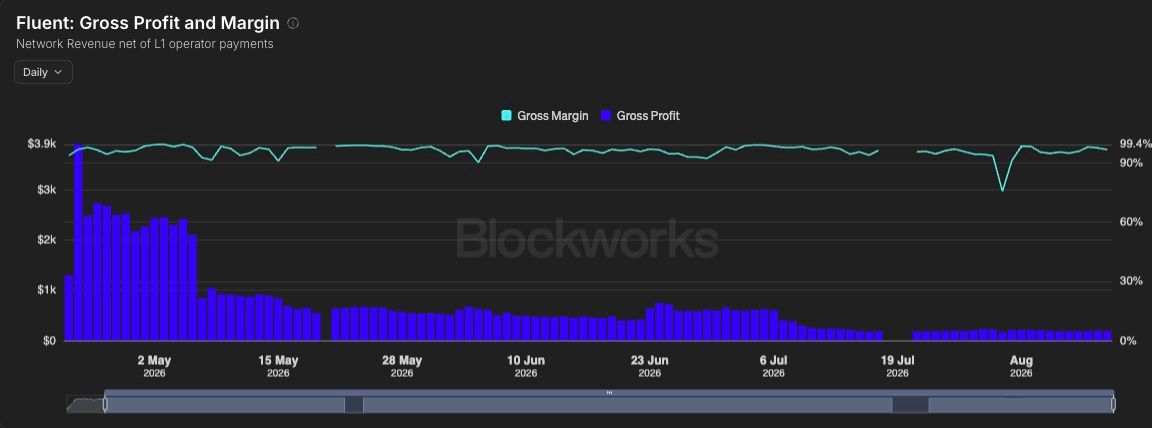
Fluent: Gross Profit and Margin: Nets L1 operator payments against network revenue. Fee income alone doesn't cover the Ethereum bill, but the monthly loss has narrowed from about $1,317 in April to $277 in July.
Onchain Activity
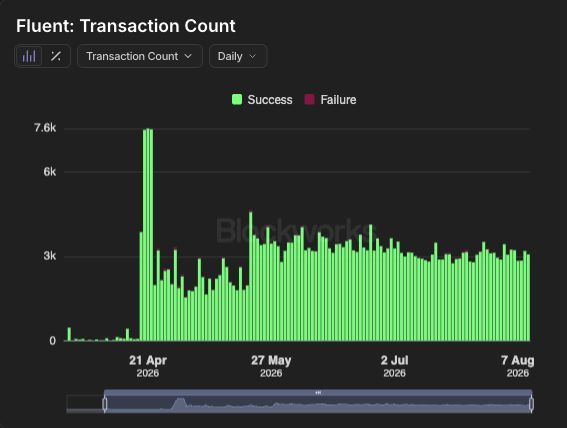
Fluent: Transaction Count: Fluent has processed over 340K transactions since mid-March, currently around 3K per day. Of the roughly 92K transactions in the last 30 days, about 87% came from a single Vena oracle contract and seven Fluent infrastructure contracts (28.4K more).
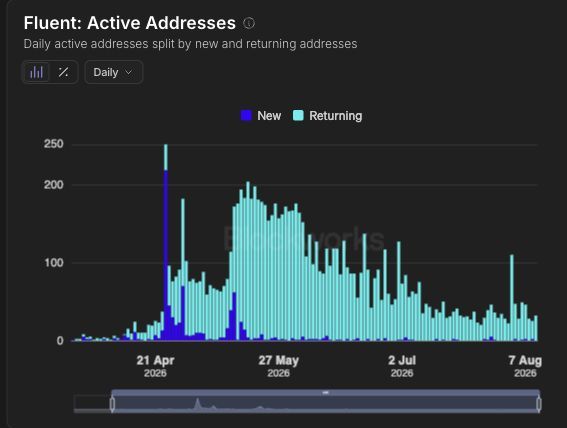
Fluent: Active Addresses: This chart splits daily active addresses into new versus returning wallets. Daily active addresses have averaged about 39 over the past month, down from a launch-day peak of 252 (219 of them new). Recent activity is almost entirely returning addresses, with new arrivals in the low single digits most days.
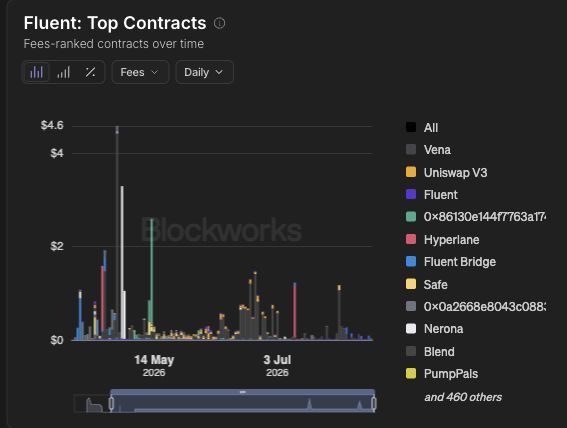
Fluent: Top Contracts: This chart shows which applications are actually driving usage. Outside the oracle calls, the last 30 days of user-facing activity break down as roughly 6,000 DEX transactions (with up to 95 distinct callers in a day), 2,500 bridge transactions, 750 stablecoin transfers, and 360 lending interactions. The Fluent: Popular Contracts (Last 1 Day) table gives the same view daily, with contract-level detail.
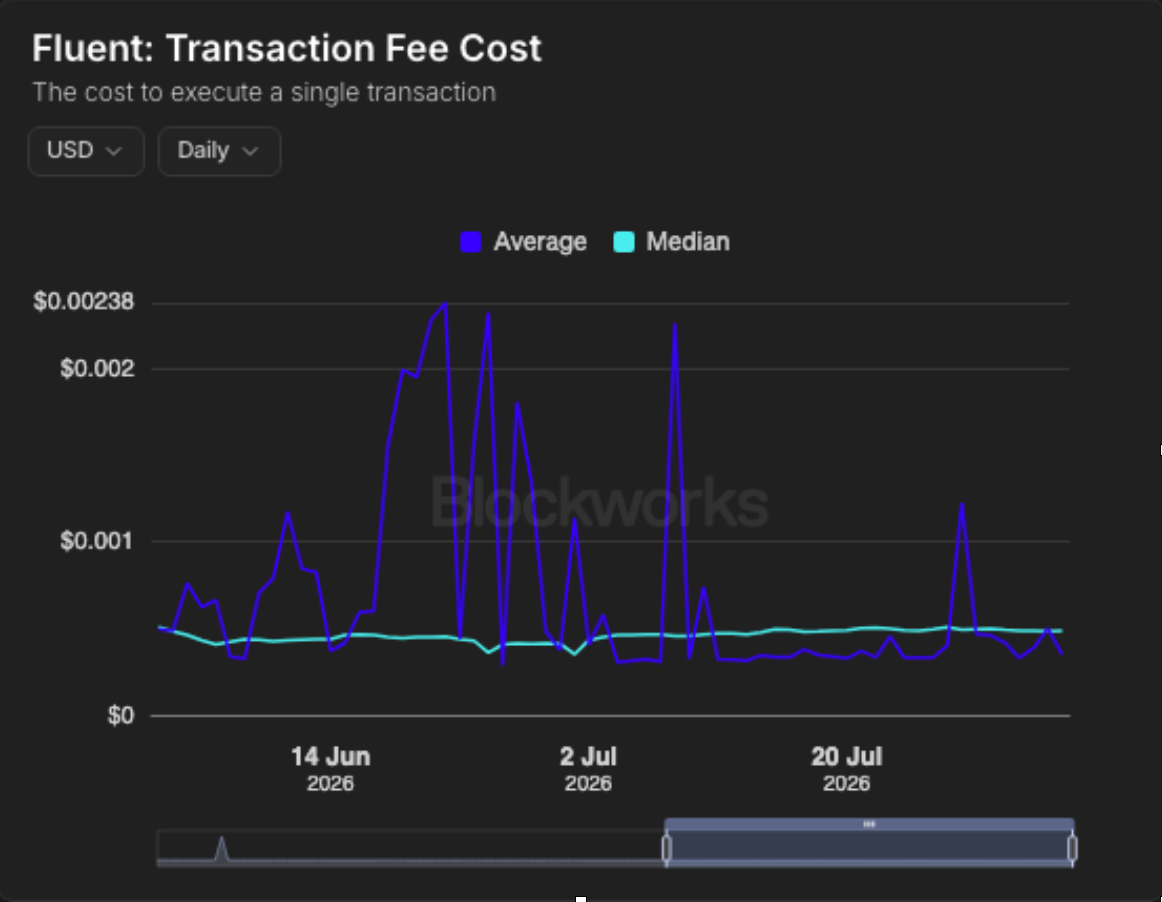
Fluent: Transaction Fee Cost: Median fees have held near $0.0005, and total fees across all tracked contracts over the past 30 days came to under $40. Fees this low are a requirement for consumer applications like polling and fantasy sports, which stop making economic sense at dollar-denominated gas costs. Fluent: Gas Throughput and Fluent: Contracts Deployed (474 to date) round out the tab.
Stablecoins
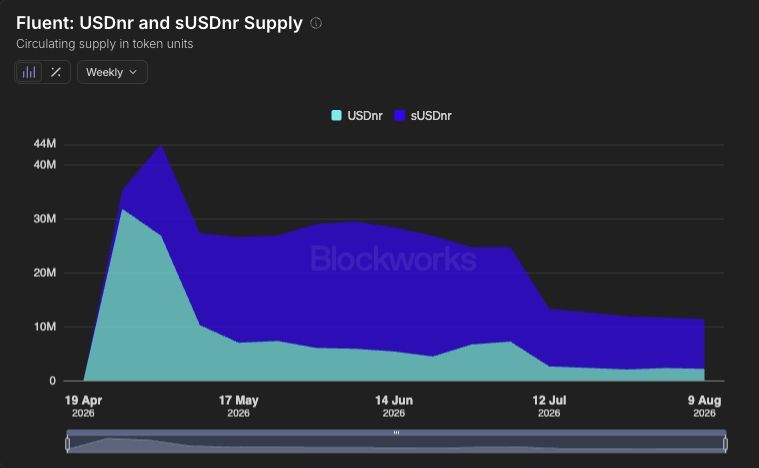
Fluent: USDnr and sUSDnr Supply: The combined float stands at about $11.5M: 2.1M USDnr circulating liquid and 9.2M staked into the sUSDnr vault, meaning roughly 80% of all USDnr has opted into the yield-bearing version. Combined supply peaked above $40M during the launch window in late April before settling to today's base. Fluent: Daily Net Supply Change and Fluent: Supply Growth by Token show the mint-and-redeem pulse underneath.
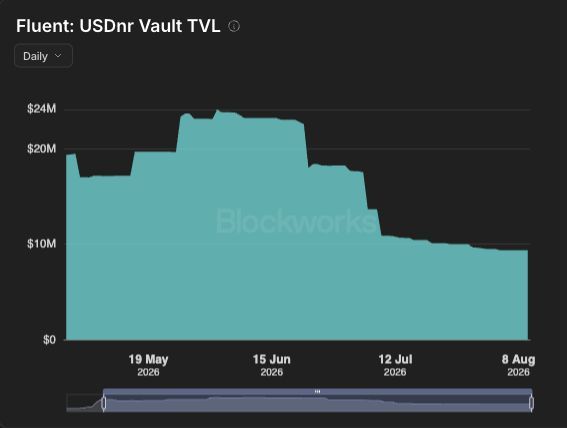
Fluent: USDnr Vault TVL: Fluent’s USDnr vault peaked at $24.1M on June 3 and sits at $9.3M, with roughly $13.7M of net outflows across June and July visible in Fluent: USDnr Vault Net User Flow.
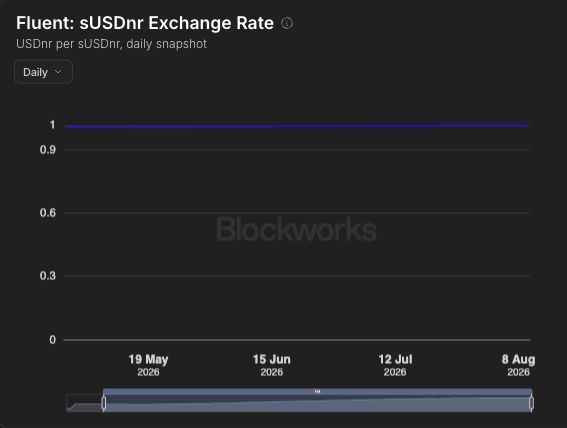
Fluent: sUSDnr Exchange Rate: Through that entire cycle, the rate has only moved up, from 1.0000 at launch to 1.0133 today, with about $150K of cumulative interest paid to stakers (Fluent: sUSDnr Depositor Interest). The steadily rising line means the yield mechanism has paid continuously since launch.
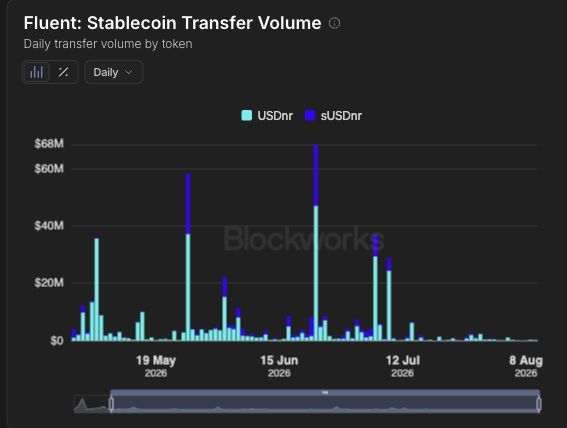
Fluent: Stablecoin Transfer Volume: This chart measures circulation rather than balances: $332M in April, $192M in May, $186M in June, and $115M in July. Supply measures the dollars held on the chain, while transfer volume measures the total value being transacted. The declining trend alongside a stable supply base indicates that most USDnr is currently held for yield rather than used for payments.
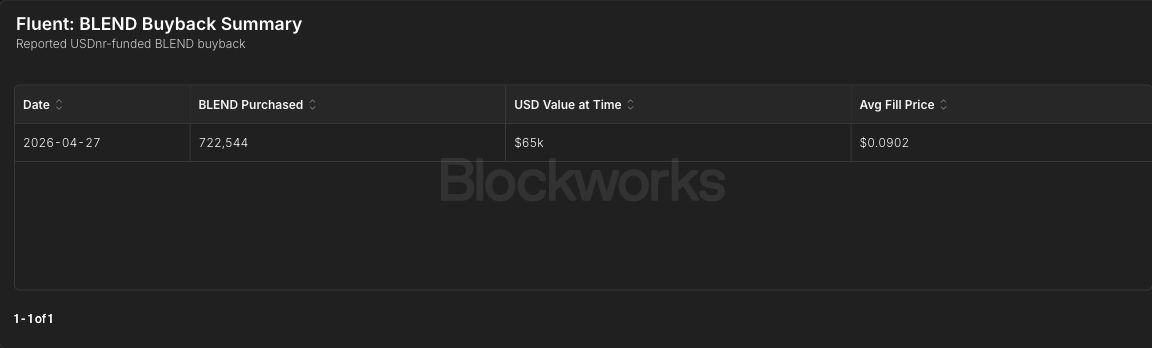
Fluent: BLEND Buyback Summary: This table records a single buyback to date: 722,544 BLEND purchased on April 27 at an average fill of $0.0902, about $65K, executed on a centralized venue and reported offchain (the one table on the dashboard not derived from chain data). That purchase roughly matches the $79K of program yield the protocol has earned since mainnet launch.
Fluent is four months old and is building a consumer-first blockchain. With its native stablecoin, USDnr, revenue is earned from T-bill yield that is used to fund BLEND buybacks. Transaction fees are kept intentionally low, creating sustainable value alongside the next generation of onchain applications. Track all of these metrics on Blockworks’ Fluent dashboard.
The information contained in this report and by Blockworks Inc. and related affiliates is for general informational purposes only and is not intended to provide legal, financial, or investment advice. The report should not be construed as an offer or solicitation to buy or sell any security, token, or financial instrument and does not represent any recommendation or endorsement of any investment or financial product or service. Blockworks Inc. and related affiliates are not registered as a securities broker-dealer or an investment advisor in any jurisdiction or country.
Back to Insights
Newsletter
The Breakdown
Decoding crypto and the markets. Daily, with Byron Gilliam.
Blockworks Research
Unlock crypto's most powerful research platform.
Our research packs a punch and gives you actionable takeaways for each topic.
Blockworks Inc.
133 W 19th St., New York, NY 10011
Blockworks Network