First shared sequencer tech to go live on Polygon zkEVM testnet
The testnet, dubbed Doppio, will be open to external nodes over the next few months
Satheesh Sankaran/Shutterstock modified by Blockworks
Blockchain infrastructure company Espresso Systems has released a testnet version of the Espresso Sequencer on a forked version of Polygon zkEVM.
The testnet, named Doppio, has been operating within the company and will be open to external nodes over the next few months.
Sequencers are responsible for ordering transactions from the mempool and then sending the information back to a virtual machine. Similar to validators on a layer-1 network, they play a critical role in operating layer-2 blockchain networks.
Today, sequencers remain relatively centralized. Rollups run their own siloed sequencers with their own execution environments — and in the case of zero-knowledge (ZK) rollups, they also have their own provers.
In an interview with Blockworks, co-founder and strategy lead at Espresso Jill Gunter explained that existing sequencers operate in a relatively monolithic way.
“In existing rollup solutions, the sequencer is just a component bundled with the rest of the rollup software,” Gunter said. “Nothing is programmable, upgradable or swappable in a very easy way.”
As a result, many rollups today have experienced some type of downtime, something Gunter believes is downplayed in today’s rollup environment.
“It’s not a total disaster because you can always force the transaction back to the [layer-1],” she said. “But that might be prohibitively expensive, and cause what I call soft censorship issues where the transactions are not being prioritized.”
How does espresso’s decentralized sequencer work?
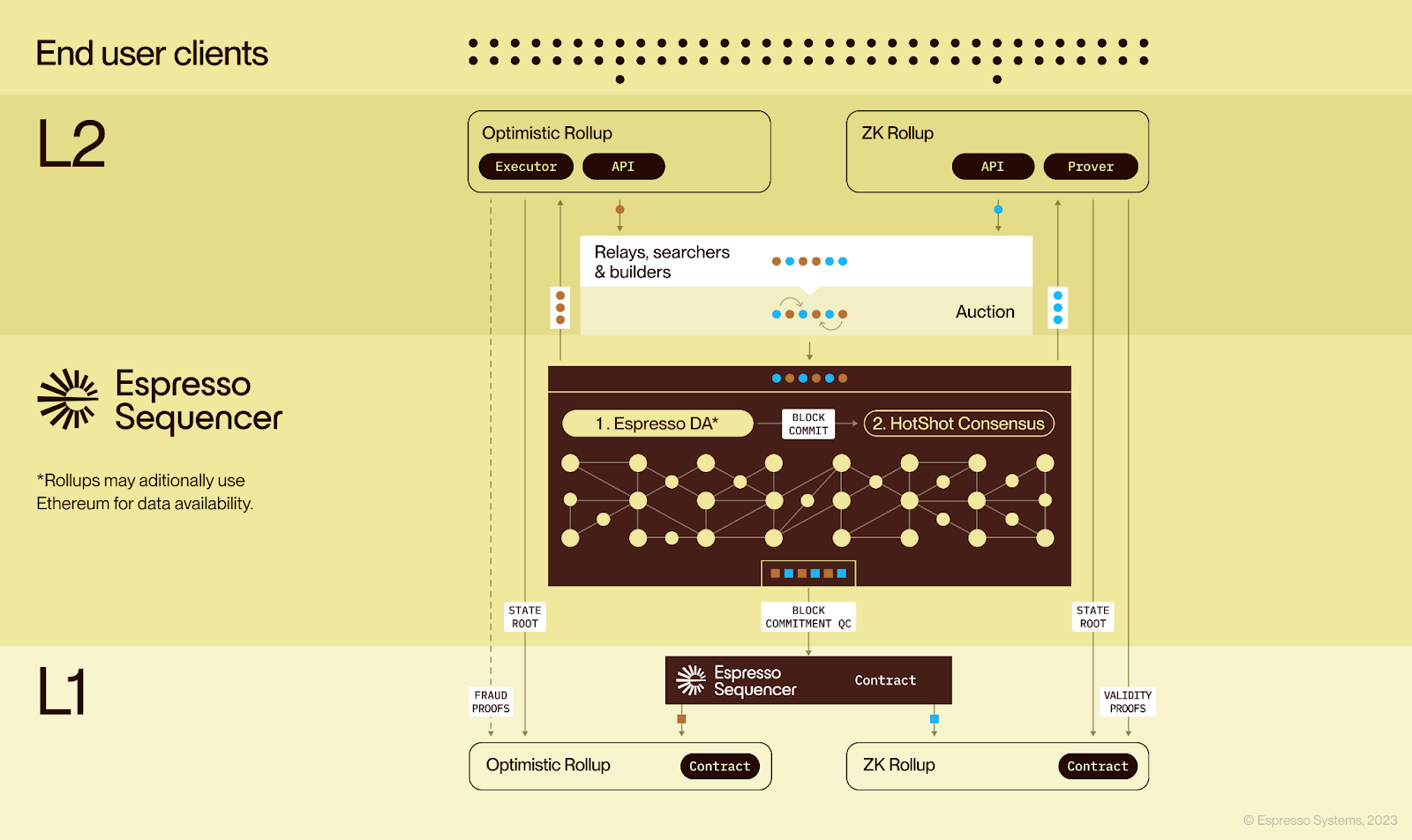
Espresso has designed its very own specialized proof-of-stake system — HotShot — that will be used to optimize for the right balance of performance while remaining decentralized and robust, Gunter explains.
“It is a distributed consensus system that can be shared among different rollups, so no longer will a rollup have to have the sequencer bundled within their own software stack. They will be using the Espresso [application programming interface] to call and submit transactions to the Espresso sequencer,” she said.
The Espresso sequencer does two things: It performs data availability as an option — this means that if a rollup wants data availability as something that is additive, they can. It also performs consensus on the order of transactions.
“The Espresso sequencer can do this across multiple rollups and there’s all kinds of interesting things that happen when you start having cross rollup ordering,” Gunter said. “There’s potential for cross rollup MEV — which we think can be a source of revenue for those who are participating in the Espesso network and the [layer-2s] as well.”
 Source: Espresso Systems
The team is also planning to leverage ETH staking to ensure there is economic alignment with Ethereum layer-1 — this is currently in the works with Eigenlayer.
Following the testnet launch on Polygon zkVM, Gunter notes that Espresso is also working on a partnership with Caldera to build an integration between the Espresso Sequencer and the OP stack. There are also existing agreements with Spire, Injective and Catalyst AMM to support them in prioritizing integration with Espresso’s Sequencer.
Get the news in your inbox. Explore Blockworks newsletters:
- The Breakdown: Decoding crypto and the markets. Daily.
- 0xResearch: Alpha in your inbox. Think like an analyst.