


Hi all, happy Tuesday!
Monday's tape was quiet at the index level but sharply dispersed underneath, led by Bittensor's subnet tokens, even as TAO slipped. And returning to new crypto cards, Plasma One has shown a strong first week of public metrics, 35.5k cardholders and $14.5M in deposits, juxtaposed against an XPL token that still captures little of it.
Monday was a low-conviction, narrow-breadth session in which the majors barely moved and the day's returns concentrated almost entirely in two narrative sectors. Bittensor Ecosystem (+9.1%) and Modular (+5.2%) ran away from the cross-sector board, while everything else clustered in a tight band: L2 (+1.3%), Lending (+1.2%), Ethereum Eco (+1.2%), Oracle, Revenue Leaders, and L1 (all ~+1.1%).

The benchmarks confirm how quiet the underlying tape was — BTC +1.0%, Gold +1.0%, Nasdaq 100 +0.3%, S&P 500 roughly flat. There was quite some dispersion between the top sector and the worst (Crypto Miners, -3.4%) at ~12.5 points on a day BTC moved ~1%.

Bittensor and the broader decentralized-AI complex garnered a fresh look after the June 12 US export-control directive that forced Anthropic to disable its latest models, a sequence framed across crypto media as a live demonstration of centralized-AI access risk.
TAO itself has retraced nearly all of its 30% run up, however, and was lower yesterday even as the subnet basket rose.

The Bittensor Ecosystem index tracks subnet alpha tokens rather than TAO itself, and the market is responding to changes in the way the Opentensor Foundation is directing TAO emissions to subnets (more on that from Nick Carpinito soon).
Subnet tokens typically trade as leveraged TAO beta, and the curve wasn’t limited to a single name: lium (SN51, +19.4%) topped the component board, followed by Chutes (SN64, +15.1%), iota (SN9, +11.8%), affine (SN120, +8.9%), and NOVA (SN68, +8.0%), but roughly half the basket closed lower, so the index gain rode a handful of names rather than a sector-wide bid.
Modular's +5.2% (led intraday before fading from a midday high near +11%) purely on the strength of TIA. Celestia's v9 upgrade, which will reduce block times by half to 3 seconds, is currently on testnet.
The cleanest downside sub-story was Solana Eco (-1.7%), dragged almost entirely by DRIFT. The token shed ~16%, by far the worst index component, reversing a similar sized weekend pump. BONK, CLOUD, KMNO, ORCA, and RAY all finished modestly green. DRIFT remains offline post-hack and so cannot benefit from Solana’s burgeoning onchain equity trading interest.

— Macauley

Blockworks is now tracking BNB Chain, one of the largest blockchain ecosystems in crypto with over $18.5 billion in stablecoins and other RWAs.
Since launching in 2020, the EVM-compatible L1 has delivered consistent upgrades and rock-bottom fees, while staying one of the most used blockchains in crypto.

The new dashboard offers 14 pages of data, allowing users to explore the most in-depth BNB Chain dashboard in the industry. With more than 100+ charts, we cover activity, burns, fees, TPS, TVL, stablecoins, DeFi leaders, and more.
Plasma One: Growth Before Monetization
Plasma One publicly launched last week on June 17, giving the market a clearer read on early demand for the product. The initial growth metrics are notable.
As of June 22, Plasma One had 35.5k registered cardholders, more than 13k activated cards, and 4k Earn users. Deposits have also ramped quickly. Combined Earn and Checking deposits have increased from less than $1M at the end of Q1 to $14.5M today, with Earn accounting for most of the growth.

Card usage is also scaling quickly. Total card spend has reached $11.3M across 64.6k transactions, but the more important point is the recent growth acceleration. Plasma One was doing less than $5k in daily card volume around mid-March, rising quickly to over $400k per day in the last two days following the public launch on June 17.

The caveat is that growth is being partly subsidized by incentives. Plasma One has distributed roughly 3M XPL in cashback, worth about $280k at current prices. At an illustrative 1.5% take rate on card spend, the $11.3M of cumulative card volume would imply roughly $170k of card revenue. The take rate required to cover cashback alone is closer to 2.5%, which is likely above what most stablecoin card products can realistically retain.

Broader XPL issuance is also meaningful. Claimed XPL incentives were roughly $158k in the latest week and have ranged from $120k to $240k per week over the past six weeks. That is not necessarily a problem at this stage. Incentives can be rational if they acquire users who retain balances, spend through the card, and ultimately deepen the Plasma ecosystem. But it does mean investors need to separate product traction from token value capture.

That is still the open question for XPL. Chain monetization remains minimal, with Plasma network fees running in the low hundreds of dollars per day and fee burn still negligible. It is also unclear whether XPL holders have any direct claim on Plasma One app-level revenue. For now, the clearest XPL utility comes through the card-tier lock mechanism, where users can lock XPL to access higher-tier benefits.

This makes the next few months important. Plasma One’s public launch has made the growth story more credible, but XPL still faces a meaningful burden of proof. Only about 25% of supply is circulating today, while team and investor allocations, which represent roughly 50% of total supply, begin unlocking in about three months.

The setup is straightforward: Plasma One is showing real early consumer traction, but XPL value capture remains low. The next phase is proving that app growth can become sticky enough to matter for Plasma the chain and durable enough to absorb incentives and upcoming unlock pressure.
— Carlos


Clément Lesaege, from Kleros, published an Ethereum Research post proposing Validator Redirected Revenue (VRR) as a protocol-level funding mechanism to fix Ethereum’s chronic free-rider problem around public goods funding. The core idea is that validators would signal two preferences — what share of staking rewards to redirect (0–10%) and which recipient addresses should receive those funds — and if a majority opts in, the redirect becomes mandatory for all validators, with execution clients converging on a “king of the hill” splitter contract that best matches validator preferences.
The author frames this as a way to reduce deadweight loss in the Ethereum economy by letting validators collectively fund ecosystem development they already benefit from, while still keeping governance overhead low through mostly “set-and-forget” preferences. The main concerns raised are validator cartelization, principal-agent conflicts between staking operators and ETH holders, and whether willingness to redirect rewards implies ETH issuance itself is too high.

Katherine We from ENS Labs proposed a major governance redesign that shifts day-to-day stewardship, treasury strategy, and grant allocation from the ENS DAO into an expanded ENS Foundation, while keeping protocol control exclusively with tokenholders. The argument is that ENS DAO works well for credibly neutral protocol stewardship, but poorly as an operating body for budgets, staffing, and long-term capital planning, so the proposed fix is a more traditional nonprofit-style foundation model inspired by groups like Mozilla and Signal.
Under the proposal, ENS Labs and the Foundation remain independent but mission-aligned: the Foundation would hold the trademarks, fund Labs through grants, manage the broader operating envelope, and be run by a five-seat board made up of a full-time Executive Director and three independent directors, all subject to DAO ratification and removal. The post emphasizes that this is not a retreat from DAO governance, but a narrowing of what the DAO governs directly, so tokenholders still control smart contracts, pricing, fees, root key/registry control, and constitutional changes, while the Foundation takes over the slower, more context-heavy work of strategy, coordination, and capital stewardship.
recent research
Research
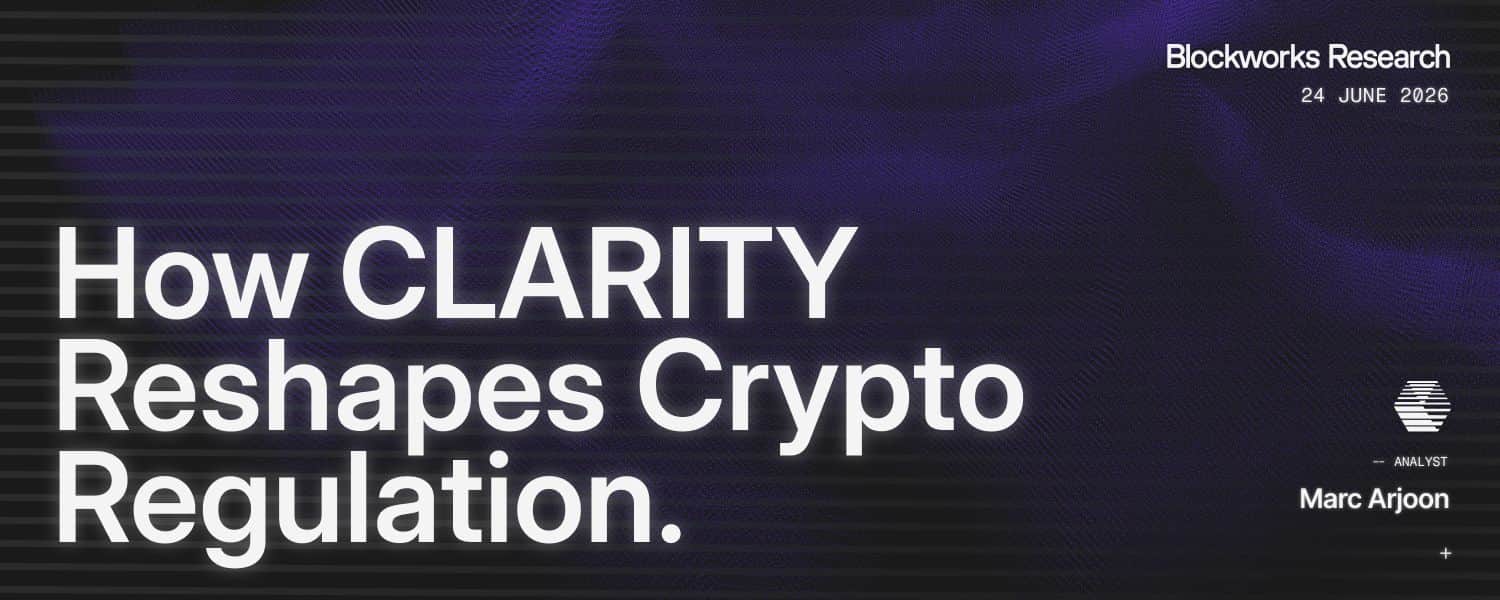
Classified as a market-structure bill, CLARITY is closer to a full operating system for US crypto. At its core is the SEC/CFTC jurisdiction split (ancillary assets vs network tokens), mediated by a decentralization test. The bill also covers disclosure and raise-cap rules for token originators, a safe harbor for staking and NFTs, restrictions on stablecoin yield, explicit self-custody protections, and a sweeping anti-illicit-finance regime that pulls crypto brokers under the Bank Secrecy Act. The result is a framework more investor-protective than its global peers, if it can pass before the August recess.