Introducing Agentic Detection : Asset monitoring built for the AI EraLearn More
Insights / DeFi Credit Risk
Reflect: The Mechanics of Onchain Tranching
A survey of the current state of DeFi tranching, how protocols split yield into protected senior and first-loss junior tranches, how these designs compare to traditional CLOs, and what they imply for Reflect's own tranche product.
By Toma Yamashita ·
Disclosure: Reflect commissioned and funded this advisory research.
DeFi has rarely suffered from a shortage of yield and has instead suffered from a shortage of risk segregation, forcing every participant into the same undifferentiated positions. Tranching separates the question of who gets paid first from who gets paid most, which lets a single yield engine serve a conservative allocator and a leverage-seeking one at the same time. As DeFi offerings converge to risk adjusted products offered in traditional finance, tranching products have seen a rise in popularity due to the clear risk-return tradeoffs associated with them.
The mechanism is imported from structured credit, where a collateralized loan obligation (CLO) pools a granular book of corporate loans inside a bankruptcy-remote vehicle and funds it by issuing a stack of liabilities that runs from AAA-rated debt down through BB and into an unrated equity tranche at the base. Cash flows descend through the stack in priority order, with senior obligations being paid their coupons first while the equity tranche claims the residual last. Losses ascend from the bottom and consume equity before they reach a rated layer.
Three features of the CLO are worth carrying through this report, because each is either missing onchain or present only in a weaker form. The first is diversification: a CLO spreads its capital across one to three hundred separate loans, ensuring no single default does much damage, which lets the senior tranche earn an investment-grade rating even while the loans beneath it are rated lower. The senior is kept safe by the sheer number of loans rather than by the quality of any one of them.
The second is active de-leveraging: a CLO runs ongoing overcollateralization and interest-coverage tests, which ask whether there is still enough collateral behind the debt and enough interest coming in to cover obligations. When these checks weaken, they stop paying the junior tranches and routes that capital to pay down the senior debt instead, shrinking senior claims until the structure regains its health. In effect it repairs itself with the junior's money before the senior is ever touched.
The third is external validation and a managed term structure: CLO tranches are rated by external agencies against published methodologies, giving investors a third party read on the associated risks. The vehicle is term-funded with set reinvestment and non-call periods, meaning capital is committed for a set period of time, with defined windows for reinvesting and early exits. This prevents investors from rushing out of such vehicles all at once and causing CLO managers to weather a run.
Architecture and Design Space
Two tranches (junior and senior) is the standard across DeFi. While some protocols have introduced a third tranche, there has been no proven use to one yet. The pattern that fits a stablecoin issuer has converged across the product-native protocols: issue a base token worth one unit of the underlying, then layer the tranches on top as derivatives. This adds a third party beside the senior and junior tranches, the base-token holder, who takes no tranche position but supplies redeemable liquidity. For an issuer that already has a base stablecoin, this is the easy path in, since the senior and junior are just two products layered on an existing token.
Voluntary Junior Tranche
A voluntary junior tranche design is the simplest case. Junior and senior tranches are separate deposits, and anyone can take the first-loss side for the higher yield. The junior tranche acts a levered position, giving the senior tranche protection as a side effect. The weakness of this design lies in cases of runs: if the junior tranche can exit freely, the protective asset is able to walk out when it is most in need. Most protocols address this with a redemption gate or a cooldown mechanism.
Junior Lockup
The lockup model, used by infiniFi, lets the same depositors pick their risk by locking up. A deposit mints a base token, which can be staked into the liquid senior leg, or locked into the junior leg. Junior tranche depositors earn a higher yield for a fixed term, but take on first loss risk. An explicit lock allows depositors to make a conscious decision, making first-loss credible and preventing any runs when protection is most needed. The main risk is that the protocol now behaves like a bank, with both short and longer term liabilities (senior and junior tranche depositors), making a redemption run on senior tranche assets a critical risk if sufficient liquidity is not maintained. Yield generating strategies taken on by the protocol are most likely harder to exit during times of stress, causing a potential unwind of positions at losses. The critical design choice in this model is the liquidity buffer to meet short term redemptions and ensure no maturity mismatches.
Curator as First Loss
Curator as first loss requires the curator of a vault to post the junior capital, ensuring skin in the game by the decision maker. This acts as an alignment tool and can most be compared to CLO risk retention, where the manager holds the equity tranche. The risk is with curators holding too thin of a stake, as fees would largely outpace the potential small first loss risk. When the curator stake is too thin relative to fees, curators are incentivized to take on risk rather than to avoid it.
The Yield Engine
In tranching as a product, the protocol runs its own strategy and tranches it. Avant runs a multi-strategy book, Yuzu leveraged stablecoin loops and arbitrage, and 3Jane unsecured credit. Strategy and structure live together, with yield engine failure resulting in protocol failure.
In tranching as a service, a platform splits a yield source it does not run. For example, Strata splits Ethena's sUSDe into a benchmark-floored senior and a junior insurance pool, Royco splits any source and prices the split by utilization, and Centrifuge is a toolkit issuers configure themselves. The platform owns the structure rather than the strategy, allowing it to grow by adding sources. This spreads risk but leaves it dependent on outside teams for quality.
Yield Distribution
Yield distribution in existing models ranges from fixed to fully discretionary. The first generation of tranching products like BarnBridge set yields from a moving average of the lending rate and held it for the life of the bond, with junior taking the surplus or covering the shortfall, while Saffron paid junior a fixed multiple of pool interest funded by what senior tranches gave up. Both leaned on token emissions for yield, which made them fragile once emissions fell.
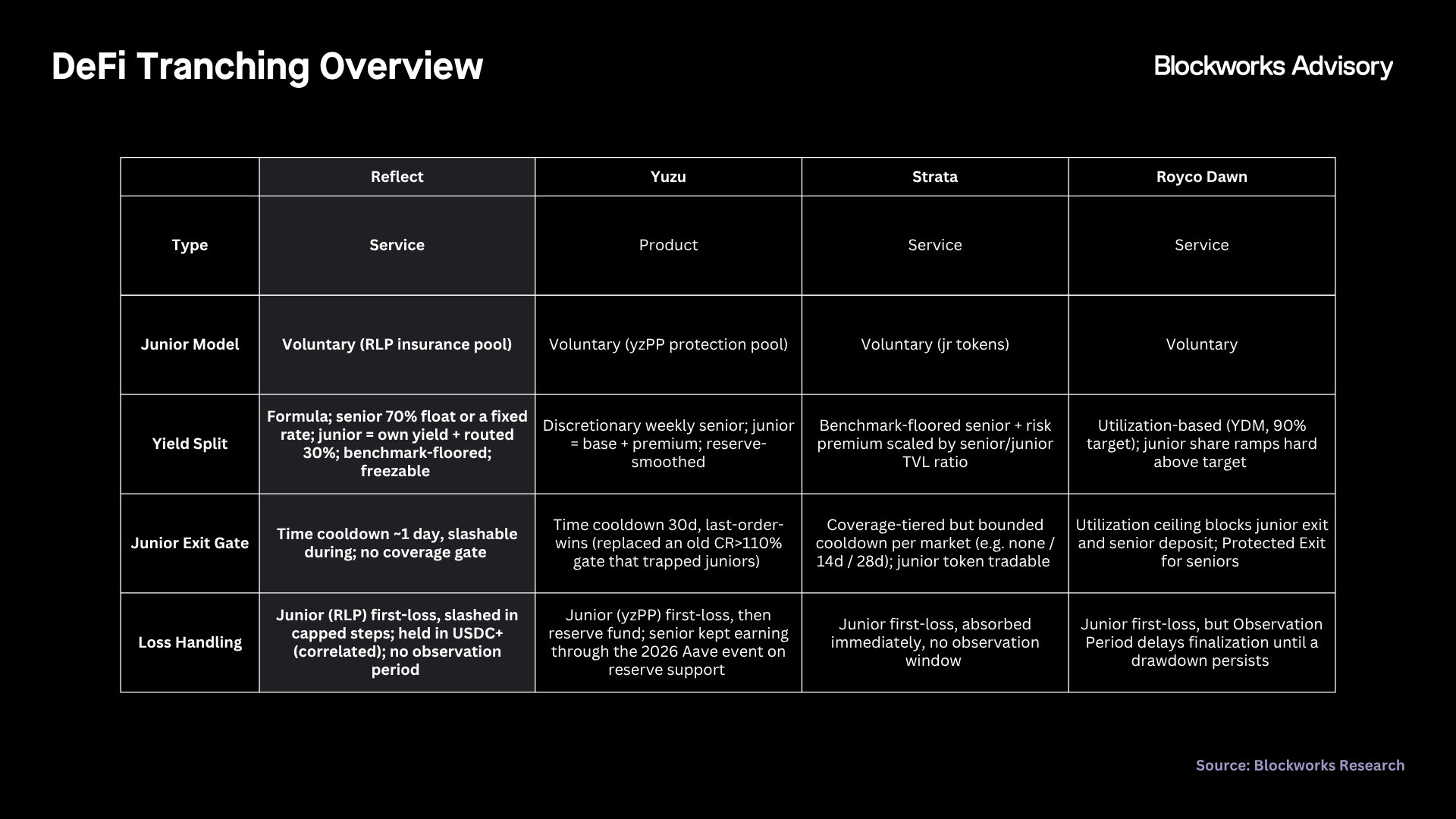
Today's designs split dynamically and differ mainly in how much the senior tranche has to trust a curator. Resolv is the most explicit, splitting profits into a shared base, a risk premium for junior, and a fee, and sending any loss entirely to junior. Strata floors the senior to an external benchmark and sizes the junior's premium off the senior-to-junior ratio, so junior depositors pay more as senior grows and pulls in fresh coverage. Royco prices the split purely on utilization, targeting ninety percent coverage and paying junior steeply more above that. At the other end, 3Jane splits its credit book interest in fixed proportions, a set fraction to the junior and the rest to the senior tranche. Both rates float with what the loans repay, meaning the senior tranche has no fixed coupon to defend.
3Jane's split tracks borrower repayment, and Yuzu's is set by hand each week and smoothed by a reserve, which leaves the reported yield detached from what the book actually earned. The plain reading is that a formula lets the senior verify its claim, while a discretionary split turns the senior position into a bet on the team.
Liquidity and Redemption
Redemption is where the senior's protection is tested the most. First generation tranching products locked all depositors into fixed epochs. Today, cooldowns that run longer for junior tranches than senior are more common. Avant gives senior depositors almost no cooldown and juniors seven days, during which the junior earns no yield and redeems at the worse of two prices, discouraging quick exits. 3Jane locks junior depositors for a month, in addition to capping redemptions to the idle cash behind an illiquid loan book.
The strongest designs gate redemption on the system's health, which is the onchain version of a CLO coverage test, with one difference that matters: a CLO repairs itself by moving cash while capital stays invested, while a coverage gate repairs the ratio by freezing the junior in place. For example, Strata raises junior tranche fees and cooldowns as coverage falls. The risk shows in Yuzu's old design, where junior tranches could only exit above a ratio the system never reached, effectively locking depositors with no real exit. A coverage gate that may never open needs a time limit or a secondary market, so the junior is illiquid rather than trapped.
Composability
Tranche tokens are liquid and can be used as collateral, which is an advantage over a locked CLO tranche and a new source of risk. Pricing them remains a difficult task as senior tranches benefit from increased safety from junior protection, while introducing smart contract and liquidity risks. These two extremes are constantly in tension when pricing tranches for lending.
One aspect of composability that has been pushed to its limits in lending is the notion of continuously looping a yielding asset to enhance its yield. As junior tranches will inherently yield more than a senior tranche, it is expected that it will be looped on lending markets to push yields to a maximum.
Reflect's Design
Reflect is entering the space on Solana with a design based on permissionless slashing and fixed time locks to improve the protection offered to seniors.
Reflect Tranches splits a single yield-bearing stablecoin, USDC+ or another, into a protected senior position and a higher-earning junior position, run by two programs: a proxy that issues the senior token and a pool that holds the junior capital.
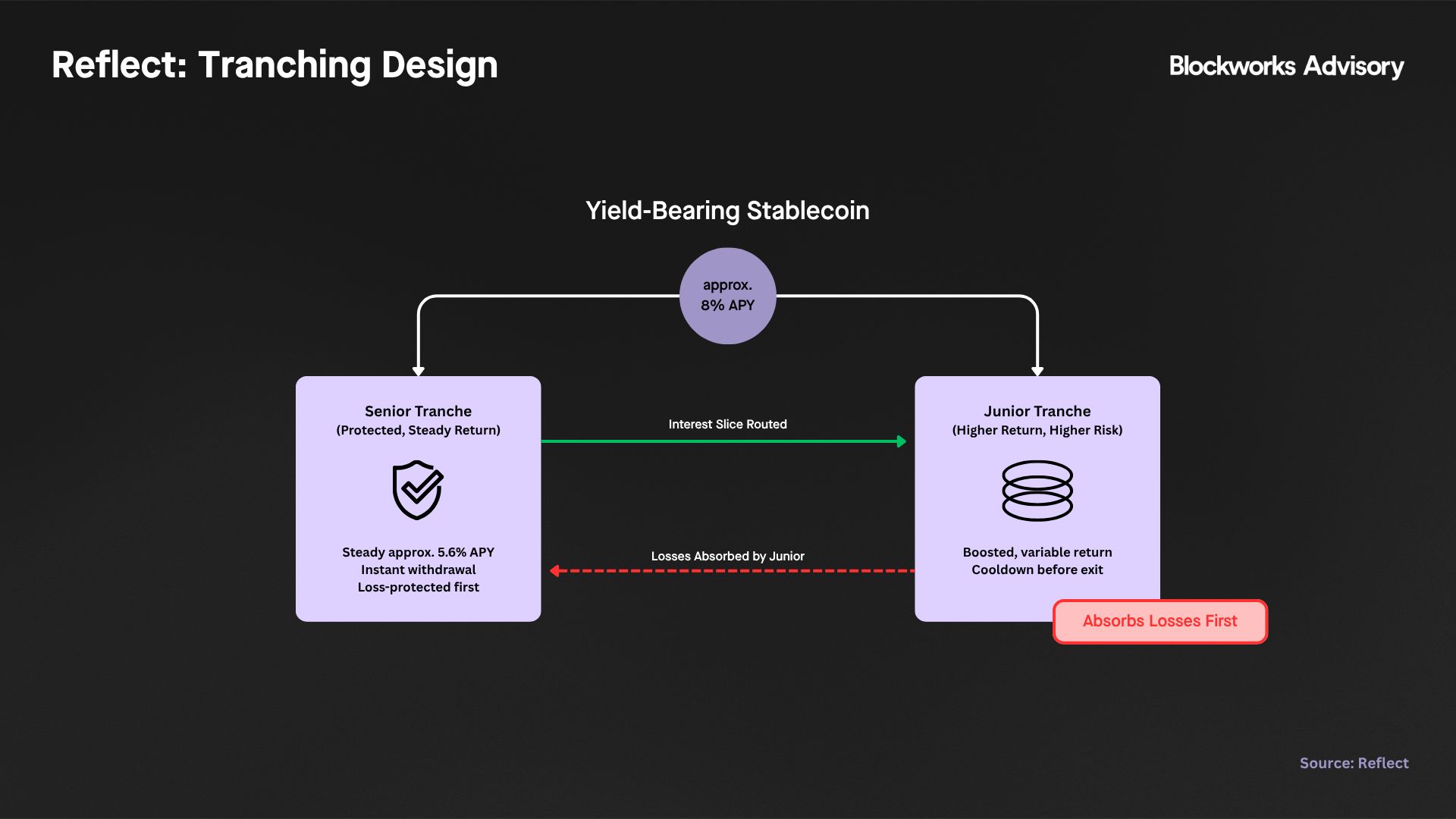
The senior holder receives a protected version of the stablecoin, with a steady return and instant redemption, and gives up part of its interest, which is routed to the junior as payment for the protection. If the underlying loses value, the junior pool is drawn down to restore senior holders, ensuring senior coverage up to the size of the junior tranche below it. Restoration happens in capped steps, meaning recovery from a large loss is gradual rather than immediate.
The junior holder supplies that protection and is paid for it twice, keeping the underlying's own yield and receiving the slice routed from senior on top. The size of that boost depends on coverage, the ratio of senior to junior capital. When senior is large relative to junior the routed reward is split among fewer depositors and each earns more, which is also when the protection is thinnest, so coverage is the junior's return driver and the senior's safety margin at once, pulling in opposite directions for the two sides.
Take the first of those two, the underlying's own yield. The junior earns it because the pool is held in USDC+, not in some separate asset kept aside for insurance. That was on purpose. It keeps the junior's money working instead of sitting idle, and it keeps losses simple to handle, since a slash just moves USDC+ from the junior pool to the senior vault with nothing to convert along the way. The catch is that the insurance is made of the same thing it insures. It handles a contained loss in one venue fine, but in a broad USDC+ shock it loses value right when it is needed, which is where a buffer held in something unrelated would have held up. So the buffer is really built for the everyday losses, not for USDC+ itself failing, and that is worth saying out loud.
A benchmark rate sets the floor for the senior under either setup. In the floating setup the senior tracks the underlying yield, net of the routed slice, and the junior tops it up whenever it would fall below the benchmark. In the fixed setup the senior is locked at a set rate, with any surplus passing to junior and any shortfall covered by junior. The fixed setup gives the most predictable senior return and puts the most pressure on the junior, which absorbs every gap between the promise and what the market delivered.
Withdrawals are asymmetric, and the asymmetry is built into the design rather than bolted on. Senior redemptions are instant because the senior token is just a wrapper: each one is backed by a unit of USDC+ sitting in the proxy vault, not lent out or redeployed, so redeeming hands the USDC+ straight back with nothing to unwind. Junior redemptions run through a cooldown, and the capital stays slashable the whole time, so a junior holder cannot get out ahead of a loss. Those two facts are the same fact. The junior's cooldown is what keeps the vault behind the senior full, which is what lets the senior leave on demand even in a bad moment. The senior gets the first call on the liquidity, and the junior waiting is what pays for it.
Looking ahead
Tranching is a new risk primitive that allows a more precise allocation of risk across market participants. We've seen different designs in the market, each one mapping to different trade-offs and risk profiles, many of which are not always obvious.
In the beginning of the report we’ve seen three different features of CLOs: the onchain alternatives are competitive when it comes to enforcing overcollateralization and interest coverage rules, but lack diversification and the presence of external validation and managed term structure to prevent bank runs.
Reflect is entering the space on Solana with a flexible stack, presence of floating and fixed set-ups for rate settings and permissionless lashings, improving on the pricing and transparency issue. Watch this space, as we believe that it will grow substantially over the next few months.
Back to Insights
Newsletter
The Breakdown
Decoding crypto and the markets. Daily, with Byron Gilliam.
Blockworks Research
Unlock crypto's most powerful research platform.
Our research packs a punch and gives you actionable takeaways for each topic.
Blockworks Inc.
133 W 19th St., New York, NY 10011
Blockworks Network