Blog / Advisory Analysis
Ethena: sUSDe Dynamic Cooldown Framework
This analysis develops a dynamic cooldown framework that adjusts sUSDe unstaking periods based on real time liquid backing adequacy.
By Blockworks Advisory ·
1 Framework architecture
Liquidity tier classification
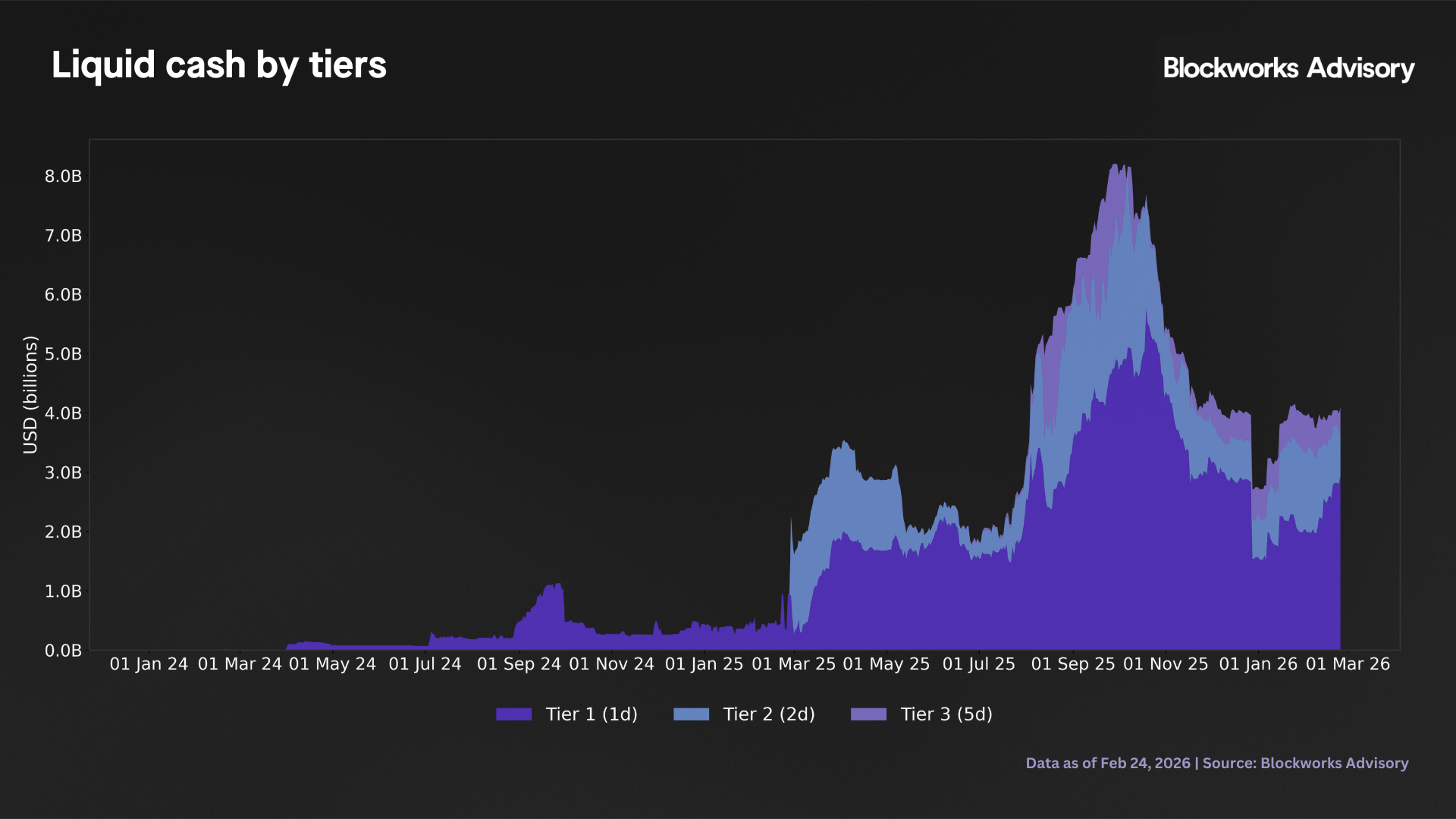
The framework categorizes liquid backing into three settlement speed tiers:
Tier 1 (1-day settlement)
- Blue chip stablecoins (USDC, USDT, PYUSD): currently $1,996M (50% of liquid backing)
- Mint/redeem contract holdings: Included in above
- Ethena native stable (USDtb): Included in above
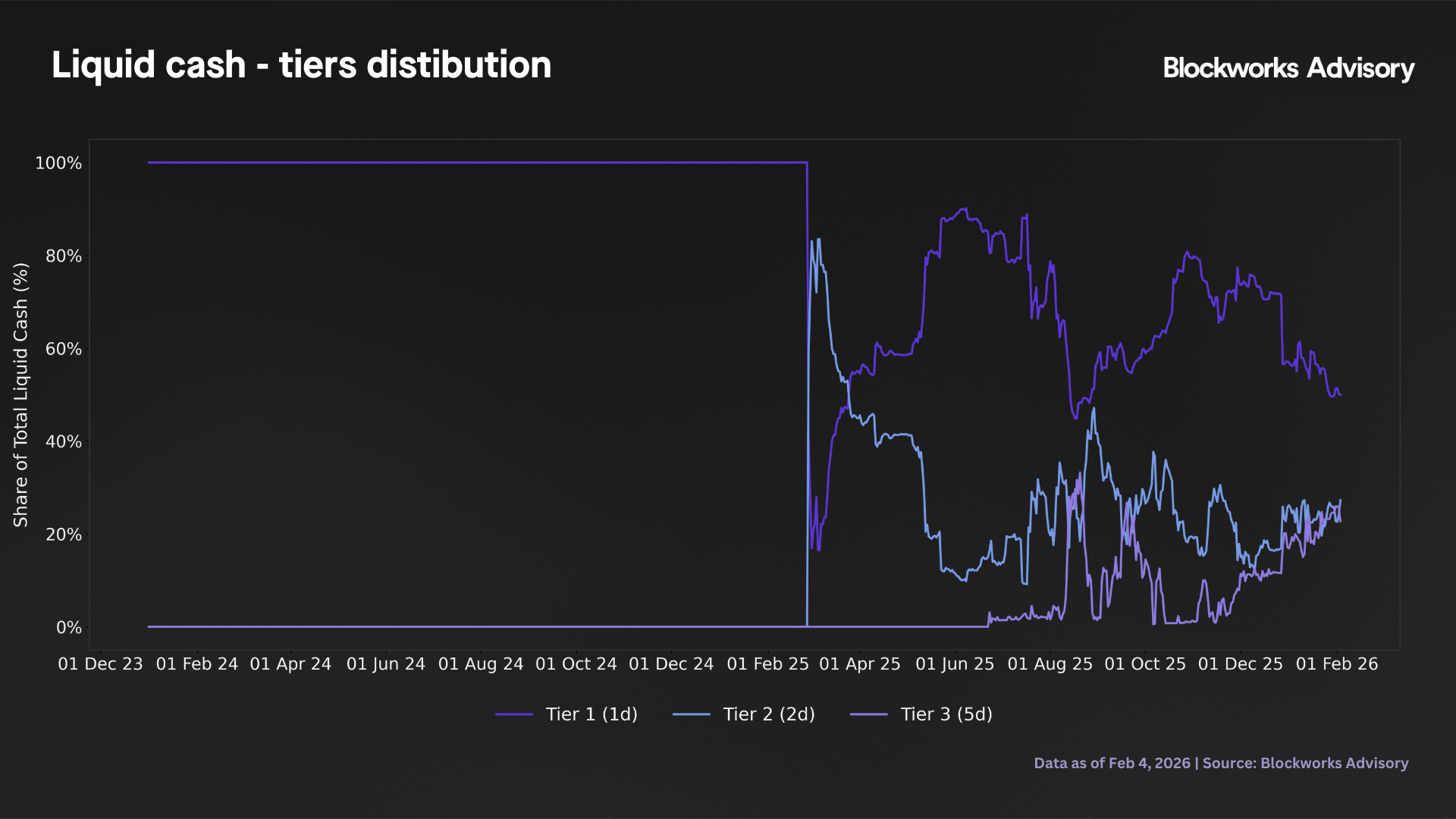
- Current allocation: 50% (target 40-55% for consistent < 3-day cooldowns)
Tier 2 (2-day settlement)
- Yield bearing stables (sDAI, sUSDS): currently $1,089M (27%)
- Withdrawable lending positions: Weighted by protocol liquidity constraints
- Methodology: Per protocol allocation = min(supplied balance, withdrawable liquidity)
Tier 3 (5-day settlement)
- Utilization constrained lending positions: currently $908M (23%)
- Rationale: Requires market utilization decrease to free capital
Current state (February 4, 2026):
Based on the cooldown analysis, total usable liquid backing is $4.0B (61% of $6.5B USDe supply) with
- Tier 1 alone ($2.0B) exceeds required buffer ($897M) by 2.2×
- Recommended cooldown: 1 day
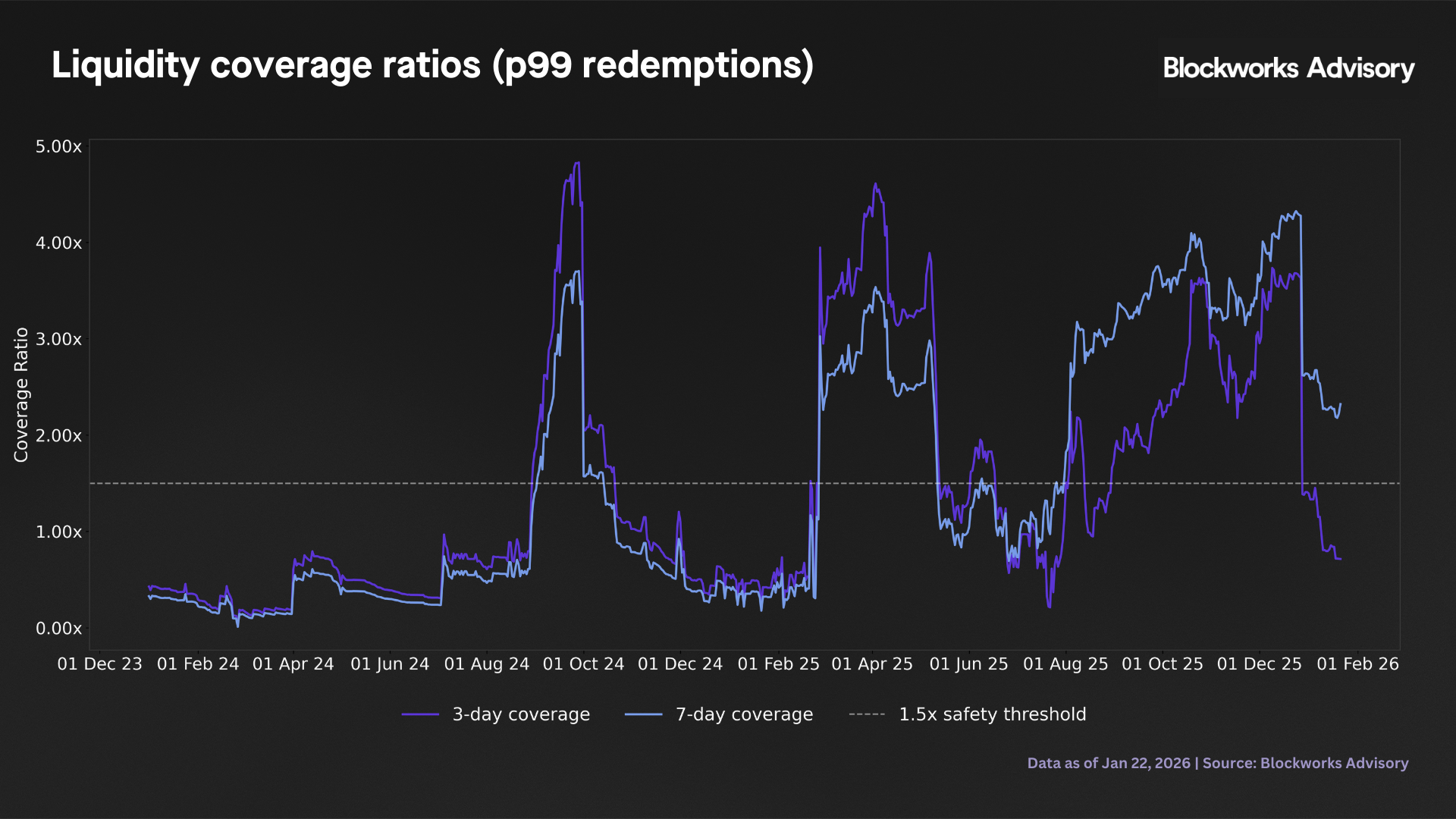
- Safety status: green (4.42× coverage >> 1.5× target)
2 Historical performance analysis (752 Days)
Coverage distribution - statistical summary (1.5× target):
Minimum: 0.00× (complete depletion during early growth phase)
Median: 1.33× (11% below safety threshold)
P95: 4.54× (abundant liquidity periods)
Maximum: 4.89× (current near peak state)
Interpretation: Median coverage below 1.5× target indicates 50% of historical observations operated in suboptimal liquidity regime.
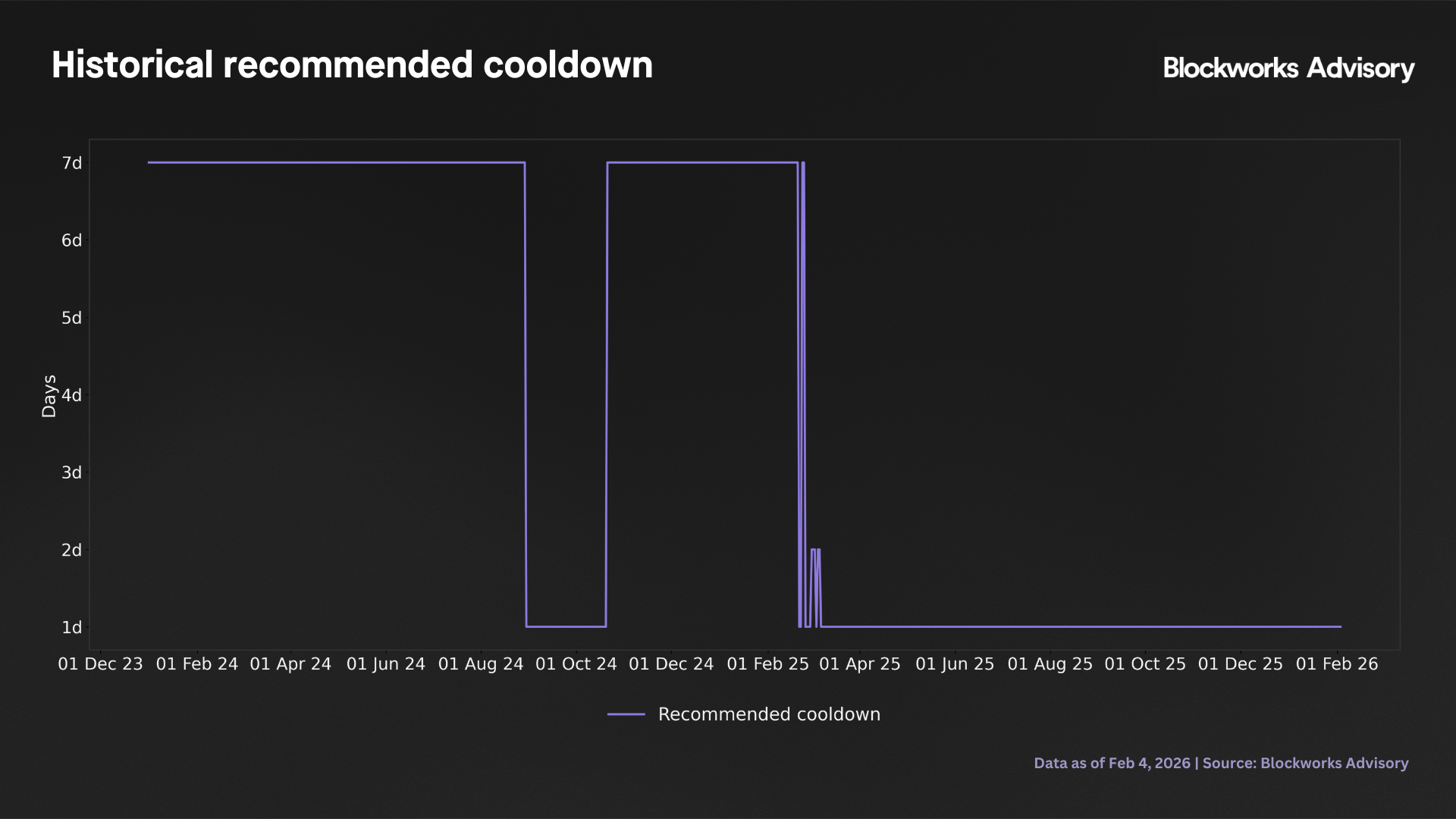
Cooldown requirement distribution - bimodal regime structure:
1-day cooldown: 51.4% of days (high liquidity regime)
2-day cooldown: 0.7% of days (rare transition state)
7-day cooldown: 48.0% of days (low liquidity regime)
Average cooldown: 3.88 days
Regime transitions: 9 events over 752 days (1.2% regime change frequency)
Critical observation: The system exhibits discrete operational modes. The near absence of intermediate cooldowns (2-5 days at 0.7%) reveals binary regime dynamics:
- High liquidity regime (Regime A): Tier 1 >50% of liquid backing, coverage >2.0×, supports 1-day redemptions
- Low liquidity regime (Regime B): Tier 1 <35% of liquid backing, coverage <1.5×, requires 7-day cooldowns
Regime transition triggers:
- A → B transitions: Rapid supply growth (+20% in 30 days) without proportional Tier 1 additions, or backing rebalancing toward yield generating Tier 3 assets
- B → A transitions: Supply contraction, defensive Tier 1 accumulation, or external liquidity infusions
Liquidity evolution patterns - historical tier composition dynamics:
Phase 1 (Jan 2024 - Feb 2025): Emerging operations, Tier 1 dominated (100%), backing ranged from $3.6M to $1.1B, coverage highly volatile especially during rapid scaling period (July-September 2024 saw growth from $70M to $1.1B), minimal backing complexity with all liquid assets in blue-chip stablecoins.
Phase 2 (Feb 2025 - Jun 2025): Framework expansion, Tier 2 introduced on February 27, 2025 at $1.33B (immediate diversification), Tier 1 share collapsed from 100% to volatile 20-80% range as backing rebalanced toward yield generating assets, total liquid backing scaled from $2B to $4B, Tier 1 absolute amounts remained $270M-$2.0B but represented diminished percentage of total (period of framework operationalization).
Phase 3 (Jun 2025 - Feb 2026): Full three tier framework operational, Tier 3 introduced on June 23, 2025, liquid backing surged to peak $8B (October 2025) driven by massive expansion, then contracted 50% to current $4.0B, Tier 1 maintained at $2.0B representing 50% of liquid backing (defensive stance during contraction period), current coverage 4.42× represents local maximum
Implication: Current favorable coverage (4.42×) reflects recent supply contraction combined with maintaining Tier 1 at 50% of liquid backing, not structural improvement in supply liquidity dynamics. Renewed growth will likely revert to Regime B unless Tier 1 grows proportionally.
3 Forecast scenarios (12 month horizon)
Econometric framework:
- Vector Autoregression (VAR): 7-day lag structure modeling Tier 1/2/3 interdependencies and supply dynamics
- Regime-Switching: Endogenous identification of normal versus stress states based on coverage thresholds
- Monte Carlo Simulation: 1,000 runs per scenario, student t innovations for fat tail representation
- Initialization: From historical median state to avoid optimistic bias
Forecast validation: Updated scenarios show 5-10% of days requiring 7-day cooldowns (vs historical 48%), indicating the model assumes moderate liquidity regime improvement but acknowledges persistent constraints.
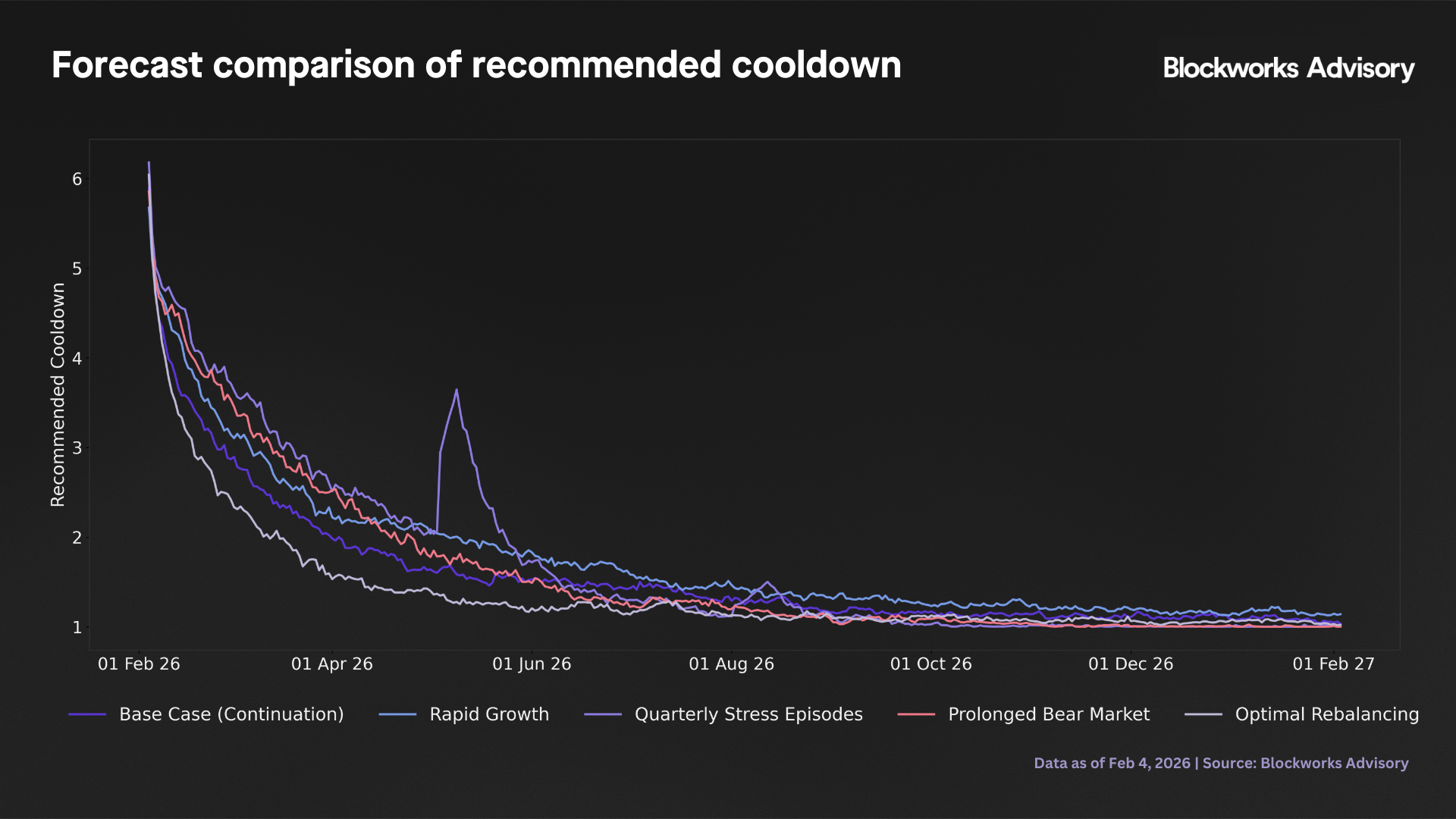
| Scenario | Avg Cooldown | % Days ≤3d | % Days 7d | Avg Coverage | P5 Coverage | Risk Assessment |
|---|---|---|---|---|---|---|
| Base Case | 1.17 days | 98.4% | 0.5% | 5.31× | 1.72× | Low risk, assumes moderate supply growth (5% quarterly) and stable Tier 1 allocation (50%) |
| Rapid Growth | 1.32 days | 97.0% | 0.8% | 5.02× | 1.57× | Moderate risk, 15% quarterly growth strains liquidity, P5 coverage approaches safety threshold |
| Stress Episodes | 1.35 days | 96.2% | 2.2% | 17.59× | 1.44× | Elevated risk, quarterly shocks cause periodic compressions, high volatility (P95: 56.9×) |
| Bear Market | 1.26 days | 96.4% | 0.8% | 11.35× | 1.46× | Low to moderate risk, supply contraction reduces redemption pressure, coverage inflates |
| Optimal Rebalancing | 1.12 days | 98.6% | 0.5% | 5.71× | 1.88× | Lowest risk, Tier 1 increased to 55%, supports consistent <2-day cooldowns |
Scenario summary
- All scenarios forecast dramatic improvement over historical 48% at 7-day cooldowns: Even rapid growth shows only 0.8% at maximum cooldown vs 48% historically. This optimism reflects the assumption that recent Tier 1 strengthening (50% vs historical 35% average) persists.
- P5 coverage (5th percentile) is a critical metric: Represents worst case liquidity stress. Rapid growth and stress scenarios show P5 near 1.5× threshold, indicating 5% tail probability of coverage inadequacy requiring emergency measures.
- Optimal rebalancing scenario shows path to consistent short cooldowns: By maintaining Tier 1 at 55% (vs current 50%), protocol achieves 98.6% of days ≤3-day cooldowns with P5 coverage 1.88× (26% safety margin).
- Stress episodes scenario reveals vulnerability to exogenous shocks: Despite average coverage 17.59×, episodic events compress coverage to 1.44× (P5), demonstrating that high average coverage does not eliminate tail risk.
Model assumptions requiring monitoring:
- Initialization optimism: Forecasts start from the median level liquidity which is based on Tier 1 allocation. If Tier 1 erodes due to yield seeking rebalancing, outcomes will underperform projections.
- Behavioral stationarity: Assumes redemption patterns follow historical P99 benchmarks (9.2% for 3-day window). Black swan events or protocol specific crises could generate larger redemption waves.
- Scenario parameter effectiveness: Rapid growth scenario should show more stress than base case, but coverage differential is modest (5.02× vs 5.31×). This suggests VAR dynamics dominate scenario inputs, potentially understating growth driven risks.
4 Conclusion
The dynamic cooldown framework represents a theoretically sound, operationally feasible approach to balancing user experience (fast redemptions) with protocol safety (liquidity adequacy). Current system status is highly favorable (4.42× coverage, 1-day cooldowns), but historical analysis reveals persistent structural tension between supply growth and Tier 1 liquidity accumulation that generates bimodal operational regimes.
Forecast scenarios suggest moderate improvement over historical performance, with 95-99% of days supporting ≤ 3-day cooldowns across all scenarios. However, this optimism relies on maintaining current favorable Tier 1 allocation (50%), which has historically fluctuated between 15-70% and averaged 35%. The protocol must institutionalize minimum Tier 1 policies to prevent reversion to low liquidity regimes that characterized mid-2024 to mid-2025 operations.
Live dashboard integration enables proactive risk management, transforming a reactive system (extend cooldown after coverage falls) into a predictive system (extend cooldown before coverage crisis materializes). Real time monitoring with 1-hour update frequency for critical metrics provides operational teams 24-48 hour advance warning of liquidity stress, sufficient time to execute defensive rebalancing or cooldown adjustments.
Back to Blog
Markets, protocols, and policy, read by 200K+ professionals.