Jito’s Big Upgrade
Maker priority could tighten Solana spreads
Sam Schubert, Kunal Doshi · May 1, 2026

Hi everyone. Markets were mixed today, with equities pushing higher on the back of strong AI-driven earnings while BTC and gold continued to drift lower.
Alphabet’s results reinforced the strength of the AI narrative, but that optimism hasn’t translated to crypto, where most sectors remained under pressure. Below, we break down the divergence, take a closer look at MegaETH’s post-launch reality, and highlight why Jito’s latest upgrade could be a meaningful step forward for Solana’s market structure.

Performance was mixed across benchmarks, with the Nasdaq and S&P 500 posting gains of 1% and 0.12% respectively, while BTC and gold continued their weak run, down -0.74% and -1.1% on the day.

The strength in equities was driven largely by Alphabet, which surged nearly 10% after delivering strong Q1 results. Earnings per share came in at $5.11, well above expectations of $2.63, supported by robust cloud revenues of $20B, up 63% year over year. The results further reinforce the strength of the AI narrative, with Google planning to invest up to $190B into AI data centers this year.
On the flip side, gold remains under pressure as oil prices hold above $100, keeping inflation concerns elevated and reinforcing expectations of a higher-for-longer rate environment. Markets are now pricing a 57% probability that rates remain unchanged through June 2027.

Across crypto sectors, performance was broadly weak, with most indices closing in the red. Crypto equities were a rare bright spot, up 0.6%, driven by CRCL which gained 4% on the day. The move reflects its sensitivity to higher rates, as elevated yields translate directly into higher reserve income from USDC backing assets.
In primary markets, MegaETH’s highly anticipated TGE has struggled to hold momentum. The token is down around 25% since launch, though it still trades at a $1.55B FDV, up 55% from its $999M ICO valuation in October 2025.

The focus now shifts to execution. While MegaETH’s theoretical throughput is significantly higher, current usage remains limited at 8-10 mgas per second, far below its stated capacity of 1700 mgas per second. More importantly, revenue generation is minimal, with daily REV at roughly $2K, implying an elevated P/S multiple of over 2000x.
Until meaningful demand materializes through differentiated applications, the gap between valuation and fundamentals is likely to remain a key overhang.
— Kunal
Jito’s Maker Priority Plugin
Jito shipping the Maker Priority Plugin is one of the most important market structure upgrades to Solana. We flagged Jito's infrastructure roadmap as a key catalyst for Solana in our Block Building piece earlier this year. This is the first plugin to launch, and it directly addresses a binding constraint behind every wide spread on Solana.
Solana spot already beats Binance on majors like SOL-USDC through prop AMM competition routed via DEX aggregators (as seen in the chart of Titan’s realized trades below), so the microstructure is working. But the lead can extend further and to more pairs once the cancel-race tax that still inflates maker spreads is removed.

Validators run a mix of schedulers, causing maker oracle updates to land at unpredictable positions across blocks, so prop AMMs either spam multiple copies of every update (which is costly) or quote defensively wide to absorb being picked off by takers. Hence, makers spend more effort landing transactions than pricing them.

The Maker Priority Plugin gives enrolled makers structural top-of-batch priority every 50 ms, ahead of all bundles and regular transactions. Even high-paying taker transactions can't override it. The fee/CU sort everyone else competes on now has an exception to enable deterministic execution, a foundational property of well-functioning financial markets. Below is Jito's diagram showing the intended behavior with the plugin enabled: consistent, uniform, predictable ticks for market makers.

This is just the first plugin to ship. Jito's roadmap has more coming, and each one will compound the case for application-layer execution quality on Solana.
— Sam


HumidiFi announced Aquarium, a transparent onchain market making program with public terms, fixed monthly fees, and every spread viewable in real time on a public dashboard. The piece frames Aquarium as the end of opaque CEX market making contracts that extracted millions in token options for unverifiable performance. HumidiFi has already powered the token generation events of $SKR, $FOGO, and $ZAMA and led $CHIP volume at 2x the next Solana DEX through Sunrise.
2. The Agentic Control Plane: Who controls discovery, authorization, and payment in the agent economy

The report argues that the real battleground in agentic AI is not app stores but the control plane, the coordination layer that governs service discovery, permissions, and payments, effectively routing how agents create and spend value. While open standards like x402 and MPP will expand interoperability, value will accrue to platforms that bundle trust, authorization, and settlement into default workflows, especially as pure payment rails become commoditized. The likely outcome is fragmented consolidation across discovery, checkout, and account layers, with durable economics concentrated in compliance, identity, and operational services rather than simple transaction fees.
Aerodrome Finance is the dominant DEX on Base. Launched in August 2023 by Dromos Labs, the protocol was designed from inception to serve as Base's primary liquidity layer. Its product suite spans a constant-product AMM for stable and volatile asset pairs, and Slipstream, a concentrated liquidity module closely derived from Uniswap V3 that allows LPs to deploy capital within defined price ranges for improved capital efficiency.
Aerodrome holds ~$240M in TVL, with cumulative fees since launch exceeding $322M.
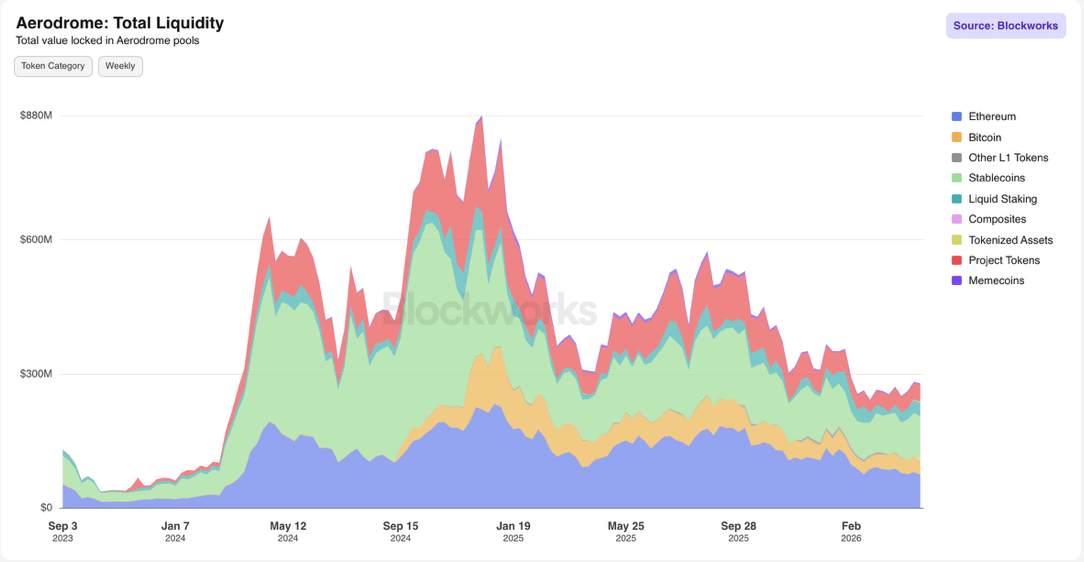
The protocol is preparing a major architectural upgrade, Aero/MetaDEX03, targeting a Q2 2026 launch that will merge Aerodrome and Velodrome into a unified cross-chain DEX and introduce MEV internalization as a new revenue stream.


April has been a record month for Jupiter Predict, breaking past $5 million in monthly spot volume for the first time. Monthly spot volume on Jupiter Predict increased 70.8% from March's record of ~$3 million.


Today @humidifi is launching Aquarium, a transparent market making system built to give Solana projects deeper liquidity, tighter spreads, and clearer performance. Where the water is deep, the fish gather. Live on Solana ↓ 🐟


The biggest difference between equity and tokens is trust. Tokens are better structurally than equity in theory: they're programmable and trade on global rails. The issue is the current iteration sucks and it's unclear what you're buying. If Blockworks is successful, this will Show more

Today we’re announcing our $5 million seed round, led by @Multicoin This funding directly supports Exponent’s next phase: becoming the premier platform for onchain portfolio construction
